Showing posts with label China. Show all posts

Saturday, October 18, 2025

Read what a Chinese officer wrote of D-Day in his diary salvaged in Hong Kong

From theintelligencer.com

By 

OUISTREHAM, France (AP) — The captain of the giant Royal Navy battleship called his officers together to give them a first morsel of one of World War II’s most closely guarded secrets: Prepare yourselves, he said, for “an extremely important task.”

“Speculations abound,” one of the officers wrote in his diary that day — June 2, 1944. “Some say a second front, some say we are to escort the Soviets, or doing something else around Iceland. No one is allowed ashore."

The secret was D-Day — the June 6, 1944, invasion of Nazi-occupied France with the world’s largest-ever sea, land and air armada. It punctured Adolf Hitler’s fearsome “Atlantic Wall” defences and sped the dictator’s downfall 11 months later.

The diary writer was Lam Ping-yu — a Chinese officer who crossed the world with two dozen comrades-in-arms from China to train and serve with Allied forces in Europe.

For 32-year-old Lam, watching the landings in Normandy, France, unfold from aboard the battleship HMS Ramillies proved to be momentous.

His meticulously detailed but long-forgotten diary was rescued by urban explorers from a Hong Kong tenement block which was about to be demolished. It is bringing his story back to life and shedding light on the participation of Chinese officers in the multinational invasion.

Sau Ying Lam poses with a photo of her father Lam Ping-yu on the beach in Ouistreham, France, on Saturday Oct. 4, 2025.     John Leicester/AP


As survivors of the Battle of Normandy disappear, Lam’s compelling first-hand account adds another vivid voice to the huge library of recollections that the World War II generation is leaving behind, ensuring that its sacrifices for freedom and the international cooperation that defeated Nazism aren’t forgotten.

“Saw the army’s landing craft, as numerous as ants, scattered and wriggling all over the sea, moving southward,” Lam wrote on the evening of June 5, as the invasion fleet steamed across the English Channel.

“Everyone at action stations. We should be able to reach our designated location around 4-5 a.m. tomorrow and initiate bombardment of the French coast,” he wrote.

Breakthroughs

Sleuthing by history enthusiasts Angus Hui and John Mak in Hong Kong pieced together the story of how Lam found himself aboard HMS Ramillies and proved vital in verifying the authenticity of his 80-page diary, written in 13,000 wispy, delicate Chinese characters.


Hui and Mak have curated and are touring an exhibition about Lam, his diary and the other Chinese officers — now on display in the Normandy town of Ouistreham.

An exhibit on display shows members of a Chinese contingent of naval officers who travelled to Europe in World War II to train with British forces, including Lam Ping-yu, who kept a diary and is shown by a blue arrow, in Ouistreham, France, Oct. 4, 2025.     John Leicester/AP

One breakthrough was their discovery, confirmed in Hong Kong land records, that the abandoned 9th-floor flat where the diary was found had belonged to one of Lam’s brothers.

Another was Hui’s unearthing in British archives of a 1944 ship’s log from HMS Ramillies. A May 29 entry recorded that two Chinese officers had come aboard. Misspelling Lam’s surname, it reads: “Junior Lieut Le Ping Yu Chinese Navy joined ship.”

Lost, found and lost again

Lam’s leather-bound black notebook has had a dramatic life, too.

Lost and then found, it has now gone missing again. Hui and Mak say it appears to have been squirreled away somewhere — possibly taken to the U.S. or the U.K. by people who emigrated from Hong Kong — after the explorers riffled through the apartment, salvaging the diary, other papers, a suitcase, and other curios, before the building was demolished.

But Hui, who lived close by, got to photograph the diary’s pages before it disappeared, preserving Lam’s account.

“I knew, ‘Okay, this is a fascinating story that we need to know more about,’” he says.

“Such a remarkable piece of history ... could have remained buried forever,” Mak says.

They shared Lam’s account with his daughter, Sau Ying Lam, who lives in Pittsburgh. She previously knew very little about her father’s wartime experiences. He died in 2000.

“I was flabbergasted,” she says. “It’s a gift of me learning who he was as a young person and understanding him better now, because I didn’t have that opportunity when he was still alive.”

A lucky escape

Lam was part of a group of more than 20 Chinese naval officers sent during World War II for training in the U.K. by Chiang Kai-shek. Chiang led a Nationalist government in China from 1928 to 1949, fighting invasion by Japan and then Mao Zedong’s communists, before fleeing to Taiwan with the remnants of his forces when Mao’s insurgents took power.


On their long journey from China, the officers passed through Egypt — a photo shows them posing in front of the pyramids in their white uniforms — before joining up with British forces.

This handout photo provided by Huang Shansong, son of Huang Tingxin, one of the 24 officers sent to Britain, Chinese naval officers pose for a photo in front of a pyramid on Sept. 8, 1943, in Egypt during their journey to Britain for training. (Huang Shansong via AP)     AP

In his diary, Lam wrote of a narrow brush with death on D-Day aboard HMS Ramillies, as the battleship’s mighty guns were pounding German fortifications with massive 880-kilogram (1,938-pound) shells before Allied troops hit the five invasion beaches.

“Three torpedoes were fired at us,” Lam wrote. “We managed to dodge them.”

His daughter marvels at the lucky escape.

“If that torpedo had hit the ship, I wouldn’t be alive,” she says.

Through ships’ logs, Hui and Mak say they’ve confirmed that at least 14 Chinese officers participated in Operation Neptune — the 7,000-vessel naval component of the invasion which was code-named Operation Overlord — and other Allied naval operations as the Battle of Normandy raged on after D-Day.

FILE - This photograph is believed to show E Company, 16th Regiment, 1st Infantry Division, participating in the first wave of assaults during D-Day in Normandy, France, June 6, 1944. (Chief Photographer's Mate Robert M. Sargent, U.S. Coast Guard via AP, File)     AP

Operation Dragoon

Some of the officers, including Lam, also saw action in the Allied invasion of southern France that followed, in August 1944.

“Action stations at 4 a.m., traces of the moon still visible, although the horizon is unusually dark,” Lam wrote on Aug. 15. “Bombardment of the French coast started at 6, Ramillies didn’t open fire until 7.

“The Germans put up such a feeble resistance, one can call it nonexistent.”

France awarded its highest honor, the Légion d’honneur, to the Chinese contingent’s last survivor in 2006. Huang Tingxin, then 88, dedicated the award to all those who travelled with him from China to Europe, saying “it was a great honour to join the anti-Nazi war,” China’s official Xinhua News Agency reported at the time.

Lam’s daughter says their story remains inspirational.

“It talks about unity, talks about hard work, about doing good,” she says. “World War II, I think it shows us that we can work together for common good.”


Leung reported from Hong Kong


https://www.theintelligencer.com/news/world/article/a-lost-d-day-diary-reveals-chinese-role-in-the-21103236.php

Saturday, August 30, 2025

7,300-year-old 'diary' of ancient inhabitants uncovered at New Stone Age site in E China's Anhui Province

From en.people.cn

The Shuangdun site museum in east China's Anhui Province has recently reopened to the public after an extensive upgrade, offering a rare glimpse into the lives of Neolithic communities from more than 7,000 years ago.

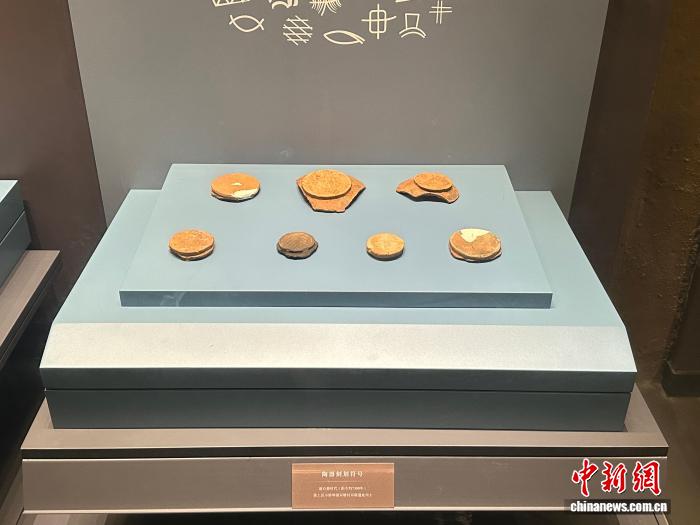
"These symbols etched on the bottoms of these bowls are like a 'diary' of the Shuangdun people's daily lives," said Shao Libo, a staff member of Bengbu's Shuangdun national archaeological site park, pointing to pottery bowls on display in the museum.

Neolithic pottery inscribed with symbols is displayed at the Bengbu's Shuangdun national archaeological site park in east China's Anhui Province. (Photo/Fu Tiancheng)

The markings on everyday objects quietly record the production activities and routines of ancient inhabitants, Shao explained.

Located in Shuangdun village, Huaishang district, Bengbu city, Anhui Province, the Shuangdun national archaeological site park dates back roughly 7,300 years and is hailed as the "light of the Huaihe River civilization."

Since its excavation, the site has yielded a wealth of valuable artifacts made of pottery, stone, shell, bone, and horn, as well as a multitude of inscribed symbols, providing invaluable insights into prehistoric life in the Huaihe River basin and the origins of Chinese characters.

In June 2025, the site was officially designated as a national archaeological site park.

The upgraded Shuangdun site museum, as an important part of the national archaeological site park, now presents a concentrated selection of the park's significant finds, ranging from symbol-inscribed pottery to early farming tools, each offering a tangible link to the distant past.

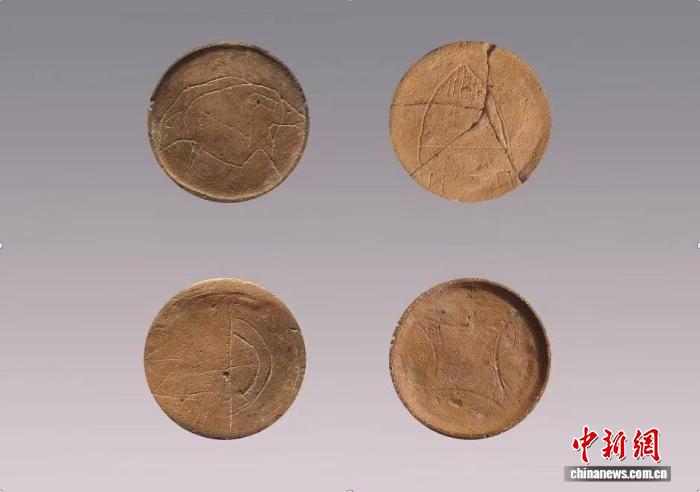
Among more than 600 symbols unearthed at the site, researchers have identified both pictographs—depicting fish, pigs, deer, and houses—and geometric signs, including crosses, triangles, grids, and markings resembling counting symbols.

"These symbols serve as a window into people's daily life back then," Shao explained. "For example, the 'pig' symbol changes in shape, with a smaller head and larger belly. It suggests that Shuangdun people might have begun domesticating pigs."

Photo shows symbols engraved on the pottery wares unearthed at the Shuangdun archaeological site in Shuangdun village, Huaishang district, Bengbu city, east China's Anhui Province. (Photo courtesy of the Shuangdun national archaeological site park)

Other discoveries, including carbonized rice remains—both wild and cultivated varieties—as well as fish bones, shells, and net sinkers, point to the development of early agriculture and the importance of fishing and hunting in the local economy.

To protect these invaluable traces of civilization, the park's core area is covered by an 8,000-square-meter protective canopy.

"We follow a principle of minimal intervention," Shao said, noting that reversible techniques are used for conservation, with daily monitoring relying mainly on manual inspection and hydrological monitoring.

An interactive experience hall has been established to help visitors better understand the symbols.

Middle school student Pu Zhou found a cross-grid pattern on a pottery bowl, and thought the symbol looks a lot like the Chinese character "井" (well). He then asked a docent with the museum to verify his conjecture, and learned that it may represent a water pit or cave, showing how ancient people recorded aspects of daily life.

"The combinations and sequences of these symbols reveal a certain level of system," Shao noted. "Similar symbols have been found at contemporaneous sites in the Huaihe River basin, such as the Houjiazhai archaeological site, indicating shared recognition and usage across the area."

These common features, together with the similarities in pottery forms to the Neolithic cultures of the country's Peiligang and Dawenkou archaeological sites, outline a cross-regional exchange network dating back 7,000 years.

(Web editor: Chang Sha, Liang Jun)

https://en.people.cn/n3/2025/0828/c90000-20358900.html

Wednesday, August 6, 2025

My diary in China: We breathe with all living things

From news.cgtn.com

Editor's Note: This is an article by Sandra Churabaeva from Tajikistan, who took part in "One Home: A Shared Future," a global youth initiative launched by CGTN to mark the 80th anniversary of the United Nations. Her Chinese friends gave her a Chinese name, "Meili" (美丽), which means "beautiful."

This year, I travelled across many corners of China. Each place felt like a universe of its own, leaving a trace on my heart. This summer, I visited Chengdu – a city where antiquity and nature speak in the language of silence.

The thunderous forest of Chengdu is as ancient as time itself. And I am here, just a fleeting moment. Yet in this moment, I dissolve into its breath. My hands reach toward the sky, as if trying to touch something greater than myself. Perhaps it's a prayer, or gratitude, or just a way to say, "I remember. I am a part of this."

This forest doesn't need people. But people need it. And this image is not about me – it's about all of us. Small but bold, forgetful yet still capable of remembering.

Later, my journey took me to Xishuangbanna in the southern part of southwest China's Yunnan Province, at the edge of the jungle. It was there that I met the being that became the symbol of my summer – the elephant.

                  Sandra Churabaeva with an elephant in Xishuangbanna, southwest China's Yunnan Province. /Sandra Churabaeva

The elephant is an ancient guardian of the Earth, and the human is its voice.

This photo, taken in the jungles of Xishuangbanna, is not just "a picture with an animal," it's an encounter between two worlds. My hand on its rough, wise skin is like a vow: We are not guests on this planet. We are part of it. And as long as elephants still breathe under these palms, there is hope for Earth.

This photo is not just a memory of a journey. It's a reminder: Protecting nature begins with realizing that we are not owners, but neighbours. Fragile, temporary, and responsible for preserving what will outlive us.

Sandra Jurabaeva breathes fresh air in the deep mountains of Chengdu, southwest China's Sichuan Province. /Sandra Jurabaeva

We take everything from nature: water, air, warmth, and give nothing in return. Yet it still gives. It endures. It lives beside us. We are not separate from it. We are part of it. We've just long forgotten that.

Don't take people for granted; love them with all your heart while they are near. Don't take life for granted; cherish every breath as a gift. Don't take nature for granted; thank the Earth that nourishes us. Gratitude is the wisdom that turns ordinary moments into sacred ones.

https://news.cgtn.com/news/2025-08-04/My-diary-in-China-We-breathe-with-all-living-things-1FzjTlm7GDu/p.html 

Wednesday, September 4, 2024

Inside Stanford’s fight to keep a precious diary about China’s troubled past

From mercurynews.com

In legal tug-of-war, university is resisting pressure to return diary to China


Protected under lock and key at Stanford University, the personal diary of a prominent Chinese political official offers a rare inside look at eight tumultuous decades of Communist Party rule, recounting an unvarnished version of history at a time when the nation’s government is seeking to sanitize its past.

But the late Li Rui’s 94-year-old widow says the diary belongs to her, not Stanford. She’s filed a suit against Stanford, demanding its return to her in China.

“The case has enormous significance,” said Orville Schell, director of the Centre on U.S.-China Relations at the Asia Society. “In chapter and verse, Li Rui documented the myriad ways in which the Chinese Communist Party was very savage, inequitable and unjust.”

In this Oct. 2004, photo and released by Li Nanyang, Communist Party veteran Li Rui reads in his study in Beijing. Li worked for Mao Zedong but later became a fierce critic of the regime. (Li Nanyang via AP)

The fight over its fate played out in an Oakland federal courtroom this week, pitting Stanford’s prestigious Hoover Institution Library & Archives against Li’s second wife and widow, Zhang Yuzhen, who the university alleges is a front for China’s powerful Communist Party.

It’s more than just an inheritance dispute. Historians fear that if the diary is returned to China, the government may alter it to rewrite the past. The trial before U.S. District Court Judge Jon Tigar ends on Thursday, and a decision will come later.

The real opponent, Stanford attorneys say, is not Li’s elderly widow, who likely has little income, but the Chinese government bankrolling the case.

“For political control, it’s very important to have a perfect version of history presented to the Chinese public,” said Perry Link, a leading American China scholar at UC Riverside and an emeritus professor of East Asian studies at Princeton. “What this diary does is undermine that perfect picture.”

The handwritten diary and 40 boxes of other materials — letters, meeting minutes, work notes, poetry and photographs — document the life of Li, a top official and personal secretary to long-time party leader Mao Zedong. He died in China in 2019 at the age of 101.

They were donated by his daughter, Nanyang Li, a physicist and vocal critic of the Chinese Communist Party who lives in the East Bay. According to court filings, Jiashu Cheng of the Stanford Centre at Peking University realized the historical importance of the diaries in 2013 and approached the family about a possible donation. Li feared that the materials would be destroyed by the Party.

The diaries of former Chinese official Li Rui, a prominent critic of the Chinese Communist Party, are at the centre of a U.S. legal battle. Stanford University assets that the diaries should remain at its Hoover Institution, where his daughter donated them, and not be returned to his elderly widow, who has been accused of acting as a front for Chinese authorities.(Hoover Institution) 

With her stepmother’s assistance, Nanyang Li gathered diaries and notebooks, according to court filings. She says she carried the materials out of China to honour her father’s wish that they rest at Stanford’s famed archives, where they would be accessible to international scholars.

On the witness stand last week, she tearfully described how she promised her father that she would carry on his legacy. Because the materials were carried to California before her father’s death, they were not part of his estate, she says.

The widow’s lawyers argue that Li never transferred legal ownership of the materials to his daughter from his first marriage.

In legal limbo, the materials are stored in the Archive’s acid-free boxes on floor-to-ceiling shelves in a climate-controlled room to preserve their fragile paper.

The Hoover Archives has long been a place where scholars could come pore over its holdings, devoted to war, peace and revolution in the 20th and 21st centuries. They preserve more than 7,000 collections in about 150 languages about the Cold War, the Russian Revolution and the Soviet Union, World Wars I and II, and various political and ideological movements.

In millions of handwritten Chinese characters, the diary includes much material about Li’s routine daily life from 1946 to 2018, such as the weather or an afternoon swim, according to books about the diaries.

But its richest vein is a repository of his political insights, tracing the arc of China’s messy and nuanced climb from a poor and isolated nation to a repressive global superpower.

Born in 1917, Li was an idealistic young man who joined the throngs of young people devoted to the Chinese Communist Party. A brilliant writer and thinker, he quickly climbed the Party’s ranks. He was hand-picked by Mao to become his personal secretary in 1958.

He was unafraid to criticize the Party as it evolved from a heroic movement in the 1930s and 1940s to a corrupt bureaucracy in the 1960s and 1970s, said Perry.

“All through his life, he was consistent in supporting freedom and human rights,” Perry said.

Li was expelled from the Party and imprisoned in work camps from 1959 to 1978, including eight years in solitary confinement, after criticizing Mao’s disastrous effort to modernize the agricultural sector using communist ideologies, causing a catastrophic famine. Following Mao’s death, the more pragmatic Deng Xiaoping came to power, and Li was reinstated into the Party.

Although his writing was censored, Li continued to document the Party’s abuses and stubbornly press for democracy.  From his balcony, he witnessed the brutal 1989 massacre of unarmed pro-democracy protesters in Tiananmen Square scene. His diary describes the event, calling it “Black Weekend” in English.

His daughter made the diary’s donation to Hoover just days before Li’s death, when he was in a coma and safe from possible reprisal.

The case already has been heard once, and Stanford lost. The Chinese court gave the university 30 days to return the materials.

But Stanford says that the proceeding was unfair. The Beijing court blocked the university from presenting evidence in that case, said attorney Mark Litvack of Pillsbury Winthrop Shaw Pittman LLP.

It has sued Zhang in California in return.

Over the past decade, China has sought increasing control over historical narratives to escape responsibility for its past, according to Schell.

China not only silences its own citizens, he said, “but is reaching out around the world to intimidate others from saying, writing, researching and participating in ways that do not reflect kindly on their rule.”

Nanyang Li, daughter of former Chinese Communist Party official and critic Li Rui, says that her father wished that his diaries be kept at Stanford’s Hoover Institution as a resource for people seeking to understand the history of modern China. (Hoover Institution) 

Lawyers for Li’s widow argue Stanford can keep photocopy reprints and scanned files of the diaries, according to a brief filed by attorneys of the law firm Skaggs and Faucette.

But Stanford worries that if it returns donated items under pressure, no one will ever donate again.

The original physical archives are immensely valuable, scholars say. Because digital copies can be altered, the Chinese government could assert, “‘The materials don’t say what you claim they do. We have the originals,'” Perry said.

“An archive that sits in ‘hard copy’ form irrefutably documents what happened in history,” said Schell. “It’s immensely important to keep the record correct.”

https://www.mercurynews.com/2024/09/04/inside-stanfords-fight-to-keep-a-precious-diary-about-chinas-troubled-past/