Showing posts with label Ukraine. Show all posts

Thursday, September 3, 2026

Diary of German paramedic who died in the Ukraine war published by her mother

From thestar.com.my

When Ula Wagner was told her daughter had been killed on the Ukrainian front line, she thought there must have been a misunderstanding.

Yes, her daughter Savita Wagner had joined the Ukrainian army as a German volunteer – but how could she be in danger, serving as a medical assistant, 50km away from the front line?

It seemed impossible for her to be dead.

But it emerged that Savita had served as a frontline medic, always deployed in the most dangerous places.

On Jan 31, 2024, she was trying to rescue two wounded soldiers when a piece of shrapnel pierced her carotid artery.

That came just a day after a similar fragment missed her by a hair’s breadth.

“I am luckier than anyone else in the world!” she wrote in her diary.

That was her final sentence. She was 36 years old.

For Savita, life on the front line was “hell”. But it was a hell of her own choosing. The world she had voluntarily left behind was perhaps no paradise, but by comparison it was an idyll.

Now, she is mourned by her mother Ula, in the city of Bonn.

On her walls, there are pictures of Savita as a little girl. In one, she is beaming as she hugs her mother, who had just returned from a business trip.

She had a sheltered childhood in the 90s, making it all the harder to imagine she would wind up buried in the Avenue of Glory at a cemetery in Kiev.

“Savita wasn’t the war type at all,” insists her mother, now 73. “She never watched a war film; she couldn’t stand the sight of blood. If someone had told me all this five years ago, I would have said: utter nonsense.”

After finishing school, Savita studied medicine, but dropped out halfway through and began studying mathematics in Halle.

That was when she met Canadian Karl Stenerud online. The two married, and he relocated his job as a software specialist to Germany.

Soon afterwards, on Feb 24, 2022, the Kremlin launched its all-out invasion of Ukraine, launching the war that rages on.
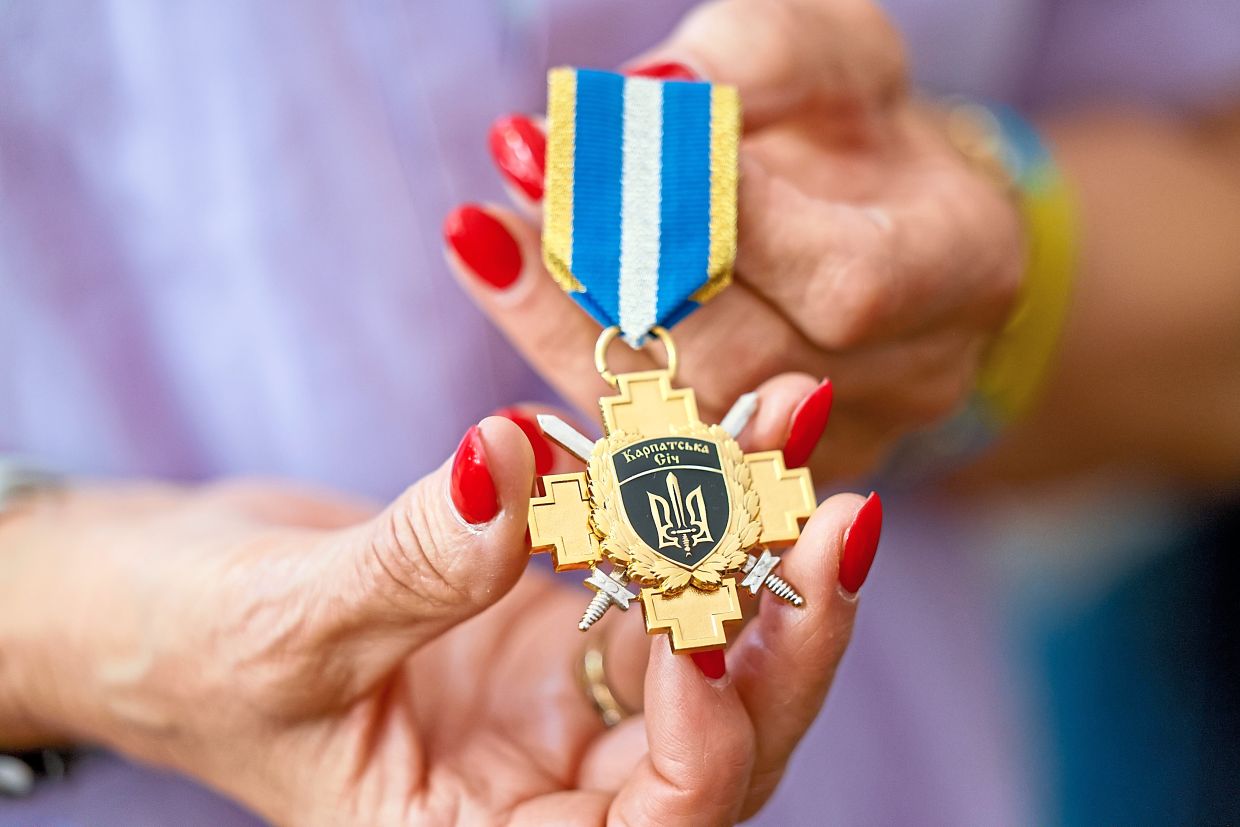
One of the four medals for bravery awarded to Savita.

Many people were angry at the time. But Savita felt a deeper rage.

“Her home was under attack; Europe was being invaded. Freedom and democracy were at stake,” is what Ula says of how Savita saw the war.

She wanted to do something concrete, so she volunteered as a driver for aid convoys. That was a political decision.

Then she drove a journalist to Bucha, where she saw the bodies lying in the streets following the massacre carried out by Russian troops.

That changed everything. She then decided that everything she had done so far did not go far enough.

She undertook military training and went to the front as a medic, taking on the nom de guerre “Snake”.

Now, Ula has set up a small memorial shelf in the hallway of her flat for her only child. It features a photo of Savita at the front, in uniform, with a bulletproof vest and a firearm.

She stands bolt straight and even smiles a little.

“I see pride and contentment in her gaze,” says her mother.

Yet in her diary, Savita openly writes, “Of course I’m afraid.”

Afraid of being injured or paralysed. Afraid of being taken prisoner and paraded as a trophy.

“But I’m not afraid of dying in battle.” So people should not pity her if that happens, she said.

After all, she reasoned, in truly dangerous situations, she had no time at all to be afraid. She just focused.

Perhaps it had something to do with the fact that she had been diagnosed with autism.

“I ‘feel’ nothing as long as I have a goal in mind,” she realised. “I don’t know if that’s professionalism or an autistic trait. In any case, I’m happy that my brain works that way.”

Ula, a retired administrative specialist, had no inkling of any of this. Savita did have a blog where she shared her thoughts, but her mother knew nothing of it. Or did she simply not want to know about any of it?

“No,” she says after a moment’s thought. “I really had no idea.”

There is a video that Savita sent her from her post in a doctor’s office, supposedly 50km from the front line.

“Hello Mum,” it begins. “I thought you might like a video. I’m working here as a sort of nurse.”
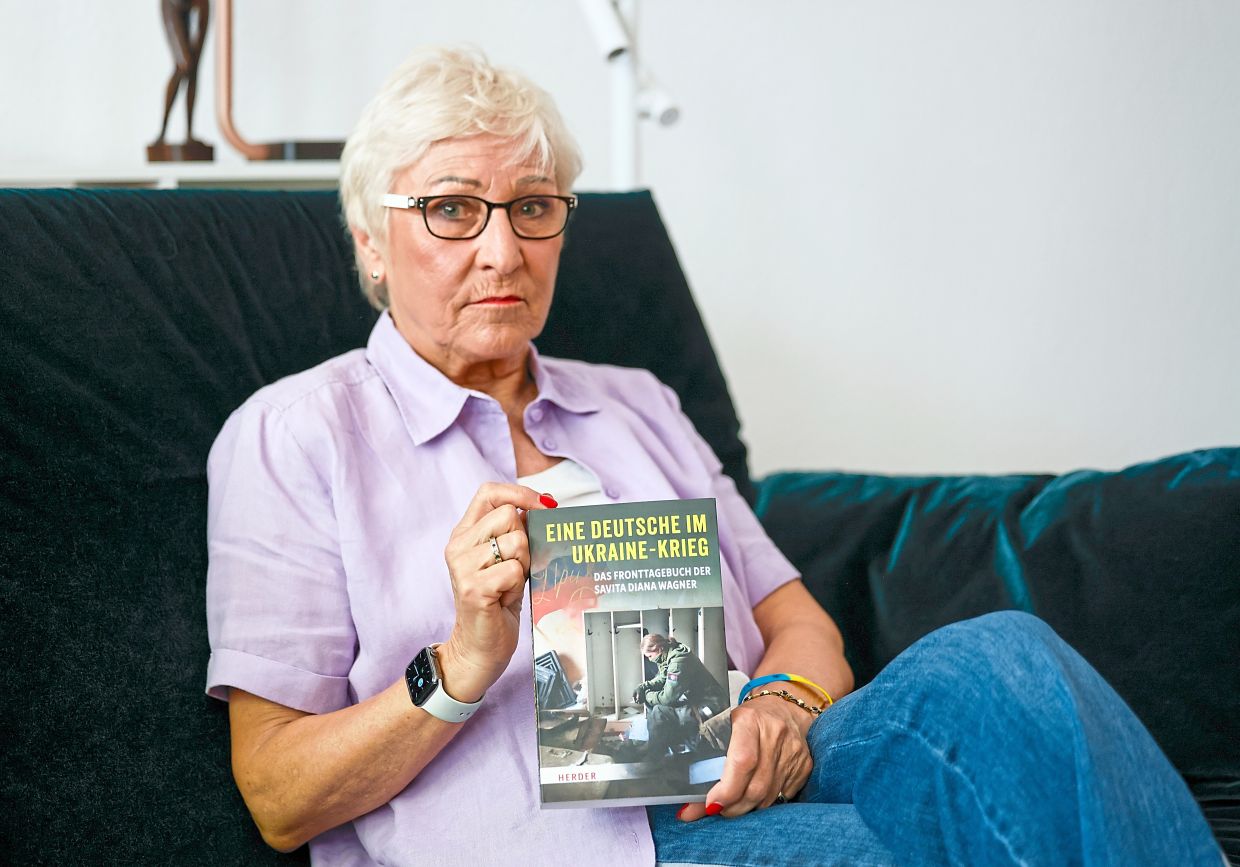
Ula holding the published diary of her daughter.

Insects, spiders and snails everywhere

But another video shows a glimpse of her real life, filmed by one of her comrades. It starts with soldiers sitting in the trenches, bullets whizzing past them. Then there’s an explosion. You hear screaming.

But it wasn’t just this constant danger she had to learn to live with.

“It’s always cold and damp. All my things – my clothes, my sleeping bag, simply everything – are constantly damp. There are insects, spiders and snails everywhere. In the bed, in the food, under my clothes.”

Does her mother mind that she kept all this from her? No, she says.

“She did it to protect me. Otherwise, I wouldn’t have been able to sleep a wink. Just like Karl, her husband. She spared me that. And I couldn’t have stopped it anyway. Once she’d set her mind on something, there was no dissuading her.”
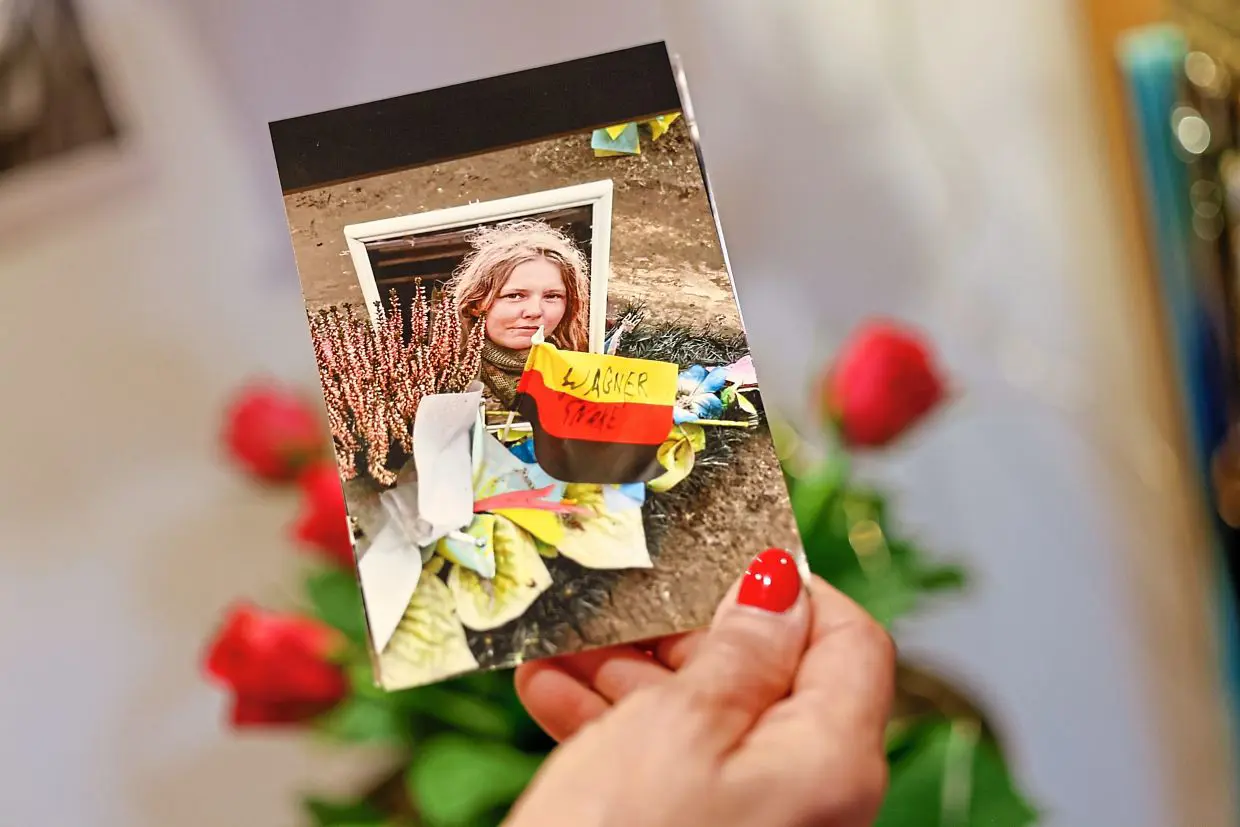
99348587

                                                                  A picture of Savita, who is Ula’s only child

When Savita remained unwilling to return to Germany, even for a holiday, despite repeated urging, Ula finally announced she was going to go and visit her daughter herself.

“That’s when she panicked. Which trench should she have given as her address?”

She then came up with the suggestion that she should meet her mother in Kiev, in early January 2024. Her husband Karl would be there then too.

When they met, Ula realised how much her daughter had changed.

“I had the impression that a different person was standing before me. It was her eyes, above all, that had changed so much. They had a depth that wasn’t there before. Today, of course, it’s clear to me why. Those eyes have seen things one doesn’t want to see.”

No one can say how many lives she saved.

A month later, on Valentine’s Day, Ula was back in Kiev – this time for Savita’s funeral.

Only then did she learn that, through her work as a medic on the front line, she had saved many lives – no one could say how many.

Savita has been awarded four medals for bravery. Two have been given to the Haus der Geschichte history museum in Bonn, at her own request.

Savita’s boots, her helmet, her field jacket and her frontline diary also went to the museum – and has since been published as a book, too.

“It is important to me that she is not forgotten,” says Ula, and that she carries on her legacy.

Ula is currently setting up a foundation, and plans to add to it part of the proceeds from the sale of her family home in the historic centre of Bonn. She wants the money to support aid projects in Ukraine.

What would Savita say if she could see this? That makes Ula smile.

“She would say: ‘Mum, you’re doing the right thing’.” – dpa

https://www.thestar.com.my/lifestyle/living/2026/09/03/diary-of-german-paramedicwho-died-in-the-ukraine-war-published-by-her-mother#goog_rewarded 

Wednesday, October 8, 2025

“A slow-moving diary” of the war in Ukraine

From niemanreports.org

By Alisa Sopova

A collaborative project records Ukrainians’ day-to-day lives since the Russian invasion

The day my neighbourhood in Donetsk, in eastern Ukraine, was bombed for the first time in 2014, I was so confused I couldn’t think of anything better to do than Google: “War in your city what to do.” The only source I found advised exchanging all my possessions for a gun and fleeing to the wilderness. By the time I finished reading, I figured it wasn’t worth the effort, as someone like me was unlikely to survive anyway. Eleven years later, I’m still alive. And now I understand why meaningful information was so hard to come by: War is rarely portrayed from the perspective of the people in whose backyards it is fought.

Olga Grinik with her children, Kirill and Miroslava, in Poltava province, Ukraine, in 2022. Photojournalists Alisa Sopova and Anastasia Taylor-Lind have been photographing the family, who fled their home in Avdiivka when Russian forces attacked, since 2018 for their project 5K from the Frontline, which documents civilian life in Ukraine during the war. Alisa Sopova, Anastasia Taylor-Lind

Most media coverage of conflict relies on images of tanks, soldiers, explosions, crying women, pitiable refugees — cliches that make the situation immediately recognizable for readers scrolling their news feeds. Only the most spectacular events have the power to impress a jaded audience. The rest remain unseen. This produces a distorted picture that excludes the non-sensational, day-to-day experience of war.

I learned this the hard way, as a civilian whose war experience remained invisible to the rest of the world. This made me, a journalist at a local newspaper at the time, very determined to show the global audience what living through a war really looks and feels like. It took time to find the right form, through my Nieman Fellowship (NF ‘17), and later entering a PhD program in anthropology.

In 2018, photojournalist Anastasia Taylor-Lind (NF ’16) and I began tagging our social media posts with a shared hashtag: #5KfromtheFrontline. At the time, the war had dragged on for years but had largely disappeared from headlines. From afar it seemed frozen, abstract, forgotten. Up close it was neither. We were reporting from towns in the Donbas region that sat along the front line separating Ukrainian forces and Russia-backed separatists — Avdiivka, Marinka, Krasnohorivka, Kurakhove, Toretsk. They were close enough for the sound of artillery to punctuate daily life, yet far enough away for people to keep hanging laundry, baking cakes, and going to work. These weren’t towns featured in breaking news. And that was the point. We wanted to shift the focus away from the spectacle of violence and onto what war looks like when it becomes part of the ordinary.

Parishioners take part in a church procession in Avdiivka, Ukraine, in 2018. After a months-long battle, Russian forces recaptured the frontline town in February 2024. Alisa Sopova, Anastasia Taylor-Linda, Anastasia Taylor-Lind


Over the years, we returned again and again to the same families. Gradually, they became our friends, and their trust made it possible to ground the project in long-term, collaborative observations. Our approach resisted parachute reporting. Instead, we tried to create something that listens as much as it shows.

As the project grew, so did the war. In 2022, Russia’s full-scale invasion made it clear that what had once been considered a local conflict was, in fact, the front edge of something larger. Towns we had photographed suddenly became news again, this time for being destroyed. We continued following people from those places, now displaced.


For years, our reporting lived mainly on social media. Each post paired one of Anastasia’s photographs with a short caption I wrote. Together, they formed a slow-moving diary of the war, made up of details that might otherwise go unnoticed: a broken window covered by a carpet; a boy fishing in a reservoir; a beauty salon offering manicures to the sound of shelling. For people in the Donbas, these were snippets of the “new normal.” For those outside, we hoped they would complicate the flat images of victimhood and violence that dominated coverage of Ukraine. These small, stubborn acts of continuity don’t fit neatly into the frames of breaking news. But they stay with you because they reveal what survival really looks like.

This kind of work was not always easy to pitch. Before the full-scale invasion, Ukraine’s war was often described as “forgotten.” We placed roughly one story from each reporting trip, eventually publishing features based on our 5K reporting in Time, The New York Times, The New Humanitarian, and NPR. But until recently, 5K from the Frontline never had a home of its own. 

That changed this summer, when we launched 5kfromthefrontline.com, a multimedia website that brings together years of reporting across both the high and low points of the Ukrainian war in the news cycle. We kept telling stories for eight years, even when attention drifted elsewhere. For us, this is what responsible journalism means. We believe we must do more than headlines and breaking news — we must also stay with people who are affected when the world is tempted to look away.


https://niemanreports.org/frontline-war-journalism-russia-ukraine-donetsk-5k-frontline-alisa-sopova-anastasia-taylor-lind/

Sunday, August 31, 2025

Mona Siddiqui’s diary: Golfers without conscience

From prospectmagazine.co.uk

A confrontation over a smashed windscreen and a meeting in Alaska got this professor of religion thinking about reconciliation and renewal 

I am about to begin a new post as professor of religion and society at King’s College, London. I see this privileged role as more than a transition from one institution (the University of Edinburgh) to another. It’s a time for renewal and a moment of self-definition. What kind of colleague do I want to be and what kind of impact can I have on an institution which has put its faith in me at this stage of my career? When you’re lucky enough to be doing what you want in life, a job doesn’t feel like a job. It is more like an extension of your personality, and moving to a new one offers a time to pause, reflect and once again appreciate how lucky you are to be paid to inspire younger minds and play a small part in the culture of learning. 

♦♦♦

Sometimes you have to feel a little sorry for journalists who travel far and wide to frankly see not much. When you’re hoping to break some big news and instead have to cover high-level theatrics, it must feel pointless. And so it was when international media gathered at the Elmendorf-Richardson military base in Anchorage for a summit between Donald Trump and Vladimir Putin.

Our 24-hour news cycle can feel repetitive at the best of times, but much of the TV news coverage was relentless speculation about what might happen during the presidents’ meeting to discuss Russia’s ongoing war in Ukraine. The pressure to fill airtime in this way became tedious. And when the waiting game finally came to an end in Alaska, there was little more to comment on other than a display of remarkable performativity. 

The beaming smile on Putin’s face (whose suit looked sharper than Trump’s) and the US president’s look of self-satisfaction that the whole world was once again watching him delivered little of substance for the Ukrainians and their western allies—no deal, no ceasefire and no peace. Putin received all the honours—the red carpet, the ride in the presidential limousine known as “the Beast” and a parade of spectacular bombers and jets. In the diplomatic world, where symbolism matters almost more than substance, he was calling the shots, and no doubt will be joyously spinning this meeting as an ideological victory back in Russia. 

Trump’s subsequent meeting with Zelensky and European leaders seemed relatively cordial. But it is too early to say whether a proposed meeting between Putin and Zelensky is more stalling—or the beginning of the end of this war.

♦♦♦

I live next to a golf course with idyllic surrounding views. Occasionally I find a golf ball in my back garden, but a couple of weeks ago one hit the front of the house, bounced off the wall and struck my car’s windscreen. The glass cracked badly. 

I went out and, seeing the golfer, called out to him. He came over to the dividing fence looking a little sheepish. When I asked him about the incident he apologised and said he would speak to his insurance company to cover the cost of the damage. His friend muttered something in his ear, and they walked away for a few minutes before the golfer returned. He told me, “my wife deals with the insurance stuff in our house, and she has said not to admit anything.” Feeling angry now with him and his wife, I asked him how he could say this, especially when he had already acknowledged responsibility for hitting the car. He apologised again but said he couldn’t do anything more, and walked away. Could I have taken it further? Probably yes, but was it worth the stress for the sake of a windscreen? By law, the golfer was liable, but I didn’t have the emotional energy to deal with someone who displayed neither a backbone nor a conscience.

♦♦♦

I watched the coverage of VJ day and found the service of remembrance at the National Memorial Arboretum in Staffordshire particularly poignant. Maybe it was because we remembered those who felt they’d been forgotten, overshadowed in history by the earlier victory declared in Europe. Or maybe, with so much death and suffering in Gaza and Ukraine, it’s difficult to imagine how you construct a path to peace now.

I don’t think we should ever glorify war because the price paid by soldiers and civilians is always too high. But even as we remember the brutality and dehumanisation which is intrinsic to all wars in ceremonies like the one at the arboretum, a lone piper’s performance at a Japanese peace garden in west London reminded us of the enduring importance of reconciliation between countries.

Among many moving moments at the national memorial, Captain Yavar Abbas, a 105-year-old veteran, went “briefly off script” to salute King Charles and thank him and the queen for being there despite Charles’s ongoing cancer treatment. There was applause and tears from many, including the king and queen, as Abbas, himself a cancer survivor, read from his diary entry dated 8th February 1945. “Tomorrow, I hope I will live to do better things,” he said. I hope and pray this is a lesson for us all.

https://www.prospectmagazine.co.uk/views/columns/70924/mona-siddiqui-diary-golfers-without-conscience

Saturday, September 21, 2024

A Scottish Labour MP's diary from his 'impactful' trip to Ukraine

From dailyrecord.co.uk 

Writing in the Daily Record, Glasgow South MP Gordon McKee describes his five days in Ukraine for an international conference

Day 1 – Arrival in Kyiv, Zelenskyy

I awake on our sleeper train looking out to the sun rising on the outskirts of Kyiv.

I’m here with seven newly elected Labour MPs, on our first official to Ukraine.

The farmland on the outskirts of the city that I’m travelling through, is the same place that Russians soldiers landed when their full scale invasion began.

The closer we get to the city, the more buildings we see suffering from bomb damage.

We arrive and check into our hotel - an otherwise normal experience, apart from the hand out explaining what to do in the event of a Russian missile attack.

We’re for an international conference, so that’s not something I’ll have to worry about, I think to myself.

In the square outside the conference, destroyed Russian military vehicles sit as trophies of Ukraine’s achievements and reminders of what they continue to face.

As I wander around the conference venue, held several stories underground, I get stopped by a platoon of half a dozen bodyguards. Before long, I get a glimpse of the great hero – Zelenskyy with his wife.

In the hall, Zelenksyy takes to the stage in his combat gear to a standing ovation.

As I watch him, I feel inspired by his continued bravery. I think of the lack of sleep that I got on my way here, and I imagine how a man runs a country and its war effort without succumbing to a breakdown.

During my time here, I’m keeping a diary for the Daily Record. Read more about my trip tomorrow.

                 Gordon McKee (centre left) and fellow Scottish Labour MP Alan Gemmell (right) were part of the delegation


Day 2 – Wounded soldiers

We depart the conference in our van to head to the Recovery Military Rehabilitation Centre on the outskirts of Kyiv.

Funded by Victor and Olena Pinchuk, the hospital serves soldiers wounded on the battlefield.

In one of the physical rehab rooms, I meet some of the bravest men I’ve ever seen.

Vasyl is balancing atop a series of mats.

He explains the story of how he ended up here.

While driving a combat vehicle near the front lines on 17 May, he heard a buzz.

Above him, he noticed to his horror, was a Russian drone.

It dropped a grenade.

The explosion blew off both of his legs. Thanks to the bravery of his colleagues, he was evacuated and ended up in this incredible facility.

Talking to him, you’d have no idea the unimaginable horror he had been through.

Chipper, funny and upbeat, he was a man who could overcome any obstacle.

Within weeks of arriving here, he was balancing himself – something that normally takes six months or more.

He was determined to recover. To have prosthetic legs installed and most importantly he says, to see his family and get a holiday in the mountains of Western Ukraine.

Vasyl is one of the most inspiring men I’ve ever met in my life. Yet nearly every person I spoke to on my visit instilled in me the same sense of awe.

These people are on the front lines of freedom.

They are fighting for their own country, but they are also fighting for ours.

We have given enormous support to Ukraine, but had we given more some of these men might not have suffered their wounds.

I left that hospital determined that I would do everything I can to help.

Day 3 – Bombed children’s hospital

Today our delegation to Ukraine visited Ohmatdyt Children’s hospital.

On July 8, this facility which provides healthcare to sick children was bombed by the Russian military.

I do not have the words to put down on this page to describe how deplorable this act is.

It is a war crime, but somehow that word doesn’t capture the lack of humanity that is required to aim a missile, and it was deliberately aimed, at a hospital full of kids with cancer.

Walking around the bomb-damaged hospital, I felt rage at the campaign of misery being run by Vladimir Putin and his military.

What on earth had anyone done to deserve this.

Inside the damaged hospital, we met two twin girls, aged 5, being taught the alphabet.

Their joy was infectious.

It was an antidote to the misery we’d felt walking around the site.

From the second we entered the room, the girls couldn’t stop laughing and smiling.

Perhaps overjoyed at the thought their lesson was being interrupted.

We never found out why they were at the hospital, but whatever it was that caused them to be there, it was not impacting their spirit.

Talking to the twin girls, I felt a strange twin of emotion.

The pleasure in seeing such a joy in small children, and the horror in knowing what these girls had been through.

Next door to the room we were in, the frame of the door had been broken by the aftershock of the Russian bomb.

These kids were theoretically one of the lucky ones at this facility. But there was nothing lucky, or just about their predicament.

All I want in that moment is for these children to be safe, but while Vladimir Putin remains in the Kremlin – no one in this country is safe.

Day 4 – The Russians attack

Returning to our hotel before the midnight curfew, I head upstairs for much needed sleep.

At around 1.40am, I’m awakened by a piercing sound.

It is an air raid siren.

The Russians are attacking.

Over the hotel Tannoy, information is blasted out explaining the route to the bomb shelter.

My phone’s alert app wails as I throw on my clothes.

From my sixth floor hotel room, I walk down the fire exit stairs and toward the bunker.

Two floors underground, in what used to be car park, but it is now a bomb shelter, I meet my colleagues.

Handily, the hotel has set up beds in the shelter.

Soon, the place fills up.

The Ukrainians, for whom this is a nightly terror, quickly settle into their beds and fall asleep.

In time, I do the same. Kyiv is surrounded by world class missile defence systems.

And they work. Of the 76 Russian missiles fired at the city that night, 72 are shot out of the air.

The biggest danger that night is from the shrapnel of the downed missiles.

One hits a building in the city, but no casualties are reported.

Of course, it is scary, but I came away with it with just a glimpse of what the people of Ukraine go through every single day.

This is the terror Vladimir Putin inflicts on everyone in this country, whether they are on the front line or not.

The bases from which these daily attacks are launched are based a few hundred kilometres inside Russia’s border.

British made equipment, which has been provided to Ukraine, is able to destroy them.

But Ukraine does not yet have the permission from the US and others to use them on targets inside Russia.

That must be rectified, and urgently.

We should give Ukraine everything they need, and more, to protect their freedom and democracy.

Day 5 – final day

All seven of us newly elected MPs, three of us Scottish, gather in a meeting room awaiting our guest.

Soon, he arrives flanked by bodyguards. It is the first time I’ve seen bodyguards look less scary than the politician themselves.

Ruslan Stefanchuk, the Speaker of the Ukrainian Parliament is a giant of a man – both in physical stature and in his bravery.

But he soon reveals himself to be a gentle giant, at least to us.

With great warmth, he welcomes us to Kyiv and explains the challenges his country faces.

Like everyone we meet, he is incredibly grateful for the long and unwavering support that the UK has provided Ukraine.

He asks us to do everything we can to convince the world of the need to grant Ukraine permission to use Storm Shadow, the UK missiles that can hit Russian military targets deep inside their border.

Unanimously, we assure him that we will.

I tell the Speaker that in our country we remember the generation who lived through the Blitz as the greatest every generation. The same will be true of his generation for the people of the Ukraine – they will be remembered forever.

Later, we meet with fellows of the John Smith Trust.

Set up in the memory of the greatest Prime Minister we never had, the fellowship provides training to people in Eastern Europe.

The fellows we meet have a wide range of expertise – from education to military commanders.

The message is the same. Grant us access to Storm Shadow to help protect our nation.

Later that night, as I boarded the train out of Kyiv I reflected on my trip.

Naturally, I was apprehensive about entering a country at war. But I’m glad I did, it was one of the most impactful trips of my entire life.

I saw first-hand the incredible bravery of Ukraine’s soldiers, and of its people.

Vladimir Putin is a coward. He has sent tens of thousands of his own men to war while he hides in a bunker.

By contrast, Zelenksyy and his people lead from the front.

They are fighting for their own freedom, but they are also fighting for ours.

https://www.dailyrecord.co.uk/news/politics/scottish-labour-mps-diary-impactful-33716550

Saturday, March 4, 2023

Review: 'War Diary,' by Yevgenia Belorusets, translated from German by Greg Nissan

From startribune.com

NONFICTION: Juxtaposing the ordinary and extraordinary, a Ukrainian woman documents the unimaginable effects of war in words and photos 

Thirty-three days after the Russian invasion, Ukrainian writer Yevgenia Belorusets types the following words into a public diary she'd been keeping for the German newspaper Der Spiegel since the start of the war: "My previous entry was an eternity ago. At least that is how I perceive it."

From her apartment in the centre of Kyiv, not far from where the 2014 Maidan Revolution toppled a pro-Russian leader, Belorusets observes the surreal distortions of war, echoing the words of other Ukrainians. Time, the philosopher Volodymyr Yermolenko also writes, "is an unpredictable sequence of plains and abysses."

This sequence of unpredictability — both oppressively real and imagined — dominates the pages of "War Diary," a compilation of Belorusets' photographs and roughly 41 entries, which were translated from German by Greg Nissan. It must be said that by including a photograph of ordinary city scenes with each entry, Belorusets achieves a profound kind of juxtaposition, one that overlays the ordinary with the extraordinary realities of war.

It all started that Thursday morning with a barrage of missed calls on Belorusets' cellphone. Fearing for her safety, family and friends tried to reach her because of shocking news — Kyiv had been shelled and the war had begun. But in her entry that day, Belorusets is quick to clarify: "I have never been able to imagine the beginning of a war."

Her reasoning is simple, her insight damning. Since 2014, the Russians had been waging war in that "foggy opaque zone of violence," the Donbas region of Ukraine.

                                                       Yevgenia Belorusets                    OLGA TSYBULSKA


As a photographer, Belorusets spent time in the Donbas coal-mining region and wrote "Lucky Breaks," a collection of absurdist short stories, mostly featuring women whose lives are interrupted by war. This familiarity with war, along with Belorusets' immersive documentational skills, make for a uniquely powerful read in "War Diary."

We read how, despite the terror-inducing probability of air raids and blaring sirens, Belorusets ventures out into the streets to run errands, almost always food-related, to take pictures and to interact with people. At one point, she inquires about train tickets for her eventual return to Berlin. Her entries, written in the cloaked darkness of her apartment, convey not only the mood of a besieged city but also the spirit of its undeterred inhabitants.

In one entry, she notes that Kyiv, with its streets eerily emptied, resembled a city that is "yet to be inhabited, a city without a present, with only a past." Of the people, she observes that "time and again I watched [them] hug each other." In war, there is destruction and death, and suffering and despair, yet we are reminded that it does not, as Ukrainian poet Kateryna Kalytko asserts, "abolish the power of tenderness and love."

And if, at the end of many entries, personal moments slide briskly into directives for the "genocidal" war to end, who can blame Belorusets? "Every day at war is like a deadly disease that needs to be cured with urgency," she writes on the 34th day, already one more unpredictable, harrowing day too many.


War Diary

By: Yevgenia Belorusets, translated from German by Greg Nissan.

Publisher: New Directions, 128 pages, $16.95.

Angela Ajayi is a Nigerian-Ukrainian critic and writer living in Minneapolis

https://www.startribune.com/review-war-diary-by-yevgenia-belorusets-translated-from-german-by-greg-nissan/600255936/