Showing posts with label purpose. Show all posts

Monday, May 4, 2026

The Case for Journaling

From edexlive.com

By Angela Mary Thomas

In the 1940s, a young girl in hiding during the Nazi persecution started recording her daily life in a diary. Years later after her untimely death, The Diary of Anne Frank was published, reaching millions across the world. It is now one of the most referenced personal accounts of that period.

Keeping a diary was once a common habit, a private space to confess fears, record experiences, and let thoughts breathe without judgment. But in today's digital-first world, shaped by autocorrect and optimised algorithms, journaling has become something of an anachronism. Everyday communication now favours summarisation over depth, leaving little room for reflection. Journaling is increasingly misunderstood and prematurely dismissed, often framed as a reactive tool, people turn to when things begin to feel overwhelming.

As a result, a simple and useful practice has, in recent times, gained undue notoriety.

Clinical psychologists, however, are pushing back on this image. Speaking to Edexlive, Dr Aaradhana Reddy of Safespace Counselling describes it as "one of the most highly recommended exercises to support emotional regulation. In addition to being a medium to unload frustrations and anxiety, it is an effective tool to record our goals and gratitudes, bringing in self-awareness and thought clarity. In everyday life, conversations are becoming increasingly limited, and superficial, leaving our personal, surface-level feelings internal and without an outlet. Journaling provides a space to process them.”

Research also backs this up. Studies by psychologist James Pennebaker in the 1980s found that expressive writing reduces anxiety, improves immune function, and helps individuals process difficult experiences. Participants showed up to a 30% increase in cognitive clarity, reporting better focus and performance in the tasks that followed, leading to Pennebaker calling journaling "an important non-pharmacological tool for mental well-being."

“Journaling is your mental gym,” observes Dr Reddy. “We ourselves are the first line of helpers, healers and shielders of our mental state. Processing our thoughts and feelings helps build mental stability and resilience, much like a physical gym does for visible concerns.”

Highlighting how physical journaling remains relevant in the age of online journaling and AI, Dr Shripuja Siddamsetty, founder of Calm Mind Wellness and Barefoot Learning Experience, said “While digital journals exist, the tactile "hand-to-paper" connection involves a more complex motor-sensory loop. This physical engagement slows the brain down, facilitating deeper emotional processing.” Her patients who journal, she notes, reach breakthroughs significantly faster. She adds, "A journal doesn't hallucinate or provide polite answers like AI. It acts as a mirror."

There are also distinct differences between talking to a therapist or a friend and jotting down your thoughts.  When thoughts are written down, they can be revisited to understand what was felt, what triggered those emotions, and how one responded. Over time, this builds clarity, allowing individuals to recognise patterns, understand their thoughts and behaviours, and develop strategies. Unlike conversation, where relief often ends in the moment, journaling allows for continued reflection.

                                                                                                                      Oviya's journal

To understand the first-hand effects of journaling, we spoke to Oviya Omprakash about why she journals and how it has helped her. “I have always been an artist, and journaling allows me to combine art and words to express emotions more clearly,” she said.  Certain observations and experiences, she explains, compel her to give them tangible form, often as entries that find their place in her journal.

In an age that prizes speed and polished take, journaling is slow, private, and entirely without an audience. It asks only honesty and time, creating space to sit with, and understand one’s thoughts.

https://www.edexlive.com/news/the-case-for-journaling 

Thursday, April 30, 2026

‘Subtle but powerful form of self-validation’: how to start journaling

From theguardian.com

By Madeleine Aggeler

There is no wrong way to journal, say experts, and putting pen to paper can help with mental health and clarify thoughts and feelings 

Humans have been jotting down their feelings and experiences for millennia. The earliest example of a diary is over 4,500 years old, written on papyrus by a mid-level official who helped in constructing the Great Pyramid of Giza.

Since then, other noteworthy diarists have included Lord Byron, Virginia Woolf, Albert Einstein, Audre Lorde and also me. (One guess as to which of those intellectual powerhouses recently journaled about getting a tummy ache after eating too many Swedish Fish.)

But many find journaling difficult, even embarrassing. On forums such as Reddit and Quora, users post, “Why am I embarrassed by journaling, even though I know no one will see it but me?” and “Why do I feel stupid while writing a diary?”

“This is such a human feeling,” says Emily Chertow, founder of a series of guided workshops and events called Journaling Classes. Chertow says that because society emphasizes how we act, behave and present ourselves, “it can feel uncomfortable to show up as our full, unfiltered selves”.

Research has shown there are some mental and physical health benefits to journaling, but they are extremely context specific, meaning the results depend on you and your particular situation. Still, one meta-analysis concluded that while more research is needed to fully understand its effects, journaling is a cheap, easy and low-risk practice. In other words: why not give it a go?

Here’s how to start journaling.

What is journaling?

“The simplest way to define journaling is that you are putting your thoughts on paper,” said Melissa Nunes-Harwitt, a licensed clinical social worker and therapist at the University of Rochester medical centre. “[It] is about taking something from inside yourself and giving it an external place to land.”

It differs from other forms of writing, she explains, because you are doing it for yourself, not for an audience. What matters is not the product but the process. “You don’t have to reread things you’ve written – not only that day, but ever!” she says.

Regular diarists say journaling helps them clarify their own thoughts and emotions about things that happen in their lives. Illustration: Carmen Casado/The Guardian

Why should you journal?

Journaling can be a “subtle but powerful form of self-validation”, says Nunes-Harwitt. “Every time you write down something you’re thinking or feeling, you are honouring your unique self and allowing a release of emotional energy,” she says.

More research is needed to determine the concrete effects of journaling, but regular diarists say it helps them clarify their own thoughts and emotions about things that happen in their lives.

Putting something into words “changes our perspective”, said Dr James Pennebaker, professor emeritus of psychology at the University of Texas, Austin, who has extensively studied the effects of expressive writing. If you have an upsetting experience and don’t want to talk about it, the brain tends to want to bury it and move on.

“Writing forces you to describe it and tie it to other things,” Pennebaker says. “It gives you the opportunity to dig much more deeply than if you’re just ruminating about it.”

If you keep writing about a challenging topic and don’t feel like it’s helping, it might be helpful to seek help from a therapist, he adds.

What tools do you need to journal?

Do you need a special leather-bound notebook for journaling? Must you have a fancy pen? 

“It doesn’t have to be that deep,” says Chertow.

The best journal is one you’ll actually use, whether it’s an elegant personalized diary or a simple notepad from a convenience store. You can also type out your thoughts on your phone or computer if that feels more comfortable.

“What matters most is that it feels accessible to you,” says Chertow.

Does paper feel too permanent? “Try writing on a white board and erasing it afterwards,” Nunes-Harwitt says.

What should you journal about?


There is no research that shows when or how often one should journal in order to experience the benefits. It boils down to personal preference.

“Journaling, like yoga or meditation, is a practice,” says Chertow. “The more you do it, the more you get out of it.”

Consistency is more important than doing it every day, she says. She suggests starting small: “Set a reminder in your calendar to put pen to paper for even just 5 minutes, a few times a week.”

It’s normal for journaling frequency and volume to fluctuate over time, says Nunes-Harwitt. “Write things down when they feel pressing in your mind or body,” she says. “You might write twice in a day and then not touch your journal for a week. You can write one sentence or three pages.”

What should you journal about?

Experts emphasize that there is no “wrong” way to journal.

“I love reflecting on a day I’ve had – pulling out small moments and details, and then exploring the lived experience of them. How did they make me feel? What stood out?” says Cherkow.

If that feels like too much, Cherkow suggests starting smaller, with a list. Write down a gratitude list, a to-do list – any sort will work. “Lists are easy, low-pressure ways to get pen to paper,” she says.

Journaling is an opportunity to be “completely honest with yourself”, says Pennebaker.

If there are topics you don’t feel comfortable being honest about even with your best friend or therapist, writing can enable you to get more clear about what you feel and why.

“If you’re thinking about [an issue] too much and you keep coming back to it, that is a sign that writing could be a good step,” says Pennebaker.

And if you come face to face with a blank page and realize you have nothing to say, you can simply incorporate that discomfort into your journaling process, Nunes-Harwitt says.

“Journaling can bring up thoughts of how you are ‘supposed to’ or ‘should’ do things,” she says. “Rather than fighting those thoughts, make them part of the process by writing down those negative messages.” Doing so can help decrease their intensity.

Often, when people don’t think journaling is for them, it’s because they have internalized rules about what it should look like, Nunes-Harwitt says. So try keeping a journal around for a while, and write in it whenever you want and however you want.

https://www.theguardian.com/wellness/2026/apr/27/how-to-start-journaling

Saturday, March 7, 2026

"How Writing a Book About Diaries Changed How I Wrote My Own Diary Entries"

From lithub.com

By Betsy Rubiner

Betsy Rubiner on What We Can Learn From Writing in Journals

For several years, while I was working on a book about the diary’s role in our lives and culture, I actively looked for “diary stories” and found them, which fuelled my hunch that the diary or journal (I use the terms interchangeably) is a cultural mainstay, in an under-the-radar way.

But months after calling off my search because my book was done,  I still see diaries, often in unlikely places.  Diary! Diary! my brain alerted me recently when I read a passing mention of the late tennis great Arthur Ashe’s diary in Billie Jean King’s autobiography. And when a journal-writing passion was briefly noted in recent newspaper stories about actor Noah Wyle (of The Pitt), rapper Danny Brown, and Olympic swimming champion Michael Phelps. And when revelations from the journal of the late neurologist/author Oliver Sacks were used in a reappraisal of his work in a recent New Yorker.  And during a ballet performance, when a dancer plopped down on a stage for a few minutes to write in, yes, a diary, signalling her character’s distress after a breakup.


My all-consuming book project also changed how I read, especially other people’s diaries.  Instead of reading primarily for diarists’ accounts of their life and times, I’m looking for what, if anything, diarists wrote about their diary writing—why they invest time and energy to chronicle their experiences and thoughts, day by day. “I owe a good deal to this journal,” England’s Anne Lister wrote in 1821. “By unburdening my mind on paper I feel, as it were, in some degree to get rid of it.”

Beyond seeking a mental release, diarists write to preserve and retrieve memories.

Later dubbed the “first modern lesbian,” Lister became famous after the 1988 publication of her journal, which included details of her love affairs with women. The journal inspired the 2019 BBC drama Gentleman Jack, the nickname locals gave Lister for acting in what was deemed a manly way.

Beyond seeking a mental release, diarists write to preserve and retrieve memories. “The journal gives me back some of what I have lost,” American author Alice Walker explained in 2022.  Some diarists write to report, reveal, rebel, resist. Witness the pandemic journaling projects that started soon after the Covid-19 pandemic.  And Russian dissident Alexei Navalny’s diary entry from a remote penal colony where he was imprisoned in 2021: “If they do finally whack me, the book will be my memorial.” Part-memoir/part-diary, his book was published in 2024, months after Russian officials announced his death, during imprisonment.

Claude Fredericks, a classics professor, playwright and poet, considered his journal “a work of permanent importance.” Writing from age eight to shortly before his death at age 89 in 2013, he produced about 65,000 pages. He self-published a portion. A research institute later purchased the diary and other papers. Virginia Woolf wrote in 1919 that her diary writing “does not count as writing.” But writing for her “own eye only” was “good practice” that “loosens the ligaments.”

Reading my own diary, which I’ve written daily (almost) for more than fifty years, I tried to understand what I am doing and creating as a diarist. I started a diary and kept writing because I wanted to be a writer. Because I write on a diary’s blank page every night, I found that as a journalist, freelance writer and author I was not afraid (or was less afraid) of a blank computer screen. Because I can write anything I want in my diary, it offers a welcome break from my day job. It has served as a testing ground, for honing my craft, and a storage space, for squirreling away ideas for possible future use. (I didn’t expect that use to be a book about diaries.)

                                                                   Our Diaries, Ourselves by Betsy Rubiner is available via Beacon Press

Now that my book has helped me better understand why I keep a diary, I’m more self-conscious and intentional when I write my evening entry. Because I’m now more aware of the potential value of what I’m writing—both to me in-the-moment and to possible future readers—I am trying to write more about what matters, to be a more conscious curator of my on-the-day experiences and thoughts about myself and the world.

Has my project changed my professional writing? It’s too soon to say. I am slowly starting to contemplate a writing life (or life in general) after “the book.” Maybe I’ll dig deeper into my diary to see what more I can make from or with it, and maybe I’ll write in a more diaristic way. Or maybe I’ll plunge into a different topic and genre, away from “the diary,” away from my nonfiction book’s blend of reporting and reflecting. I’m tempted to let my diary rest in peace. Reading it can be emotionally exhausting.

As for still seeing diaries, I knew, and feared, that more diary stories would surface after my manuscript deadline. Who knew I’d be able to keep a running list?  For years now, friends and family have kindly emailed or texted me diary-in-the-news items and shared their personal diary stories, which enriched my book. Some keep sharing stories. Google and Facebook algorithms still occasionally feed my diary fixation, sending more content. At first, I found this creepy (Stop reading my mind Google!) until  I realized the content often proved valuable.

Among the many diary mentions I’ve spotted, of late, some have bolstered what I learned during my diary research. A January trend story reported a surge of journal-and-pen shoppers at Chicago stationary stores and noted an abundance of online videos about the “lost art” of  journaling, heralding a possible return to analog. Another newspaper story featured a man who wrote a marriage proposal to his girlfriend in the journal they share. (They married.)

German composers Robert and Clara Schumann started a joint “marriage diary” back in 1840. Appreciations of actress Diane Keaton after her death last year mentioned her journal and her beloved mother’s journal, both used for Keaton’s 2011 memoir.  Writers who’ve used their own diary and/or mom’s diary include English novelist Will Self, whose 2024 novel Elaine is based on the diary of his late mother. A photograph of a teenager’s troubling journal entry accompanied a recent magazine article about his parents filing a wrongful death lawsuit against an artificial intelligence company, after the teen’s suicide. His journal suggested he was enthralled by an AI chatbot. Other diary entries have helped prompt legal action.

I expect, and welcome, more diary stories soon, this time from my book’s readers. Already, new diary-spotters who’ve heard about my book’s impending publication have stepped up. I’ve learned about a man who stole his wife’s diary; and about brother and sister diarists who made a pact that the diary of whoever dies first will be left for the surviving sibling to preserve, for family history and possible publication.

One friend thinks her travel photos may be a travel journal and reported reading the final diary entries of her sister, who recently died. “Whoa!” she texted me. These shared stories, combined with my book project-induced habit of seeing diaries where others may not notice them and my fascination with diarists’ motivations, continue to feed my diary fixation and drive my new diary-writing approach. If, or how, my lingering diary-on-the-brain affects what I write, beyond my diary, remains to be seen.

https://lithub.com/how-writing-a-book-about-diaries-changed-how-i-wrote-my-own-diary-entries/

Tuesday, May 13, 2025

Meet Celebrated Southern Memoirist Judy Goldman

From styleblueprint.com

Judy Goldman’s new book — "The Rest of Our Lives" — invites readers to see aging as an exhilarating time for embracing a new kind of existence. Get to know this inspiring FACE of the South! 

When Judy Goldman turned 80, she felt she’d run out of things to write about. The South Carolina native had already published seven books — three memoirs, two novels, and two poetry collections. Then Judy, now 83, remembered what she often told her memoir workshop students: Write about what keeps you up at night. So, she decided to do just that.

Judy’s newest book – a memoir titled The Rest of Our Lives – tackles the topic of aging, offering readers a new and refreshing way of viewing each stage of life they enter. We caught up with Judy to learn more! 

How did you get into writing?

I started writing in the third grade. That’s the year I started keeping a diary. I wrote my first poem in the third grade, and I took it to my teacher, and the way she reacted to it, you would have thought I was headed for a Pulitzer. She went crazy over it. It was terrible. It showed no talent whatsoever. But that was the early encouragement that I had …

When I went to New York, I pursued a career in copywriting and advertising, and I did that for years. I was a copywriter for ad agencies and then freelanced, so I’ve always written. I was amazed that I could earn a living doing something I had always done and loved to do.

But when I was in my 30s, both of my parents were going through the process of dying at the same time. I was young to lose both parents. I took to my typewriter instead of taking to my bed, and I just wrote one poem after another. All I wrote about was loss. A friend who was in a poetry group with me said, “Judy, you are the high priestess of loss.”

But it got me through that period and started me on my path to being a writer. I stopped writing advertising copy and just devoted everything to writing poetry, then novels, then memoirs.

Judy Goldman is the author of eight books and is often asked to give talks on her writing. Image: Judy Goldman

Your newest memoir is about aging. How did that come about?

Usually, after I publish a book, I have an idea for a new book, and I’m ready to move on. But after my last book was published, I had no idea what to write about. I told my husband, “That’s my last book. I’m not going to ever write another book.” And he said, “You always say that.” I find that very annoying, because it’s so true. But part of thinking that was my last book was thinking, I’m too old to write. That’s what was happening to me.

We’re never too old to write. If we’re worrying about something, if we’re trying to figure out, “how am I going to get along or conquer the challenges of this stage — and there are challenges at every stage, not just old age; there are challenge at 15, 21, 35, 83 — we just have to decide it’s a place full of possibilities.

What encouragement would you give to a woman who wants to start writing or doing something new, but feels too old?

We have to understand that the details of our lives matter. Write about the details of your life—whether in poetry, memoir (both of those are very personal), or fiction—and use the details of your life when you’re creating your characters. Really understanding that the details of our lives matter is important, no matter what we’re trying to tackle next.

What impact does memoir writing have on your everyday life?

In general, I think the biggest effect writing has on my life, particularly writing memoirs, is that it makes me notice things more. I take in more, and I think it’s really good for us to be aware of what is around us. Many times, people ask me if writing a memoir is cathartic. I’m not sure it is, because it’s not writing in a diary — although maybe the initial impulse is the same.

What happens in a memoir is you’re trying to turn your own experiences or memories into art, into something that might matter to somebody else. And that’s very different from writing in a journal.

Judy Goldman’s eighth book and fourth memoir, The Rest of Our Lives, invites readers to reconsider their views of aging. Goldman says the book could be a guide for 80-year-olds and 40-year-olds and everyone in between. Image: Judy Goldman

Does writing a memoir feel different from writing poetry or fiction?

Writing poetry and writing a memoir feel very similar to me because they both use the language of feeling. They’re both intimate. They’re both like a fireside chat with the reader. As for writing fiction, I published two novels that should never have been published. I know that’s a terrible thing to say in an interview, but I was not very good at making things up. I would rather write out of the experiences of my life.

What do you wish more people understood about aging?

If we bother to imagine what old age is like when we’re young, we tend to think it’s something foreign or alien. Really, old age just echoes all the other stages we’ve passed through on our way from then to now. And each stage brings with it the fear of the unfamiliar, along with the exhilaration of trying out a new kind of existence.

What writers inspire you?

Usually, it’s just whoever I’m reading. I don’t read books for pleasure anymore. I read books to learn. I started writing fiction and memoirs so late. My first novel was published when I was 58, so I feel like I have so much to learn. If a book doesn’t have something to teach me about writing, I close the book. My current favorite is Claire Keegan. Her books are jewels. My favorite of hers is Small Things Like These.

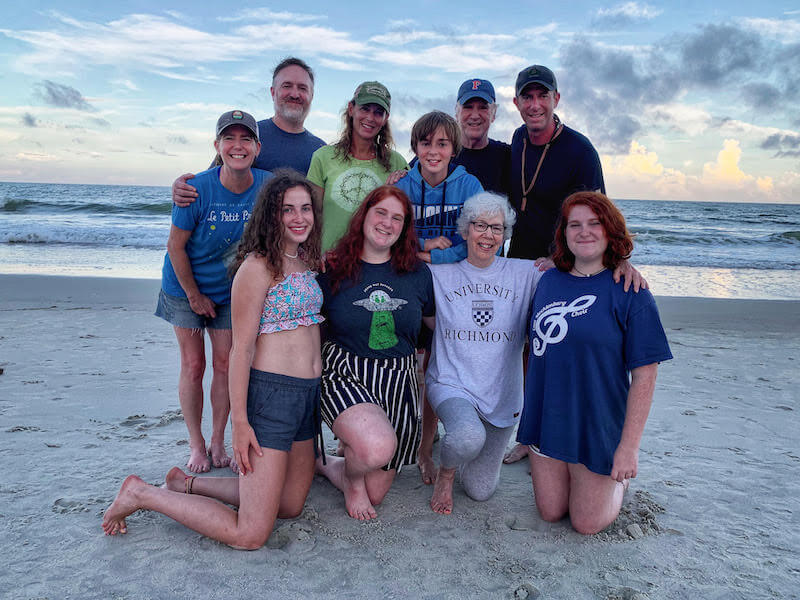
A group of ten people, including adults and teenagers, pose together on a sandy beach with the ocean and a cloudy sky in the background.Pin
When she’s not working, Judy enjoys spending time with her children, grandchildren, and her husband, Henry. We’ve been married for 57 years! I always wanted a really good love story, and Henry and I got a really good love story. We decided to get married during our third date, “she says. “I had been engaged to another guy and broke my engagement three weeks before the wedding, so I knew what I was looking for. And when I met Henry, I thought, this is it. And he thought the same thing. Image: Judy Goldman

What do you like to do when you’re not working?

I like to walk. I like to be with my family. My daughter lives 10 minutes away, and my son lives eight minutes away.

What’s the best advice you have to offer?

It’s a quote from the poet Nikki Giovanni: “I recommend old age,” she said. “There’s just nothing as wonderful as knowing you have done your job.”

Aside from faith, family, and friends, name three things can’t you live without.

My new vegetable peeler, the photographs of family and friends I have all around my house, and cutting azalea blooms from other people’s yards, and putting them in my condo.

https://styleblueprint.com/everyday/southern-author-judy-goldman/

Saturday, December 28, 2024

Forget those resolutions – take 15 minutes to look BACK and it'll change your life

From dailymail.co.uk/pressreader.com

NOT long to go now. Soon all the shopping will be done, the presents wrapped, the food prepared and then, if you’re lucky, you might have a few minutes to sit down and relax over the next few weeks. If so – and I very much hope that this is the case – why not spend a bit of time looking back and thinking about what you’re grateful for?


People tend to think the end of the year is about looking forward: New Year’s resolutions, change, a fresh start. Why look back? I’m often surprised how many people say: ‘I’ll be pleased when the year is over’ – as though it’s something you should turn your back on and not think about again.


Of course, some will have had a tough year. There will have been setbacks, upsets and maybe even tragedies. But for most, there will have been good things, too. Even if someone has had a very difficult time with a bereavement, say, there will be some positive, heart-warming or life-affirming moments too – perhaps the way friends rallied around or a partner supported you. If we only focus on the future, determined to look forward and put difficult experiences behind us, we risk missing these little gems.

In consigning the whole year to the waste bin of life as an annus horribilis we don’t get to see the glimmers of goodness that were probably also there.


THE strength of our memories tends to be closely related to the strength of the feelings attached to them, particularly in the case of negative emotions. This means we remember things that provoked strong reactions much more vividly than others. It’s very normal to find a few upsetting events dominating our memory of a year, while the lesser, but enjoyable things, fade or are forgotten.


This is why I always recommend keeping a journal. We often forget all the moments of fun and joy we had, despite everything else that might have happened. I’m not talking about a Bridget Jones-style diary with endless entries covering all your thoughts and worries. It’s actually enough to have an old fashioned datebook or calendar with a record of the things you did, where you went, people you saw. If you don’t have a physical diary, maybe you keep notes on your social engagements in your phone calendar? If so, I highly recommend that, in the time between Christmas and New Year, you spend a few hours just flicking through it, remembering everything you did.


You’ll be surprised how many fun, interesting and enjoyable things you’ve done over the year, and simply forgotten. The reality is, if we don’t reflect, we don’t get to be grateful. Finding the good things in the rubble of life often doesn’t come easily. Sometimes you have to force yourself to spot them – and to say thank you.


Psychologists call it ‘gratitude therapy’ and it helps you focus on the positives in your life. It comes out of a branch of psychotherapy called ‘positive psychology’ which has become increasingly popular in recent years.


It’s quite a shift from traditional psychotherapeutic approaches which tend to focus on the problems that someone has in their life. Positive psychology, in contrast, makes the focus of the work about exploring what is going right in someone’s life and thinking about the things they can be grateful for.


It is an important weapon in the arsenal to tackle life’s difficulties. Countless studies have shown a robust association between high levels of gratitude and long-term mental wellbeing.


It is thought to work on several levels. By focusing on the positive, we reduce toxic emotions such as anger, frustration, envy and regret.


Research has shown that saying ‘thank you’ to the people in your life helps solidify friendships and form new relationships, meaning people have better social networks. This in turn helps to stave off loneliness and improve mood. It also helps to improve empathy and decreases interpersonal conflict.


Showing gratitude for someone who made an impact (however small) in your life over the year doesn’t have to involve getting them a lavish present. Often something as simple as a phone call to wish them a Happy Christmas or a Christmas card with a thoughtful message written in it is all that’s needed.

It shows you thought about them, that you remember and appreciate them. We all know how good it feels to be on the receiving end of that.


AND it’s not just something you can do in the brief bit of downtime at the end of the year. Advocates of gratitude therapy recommend people make a conscious decision to set aside a block of time a day – say, 15 minutes – during which you reflect on the positive things in your life. The key is to really think about everything you are grateful for, which is why it’s recommended that you actually write it down, rather than just cycling through a list in your mind. The act of putting pen to paper provides a physical, tangible focus.

It’s also very helpful if you find yourself having an overwhelming negative emotion or thought. Pull out your list and remind yourself that not everything in life is bad – even if it might feel like that at times. I hope you find many things to feel grateful about this season.

https://www.pressreader.com/uk/daily-mail/20241223/282127822086939