Showing posts with label handwriting. Show all posts

Saturday, May 11, 2024

Why writing by hand beats typing for thinking and learning

From opb.org 

If you're like many digitally savvy Americans, it has likely been a while since you've spent much time writing by hand.

The laborious process of tracing out our thoughts, letter by letter, on the page is becoming a relic of the past in our screen-dominated world, where text messages and thumb-typed grocery lists have replaced handwritten letters and sticky notes. Electronic keyboards offer obvious efficiency benefits that have undoubtedly boosted our productivity — imagine having to write all your emails longhand.

To keep up, many schools are introducing computers as early as preschool, meaning some kids may learn the basics of typing before writing by hand.

But giving up this slower, more tactile way of expressing ourselves may come at a significant cost, according to a growing body of research that's uncovering the surprising cognitive benefits of taking pen to paper, or even stylus to iPad — for both children and adults.

In kids, studies show that tracing out ABCs, as opposed to typing them, leads to better and longer-lasting recognition and understanding of letters. Writing by hand also improves memory and recall of words, laying down the foundations of literacy and learning. In adults, taking notes by hand during a lecture, instead of typing, can lead to better conceptual understanding of material.

"There's actually some very important things going on during the embodied experience of writing by hand," says Ramesh Balasubramaniam, a neuroscientist at the University of California, Merced. "It has important cognitive benefits."

While those benefits have long been recognized by some (for instance, many authors, including Jennifer Egan and Neil Gaiman, draft their stories by hand to stoke creativity), scientists have only recently started investigating why writing by hand has these effects.

A slew of recent brain imaging research suggests handwriting's power stems from the relative complexity of the process and how it forces different brain systems to work together to reproduce the shapes of letters in our heads onto the page.

                                                                                                      Ivan-balvan / Getty Images/iStockphoto

Your brain on handwriting

Both handwriting and typing involve moving our hands and fingers to create words on a page. But handwriting, it turns out, requires a lot more fine-tuned coordination between the motor and visual systems. This seems to more deeply engage the brain in ways that support learning.

"Handwriting is probably among the most complex motor skills that the brain is capable of," says Marieke Longcamp, a cognitive neuroscientist at Aix-Marseille Université.

Gripping a pen nimbly enough to write is a complicated task, as it requires your brain to continuously monitor the pressure that each finger exerts on the pen. Then, your motor system has to delicately modify that pressure to re-create each letter of the words in your head on the page.

"Your fingers have to each do something different to produce a recognizable letter," says Sophia Vinci-Booher, an educational neuroscientist at Vanderbilt University. Adding to the complexity, your visual system must continuously process that letter as it's formed. With each stroke, your brain compares the unfolding script with mental models of the letters and words, making adjustments to fingers in real time to create the letters' shapes, says Vinci-Booher.

That's not true for typing.

To type "tap" your fingers don't have to trace out the form of the letters — they just make three relatively simple and uniform movements. In comparison, it takes a lot more brainpower, as well as cross-talk between brain areas, to write than type.

Recent brain imaging studies bolster this idea. A study published in January found that when students write by hand, brain areas involved in motor and visual information processing "sync up" with areas crucial to memory formation, firing at frequencies associated with learning.

"We don't see that [synchronized activity] in typewriting at all," says Audrey van der Meer, a psychologist and study co-author at the Norwegian University of Science and Technology. She suggests that writing by hand is a neurobiologically richer process and that this richness may confer some cognitive benefits.

Other experts agree. "There seems to be something fundamental about engaging your body to produce these shapes," says Robert Wiley, a cognitive psychologist at the University of North Carolina, Greensboro. "It lets you make associations between your body and what you're seeing and hearing," he says, which might give the mind more footholds for accessing a given concept or idea.

Those extra footholds are especially important for learning in kids, but they may give adults a leg up too. Wiley and others worry that ditching handwriting for typing could have serious consequences for how we all learn and think.

What might be lost as handwriting wanes

The clearest consequence of screens and keyboards replacing pen and paper might be on kids' ability to learn the building blocks of literacy — letters.

"Letter recognition in early childhood is actually one of the best predictors of later reading and math attainment," says Vinci-Booher. Her work suggests the process of learning to write letters by hand is crucial for learning to read them.

"When kids write letters, they're just messy," she says. As kids practice writing "A," each iteration is different, and that variability helps solidify their conceptual understanding of the letter.

Research suggests kids learn to recognize letters better when seeing variable handwritten examples, compared with uniform typed examples.

This helps develop areas of the brain used during reading in older children and adults, Vinci-Booher found.

"This could be one of the ways that early experiences actually translate to long-term life outcomes," she says. "These visually demanding, fine motor actions bake in neural communication patterns that are really important for learning later on."

Ditching handwriting instruction could mean that those skills don't get developed as well, which could impair kids' ability to learn down the road.

"If young children are not receiving any handwriting training, which is very good brain stimulation, then their brains simply won't reach their full potential," says van der Meer. "It's scary to think of the potential consequences."

Many states are trying to avoid these risks by mandating cursive instruction. This year, California started requiring elementary school students to learn cursive, and similar bills are moving through state legislatures in several states, including Indiana, Kentucky, South Carolina and Wisconsin. (So far, evidence suggests that it's the writing by hand that matters, not whether it's print or cursive.)

Slowing down and processing information

For adults, one of the main benefits of writing by hand is that it simply forces us to slow down.

During a meeting or lecture, it's possible to type what you're hearing verbatim. But often, "you're not actually processing that information — you're just typing in the blind," says van der Meer. "If you take notes by hand, you can't write everything down," she says.

The relative slowness of the medium forces you to process the information, writing key words or phrases and using drawing or arrows to work through ideas, she says. "You make the information your own," she says, which helps it stick in the brain.

Such connections and integration are still possible when typing, but they need to be made more intentionally. And sometimes, efficiency wins out. "When you're writing a long essay, it's obviously much more practical to use a keyboard," says van der Meer.

Still, given our long history of using our hands to mark meaning in the world, some scientists worry about the more diffuse consequences of offloading our thinking to computers.

"We're foisting a lot of our knowledge, extending our cognition, to other devices, so it's only natural that we've started using these other agents to do our writing for us," says Balasubramaniam.

It's possible that this might free up our minds to do other kinds of hard thinking, he says. Or we might be sacrificing a fundamental process that's crucial for the kinds of immersive cognitive experiences that enable us to learn and think at our full potential.

Balasubramaniam stresses, however, that we don't have to ditch digital tools to harness the power of handwriting. So far, research suggests that scribbling with a stylus on a screen activates the same brain pathways as etching ink on paper. It's the movement that counts, he says, not its final form.

Jonathan Lambert is a Washington, D.C.-based freelance journalist who covers science, health and policy.

Copyright 2024 NPR. To see more, visit https://www.npr.org.

https://www.opb.org/article/2024/05/11/why-writing-by-hand-beats-typing-for-thinking-and-learning/

Wednesday, August 24, 2022

Handwritten diaries may feel old fashioned, but they offer insights that digital diaries can't match

From salon.com

By Paula Vene Smith

Handwritten diaries and digital diaries both help preserve experiences and memories, but in different ways

he first time I taught a college course called "The London Diary" for young Americans studying abroad back in 2002, each student ended up with a tangible book of memories, a handwritten record of their semester in London. But when I taught the course 15 years later, the first question my students asked was whether they could keep their journals online. The question brought home to me how the image of a diary has shifted from words scribbled in a blank book to images and digital text on a screen.

Why not go digital?

Even while journaling apps like Penzu and Diaro become more widely available, estimates and surveys suggest that a sizable number of the world's diary keepers still keep handwritten diaries.

Fans of digital diaries grant them an edge in convenience, portability, searchability and password protection. Jonathan, one of my 2018 students, described in an essay for class how digital diarists can upload entries to multiple platforms, keeping some portions offline or restricted to a select audience while other parts go completely public. It's harder to control distribution, encrypt entries or build an index with a journal kept on paper.

I already expected my students to use electronic devices to read course materials, to communicate with me and with their families back home, to write essays for class, and to navigate London. Why not let them keep digital diaries, too?

Diary as artifact

Poet and literary scholar Anna Jackson was researching the private papers of novelist Katherine Mansfield for her book "Diary Poetics" when she made an unexpected discovery. Jackson came across a "piece of the world" that was also an element of Mansfield's journal – a kowhai flower between two pages in a notebook:

"After all this time, there it still was, still yellow, still between the same two pages Mansfield had placed it between all those years ago. A piece of the world she wrote about was right there as a piece of the world still, not a piece of writing."

Jackson's experience shows the power of holding in your hand the diary as a physical object. What scholars call the manuscript's "materiality" links writer to reader in an unexpectedly intimate way.

For historians and diary scholars, manuscripts are artifacts. A book's binding, paper quality and ink can signal an anonymous diarist's socioeconomic status. Changes in penmanship may show how the writer felt – drowsy, extra careful or agitated – while writing certain passages.

Some clues, like the bit of evidence provided by inserting a memento, relay intentional messages. Others, like crossed-out words, may reveal information the writer did not plan to share.

Physical evidence can also hint at what happened after a text was written. Damaged or missing pages may indicate a strong reaction to the contents. A few years ago, conservators at the National Maritime Museum in Greenwich, England, discovered a concealed entry in the diary of a 17th-century British sailor. In his diary, he originally confessed to committing a rape, but later wrote a different account of the event, pasting the new page so carefully over the original that it went unnoticed for more than 300 years.

Digital yet material

Every original mark in a diary reflects an impulse of the moment. As diary instructor Tristine Rainer says in "The New Diary," "At any time you can change your point of view, your style, your book, the pen you write with, the direction you write on the pages, the language in which you write, the subjects you include.... It's your book, yours alone."

With so many convenient features, digital diaries remain a popular choice. This option, we might be surprised to learn, even has its own form of materiality.

In "How to Read a Diary," literature scholar Desirée Henderson notes that digital diaries, too, are objects, shaped by tools the diarist selects – in this case, software and hardware – to create the diary. The writer's design choices, such as site structure, networking parameters, embedding of graphics, image and audio files and hyperlinks, offer grist for interpretation not unlike reading the nonverbal signs of a traditional diary.

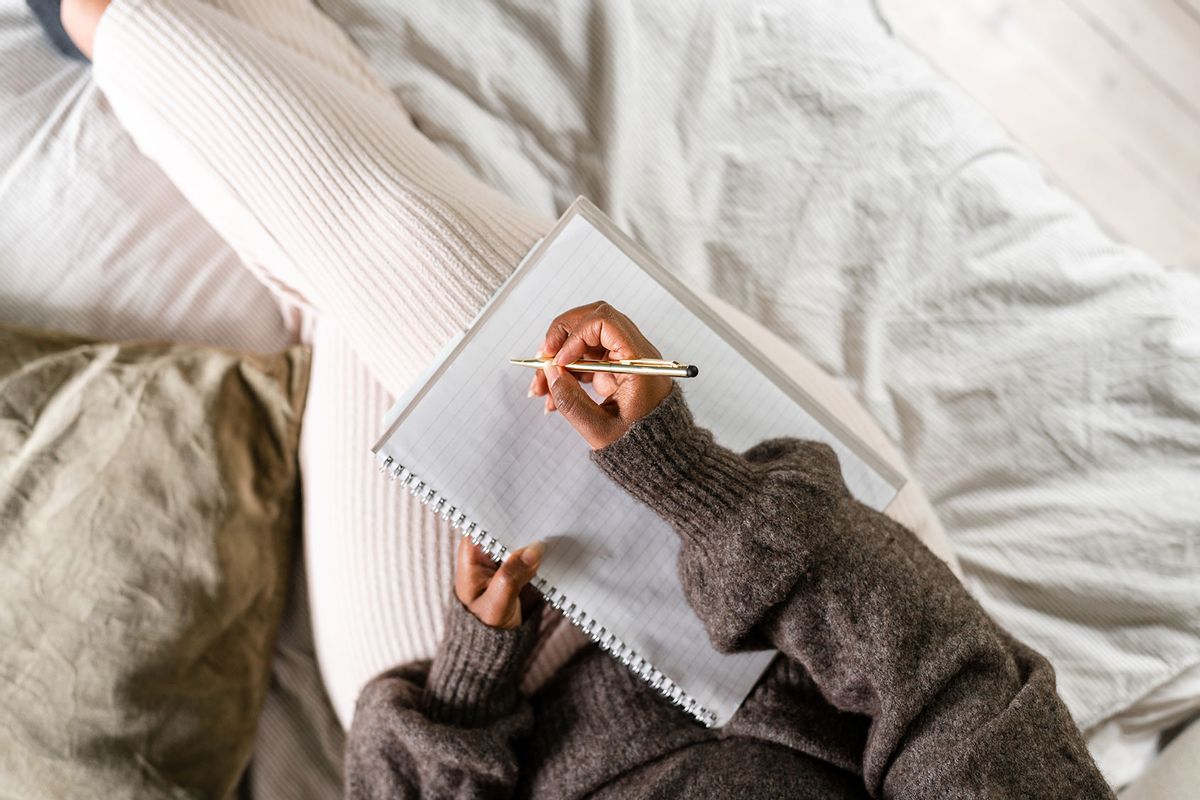
Woman writing in bed (Getty Images/luza studios)

Woman writing in bed (Getty Images/luza studios)

Writing into the future

As I thought about offering my students the online option, I began to imagine them many years from now, coming upon that London diary from their college days. I remembered my first group of students drawing sketches on their pages, attaching a Travelcard, café napkin, or theatre ticket. I remembered Anna Jackson with the kowhai flower. I couldn't shake my conviction that future diary readers will be less enthralled by a digital product – even enhanced with multimedia – than by the quirky, untidy books hand-lettered by their predecessors.

In the end, I assigned my students – at least those who were physically able – to create their London diaries by hand. They could still use their phones to capture images or take preliminary notes, but in the end they would produce a material keepsake.

Several students decided to write in their notebooks while also keeping a digital diary. The dual process felt natural to them. To his blog Jonathan posted, "Like many children of the 21st century, I love the idea of keeping everything journaled online. This way I can make notes on my phone as I walk, have them automatically update on my computer, where I can expand with more time. If I wake up in the middle of the night with an idea, I don't need to wake up a roommate with a lamp. However, the course also requires an analogue diary."

Every diary, "analogue" or digital, can be read as an artifact layered with meaning – one that conveys clues to its writer's life and times in both non-verbal signals and words.

Paula Vene Smith is a professor of English at Grinnell College who teaches and writes about diaries.

https://www.salon.com/2022/08/21/handwritten-diaries-may-feel-old-fashioned-but-they-offer-insights-that-digital-diaries-cant-match_partner/


Friday, April 9, 2021

Why pen and paper will always be best

From belfasttelegraph.co.uk

Whether for therapeutic purposes or simply to stay organised, Abi Jackson ponders writing by hand

 If you're still using a paper diary, always have a notebook nearby, and like your gratitude lists scribbled in ink, you don't need research to tell you that writing stuff down is great.

Just recently though, a study led by neuroscientist Kuniyoshi Sakai at University of Tokyo found students who took notes by hand had better recall than those who used phones or tablets. Participants were quizzed an hour later, to see how much they could remember from their notes, with MRI used to measure their brain activity.

Those who'd handwritten their notes showed 'significantly' more activity in areas associated with language, imaginary visualisation and the hippocampus (important for memory and navigation).

From journaling to keeping notes and to-do lists, we're big fans of putting pen to paper…

A sense of control 

There are loads of reasons many of us still love to write by hand. For some, keeping a physical log of everything is part of the appeal, for others, it's an effective way to stay organised and be more mindful and creative. Counselling Directory member Dee Johnson is a huge fan of the old-school pen and paper approach and still uses it as much as possible in her own life and admin, as well as with clients and patients.

"The writing slows things down, so it's making you more mindful and aware of what you're taking in. And we know the physical act of actually writing creates a motor memory - that's why when we're teaching children how to write, or even somebody who's had a stroke, just re-writing and shaping those letters jogs that part of the brain and memory bank," she says.

Emotional connection

Think about when you're trying to remember how to spell a word - sometimes, the sequence of letters can escape us when we're thinking or saying it out loud. But once we jot them down, we recall the spelling. 

Benefits: writing by hand is good for us on many levels
 

"That's the motor memory; you've built a neural pathway and it becomes that physical act of doing it," says Johnson.

The therapist regularly asks patients to do an exercise where they write out their own life story. Of course, sometimes disability, illness or physical differences might mean using technology is a more suitable option. But when handwriting is possible, Johnson says the effects can be powerful - not least in terms of jogging memory. "They'll often say, 'So much came back!'"

There's creative and emotional levels too. "[When we handwrite], we're being more considered about what we're putting on to the paper, and it makes a tangible connection between your emotions and yourself… When it's typed out, it's standardised, it's depersonalised. When your brain recognises your own handwriting, it gives that real visceral and emotional connection."

Building trust

Johnson thinks it's a massive shame so many people lack confidence in their handwriting, often after being told it was 'messy' at school. 

Tuning into the purpose and benefits of writing, rather than being bogged down by perfectionism, "builds confidence - we build a bit more trust in ourselves, and I think there is something in that, building that inner confidence".

Journaling, 'morning pages' or brain-dumps - where you sit with your pen and just let the words flow for a period of time each day are hailed for a host of - creativity, mindfulness and therapeutic benefits.

"Sometimes I get my patients to write down their 'what ifs', and if we get to the end of the day and it hasn't happened, you scrawl it out. And you're refocusing and regrouping, because if you let those things run away, they just catastrophise.

"When you're writing, it's bringing you back to what's actually going on, instead of what my scattered thoughts are doing. Then you build up a trust process - 'Ah, ok, this stuff passes. It's transient. I'm not stuck like this'."

https://www.belfasttelegraph.co.uk/life/features/why-pen-and-paper-will-always-be-best-40285343.html 


Monday, May 11, 2020

The heartening boom in handwriting

From life.spectator.co.uk
By Melanie McDonagh

There’s an upside to lockdown. If our home habits are discernible from consumption, we’re turning into altogether nicer people. We’re writing more by hand and we’re writing more letters.

This is the finding of the upmarket stationers, Smythson, which does terrifically covetable writing paper, correspondence cards and notebooks. It’s seen an increase of over 80 per cent in stationery sales in April. The range of plain stationery is up by more than 200 per cent. Record books – for journals – are up by over 70 per cent; notebook orders have doubled and telephone and address books sales have increased by 355 per cent. I can relate to that last one. The one thing I do when I have me time  – every seven years or so – is to fill in a new address book, a melancholy record of death and loss..

It’s a lockdown trend, handwriting. A YouGov survey done with the Prince’s Trust with a hefty sample of 1,200 11-21 year olds found that 27 per cent wrote their thoughts and feelings on paper at least once a week. Well over half, 58 per cent, of journal-keepers are girls. And of the total, 46 per cent said that writing things down was more helpful than typing them into a laptop or a phone. A quarter said keeping a daily diary was beneficial – as opposed to the three per cent who said that blogging was beneficial, or commenting online – four per cent.


In other words, engaging with the online world is by some distance less beneficial than actually writing stuff down. There’s something about the process of inscribing physical ink on a physical page that involves our brain and hand in a more sensual and immediate way than the fingers-keyboard-screen nexus.

Putting pen to paper is a physical activity: you see and feel the medium you write with – whether it’s pencil, pen or ballpoint. Cardinal Newman wrote with a quill up to his death at the end of the nineteenth century, and he was a prodigious letter writers (his correspondence fills 30 volumes). What that meant was that he, like every other writer up to modern times, constantly heard the scratch of the nib on paper, constantly modified his writing to take account of the flow of ink and the avoidance of blots. Handwriting means you engage with a writing instrument. And with the physicality of the paper…woven, smooth or textured, thin or thick.

This sensuous aspect of writing may explain why handwriting – sequential hand movement – seems to engage parts of the brain that keyboard use doesn’t, as shown by magnetic resonance imaging. And cursive script – longhand – means that the flow between brain and hand is more fluent than if you don’t use joined up script.

An obvious aspect of writing by hand is that you have to think before you write; your sentences are formed in the brain before you put them down. If you make a mistake on screen it’s easily remedied. When you’re writing on paper, there’s an incentive to avoid error and get the sense formed before you begin. If you ruin the whole thing, you have to bin the paper. Obviously it matters less if you’re writing a journal (unless you’re intending it should be read) but still you need to think before engaging the hand. Bluntly, that means you write less than on screen; a stream of consciousness – drivel – is much easier to get away with on a keyboard.

For a journal, you need a decent notebook, large enough to write good sized entries; small enough to hide away.

But letters need more thought. There are few more satisfying pleasures than writing letters by hand. The process of writing is physically gratifying; the visual appearance of a well written letter is pleasing to writer and recipient. It requires effort and the effort shows. And as we all know how characteristic of a person their hand (that is, handwriting) is. It’s a giveaway of character.

A pre-requisite of a satisfying letter is good writing paper – which takes an effort to find. I went into Paperchase few months ago for some and the assistant looked at me baffled; her boss had to direct me to the bottom shelf. Smaller branches don’t stock it. But if a whole page is too intimidating, a correspondence card is fine. Good, thick writing paper is an incentive in itself to write well.

And you need a pen, a fountain pen, to write properly. It gives you a smooth flow of ink and the sensuous pleasure of holding a perfectly adapted instrument. Plus there’s the environmental advantage of a fountain pen over a disposable biro or felt-tip, one you can refill from a pot of ink. God knows how many dolphins have choked on Bic plastic pens. Cartridges are less problematic but they’re still waste. What you need is a converter to switch to bottle ink.. I use a very good Cross pen – with a separate converter. Mine’s a Wanderlust, £85, but you can get a cheaper model for £20. Lamy pens with their cheerful colours also take a separate converter.

But if you’re one of those who uses an actual dip pen, where you have to keep putting your nib in an inkwell, and using blotting paper against smears, I salute you. Done well, that’s proper writing, and it shows.