Showing posts with label USA. Show all posts

Thursday, October 1, 2026

In 1972, Washington teacher Robert Shields began recording his life every 5 minutes; by 1997, his diary had reached 37.5 million words

From economictimes.indiatimes.com

Synopsis

For almost 30 years, Robert Shields meticulously documented every facet of his existence, utilizing six typewriters to ensure uniformity in his writing. His impressive archive comprises around 37.5 million words, which are set to remain sealed until 2057. Despite some psychologists labelling his journaling habits as counterproductive, his dedication to self-tracking is undeniable.


Somewhere in the basement vaults of Washington State University, there are 97 boxes containing documents that, by the terms of the family's original deed of gift, could not be opened for research until after the deaths of both Robert Shields and his wife, Grace Hotson Shields; Grace passed away in April 2024, and separate reporting has put the date for a full, exact accounting of the diary's word count as far out as 2057, fifty years after Shields's own death. Inside those boxes are approximately 37.5 million words, single-spaced, chronicling the life of one ordinary man, written in five-minute instalments, over the course of nearly three decades. Washington State University Libraries' own archives put that word count and box count on record, and it was Washington State Magazine writer Adriana Janovich's deeply researched 2025 profile of Shields, built from his archived diary and interviews with the people who knew him, that went on to win the writer several journalism awards; not, as an earlier draft of this piece implied, a face-to-face interview with Shields himself, who had died in 2007, years before she wrote about him. 


It seems that, more than fifty years later, Shields' particular obsession with recording his life in such granular detail still fascinates us, and it's easy to understand why. Long before we had smartphones to quantify every step we take or every tweet we post, a small-town Washington teacher was out there conducting the social science experiment of the century, finding out just what it costs to have such an existence.


Man, six typewriters and no vacation


Robert Shields was a retired minister and high school English teacher when he began, in 1972, systematically recording every aspect of his daily life in an extraordinary self-documentary. From the scant details he gave to the Washington State writer, it becomes evident that he kept six typewriters in his office in case one of them malfunctioned, so that he could keep recording without missing a beat.


Robert Shields. Image credits: Wikipedia


He got less than two hours of sleep at a time so that he could wake up every couple of hours and dictate his dreams onto the page while he still remembered them for another five minutes. He spent about four hours every day doing this, and a stroke finished the task in 1997. He died in 2007, leaving behind a legacy which people today are only beginning to appreciate.


Long before there was technology to quantify our lives, there was Robert Shields


If you think that Shields was just a strange figure from a bygone era, you would not be alone. He is often called the grandfather of the quantified self, someone who, decades before pedometers and fitness trackers existed, meticulously logged the raw material of an ordinary life by hand: sleep patterns, bodily functions, receipts, junk mail, even the weight of the daily newspaper, all in pursuit of some vague notion of completeness. A University of Washington-led 2014 study titled “Understanding quantified-selfers' practices in collecting and exploring personal data,” published in the Conference on Human Factors in Computing Systems - Proceedings, followed dozens of self-tracking enthusiasts and concluded that, for many of them, it was the collecting of the data that mattered most.


The paper specifically cited that many of these people engaged in self-tracking for data collection as an end in itself, rather than for specific goals, which sounds suspiciously like what Robert Shields was doing forty years earlier. It seems that, for him too, the goal was just to have it all down somewhere, just to have it all recorded, with no particular reason beyond that desire for completion.

What the science actually says about tracking everything you do


Now, here's where it gets interesting. If you've ever tried self-tracking or writing down everything that happens to you in pursuit of some kind of goal, there's a decent chance that you've stumbled onto something strange and counter-intuitive. Psychologists have studied diary keeping, and the results are mixed on whether recording everything is beneficial.

According to a landmark 2005 review titled “Emotional and physical health benefits of expressive writing,” published in the journal Advances in Psychiatric Treatment, writing about your emotional experiences in a focused, concise manner for a short period of time (15-20 minutes per day, over a span of a few days) can have beneficial long-term effects. But Shields was not writing about his emotional experiences, and he certainly wasn't doing it concisely. He was recording everything that crossed his mind with equal attention and effort. It's this latter approach that psychologists have found to be not particularly helpful to people who are trying to process their emotions.


A diary for journaling the small, insignificant details of day-to-day life. Image credits: Wikimedia Commons


In this corner of the scientific world, Robert Shields' approach has also been labelled as counter-productive. Computer scientists specializing in information retrieval published a paper titled “Beyond total capture: a constructive critique of lifelogging,” in 2010 in the Communications of the ACM, that directly tackled the concept of total capture, arguing that the idealization of capturing all of our digital footprints misses crucial details about how we think and process information. Memory is not simply recorded and played back like a video, and attempts to capture everything may interfere with how we remember. A record that tries to remember everything for us may miss the way memory actually works.


The inconvenient truth about keeping records

Of course, none of this means that people like Robert Shields aren't doing something worthwhile.

Whatever the diary's value as a personal coping strategy, its value as a historical record is a separate question, and it's on that second front that Washington State University Libraries are currently working to catalogue and preserve his writings for future researchers. There is, still, an undeniable irony in reading about this strange man and his obsession, given everything the research above suggests about total-capture recording.

If you've ever kept a journal yourself, whether to track fitness goals or for something more introspective, it's easy to understand why this might resonate on a personal level. Robert Shields spent four hours a day writing about everything that happened to him in five-minute intervals, in an effort to better understand his life, and by his own account he never felt he'd spent enough time on it to make it worthwhile. In our own small ways, we may all be a little like him.


Sunday, September 20, 2026

Dear Diary: 4 Historic Journals and Memoirs

From savingplaces.org

By Emma Peters

Dear Diary...

As autumn leaves fall and a new school season begins, Dear Diary Day encourages people to capture their thoughts on paper. The commemorative day, which takes place each year on September 22, serves as a reminder that personal writing is a creative, expressive act. In a world that is becoming increasingly fast-paced, writing provides people with the opportunity to slow down and reflect on their experiences.

While Dear Diary Day is a recently established observance, the practice of personal writing has existed for thousands of years. As historic sources, diaries and journals are a uniquely intimate source of information, often encompassing details about one’s daily life, thoughts, tasks, and personal notes. They help contemporary readers understand how everyday people lived in the past by capturing what they did, thought about, and ultimately valued.

To celebrate Dear Diary Day, we asked staff at National Trust Historic Sites and Historic Artists' Homes and Studios to share information about the personal writings in their collections. Read on to explore a selection of diaries, journals, and memoirs preserved at historic sites around the country.

Edith Farnsworth House (Plano, Illinois)

Photo of a page in Edith Farnsworth's journal. In blue ink, Farnsworth's cursive writing covers a sheet of white, lined paper.

photo by:Edith Farnsworth House

Six of Dr. Edith Farnsworth’s journals are available to view at the Newberry Library in Chicago, Illinois.

Photo of a page in Edith Farnsworth's journal. In blue ink, Farnsworth's cursive writing covers a sheet of white, lined paper.

photo by:Edith Farnsworth House

In her journals, Dr. Edith Farnsworth reflects on her life, career, and the construction of her home, the Edith Farnsworth House.

Dr. Edith Farnsworth left six journals behind, all of which are currently available to view at the Newberry Library in Chicago, Illinois. In the first three volumes, Farnsworth writes about her life and career. She also reflects on her work with architect Ludwig Mies van der Rohe during the construction of her home, the Edith Farnsworth House. The remaining three volumes contain Farnsworth’s translations of poetry and prose, including her translation of The Little Locksmith by her friend Katharine Butler. Two recent publications, Nora Wendl’s Almost Nothing: Reclaiming Edith Farnsworth and Michelangelo Sabatino’s The Edith Farnsworth House, use Farnsworth’s journals to recount her perspective on and collaboration with Mies van der Rohe in designing her iconic Modernist home.

“The glass house took on life and became my own home.”

Dr. Edith Farnsworth

Belle Grove (Middletown, Virginia)

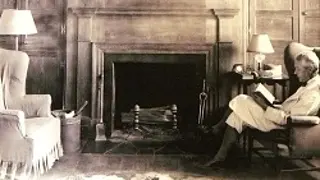
In the center of this photograph is a fireplace. An armchair and lamp stand on both sides of it. In the armchair on the right sits a man, Frances Hunnewell, who holds an open book in front of him.

photo by:Belle Grove

Frances Hunnewell, who kept a diary while living at Belle Grove, reads a book in his library.

Frances Hunnewell, the last owner of Belle Grove, left one diary behind. In it, he shares details about his life at Belle Grove, including guest visits and his daily activities. While he worked as a lawyer, in his personal time Hunnewell was a passionate and accomplished botanist. His diary reflects his interest in botany and includes information about plantings on the property, some of which continue to live onsite today. Learn more about Hunnewell in the video above from Belle Grove, which delves into some of the entries in his diary.

“Feb. 23: Min 42 - Max 57 degrees. Clear & windy. Draba verna in blossom, also alders. Silver maples back of house just coming into bloom. Walked along creek in morning. Motored to Elizabeth Furnace in afternoon. ”

Frances Hunnewell

Gari Melchers Home & Studio (Falmouth, Virginia)

In 1908, artist Gari Melchers was commissioned to paint a portrait of President Theodore Roosevelt. Melchers kept a diary during the two weeks he spent at the White House, offering a glimpse into one of the most prestigious commissions of his career. In his letters and diary entries, Melchers documents his observations and experiences at the White House and comments on how his painting is progressing. In a letter to his wife, he recounts, "… Mrs. Roosevelt took me around upstairs and downstairs to find a suitable studio and we decided on the small dining room which has a north light." Melcher’s diary entries, which are available to read online, provide detailed information about his painting process and day-to-day activities as the president’s guest.

“Monday, March 2, 1908 / worked on the head today – but got my beginning too heavy – Mrs Roosevelt came in and entertained the President until later Mr Loeb came in to take her place.”

Gari Melchers
Pictured is the oil painting of Theodore Roosevelt that artist Gari Melchers completed in 1908. In the painting, Roosevelt stands upright. He is wearing tall brown boots, pants, a green suit vest, red tie, and a navy coat with a fur-lined color. He also wears glasses and a black top hat. In his hand is a walking stick and dull orange gloves. The background of the painting is dark toward the bottom, and gradually transitions to a warm, muddy beige color.

photo by:National Museum of Asian Art, The Smithsonian Institution

While painting President Theodore Roosevelt’s portrait, artist Gari Melchers kept a diary during his two-week stay at the White House.

Pictured is the memoir of artist Frederic Clay Bartlett. The cover of the memoir is a pink-beige color, and it is a hardback. Beside the cover is a copy of the memoir that is turned to its title page, which reads "Sortofa Kindofa Journal of My Own," the title of Bartlett's memoir. On the page opposite is a black and white photograph of Bartlett, who is a beige suit and is seated while working at a desk.

photo by:Bonnet House Museum & Gardens

Frederic Clay Bartlett’s reflections on art and travel were published in his memoir “Sortofa Kindofa Journal of My Own.”

Bonnet House Museum & Gardens (Fort Lauderdale, Florida)

During his life, artist and art collector Frederic Clay Bartlett wrote a memoir. Titled Sortofa Kindofa Journal of My Own, it was published posthumously in 1965, 12 years after Bartlett’s death in 1953. In it, Bartlett recounts the wonder he experienced at the World’s Columbian Exposition, also called the Chicago World’s Fair, of 1893. He attended the exposition with fellow artist Robert Allerton. Inspired, Bartlett and Allerton left Chicago to study painting overseas after the exposition. Bartlett, who was born and raised in Chicago, reflects on this pivotal experience in his memoir. He also shares his musings on art and travel, including his time studying fine art in Munich, Germany.

https://savingplaces.org/stories/dear-diary-day-historic-journals-and-memoirs 

Tuesday, September 8, 2026

Mabel Allen’s 1908 Diary: Good-Bye To Summer

From newyorkalmanack.com

Alice Mabel Allen (1886-1976) grew up in the village of Adams in Jefferson County. In 1908, while attending Syracuse University, Mabel, as she was known, kept a diary which New York Almanack is publishing each week. This is her last week in Adams before returning to the university.

Monday, September 7

Labor Day! Woke up at six, both Edna [her sister] and I. Helped Edna pack, dusted the parlor and dining room and swept our room. I did not help with the dinner work but went down with Alma and Edith to see the Field Day crowd and races.

Went to a ballgame between Lorraine and T.I. Park. When I came back I found Jessie Torrey had arrived. Went down to the train with Edna. Poor child. Boonville will be different. We met Alma uptown and she took us around to see the parade. Louise was over for supper and we all went down to see the fireworks.

Thousand Islands Park baseball team, early 1900s.


Tuesday, September 8

Mother told me to sleep this morning but of course I could not, so I got up and made a cake before I breakfasted. To reward me, it fell. I made another later on. Jessie and I had breakfast later and she wrote letters while I served. After dinner we went downstreet for some errands and then came home and dressed.

The Dunmores came for supper and we went with them to the train. It seemed like saying good-bye to the summer. We met Edith and also Florence Buell, who came up to see Jessie. Sarah and Mr. Cooper came from Cedarwood. Letter from Harriet.

Wednesday, September 9

Jessie and I had breakfast later than the rest. We went up to chapel and then downstreet. Alma took us automobiling and we had to stop an hour on the Adams Ctr. state road for repairs. After dinner I went down with Jessie to take her watch and there I wrote to Harriet.

Mother took us down to the 4:19 train where Jessie left. Mother and I drove around Cooper’s square and reached home at supper time. Helped Louise with her dishes and then went downstreet with her. Slept out on porch with mother.

Thursday, September 10

The sun rises in a red ball and the moon is like it. Have felt ambitionless all day. Took my checked jumper over to Miss Frazer to be altered and went over to see Miss Armstrong’s also sewed. After dinner I made two balsam pillows and then went to [Jefferson County Journal] office to work on father’s books.

Before I finished supper, Alma came for me to go automobiling. We went on the state road to Allendale and the country was beautiful with a soft haze. The trees stood out a dark green. Afterwards I went down after father’s mail and then walked with Alma. Slept out of doors.

Friday, September 11

Sorted over my books to take back to college. Went down to see Dr. Manville and found I needed no dentistry done. Took my skirt down to Mrs. Bassett to dry clean and mother and I stopped to see Cousin Fannie who seems better. Cleaned my rain coat.

After dinner I went down to the office and worked until Alma came for me to go riding with Edith and Georgia. Went to try on my jumper and then went back to the office. Uncle George came up after supper. Went with the girls to play bridge up at Alma’s. Georgia told me about her trip abroad. Louise walked with Edith and me afterwards and we ate delicious Delaware grapes.

Saturday, September 12

Miss Armstrong here to fix over my Eton coat into a waist. Sarah helped me wash out both kimonos, white waists and green dress. Mother helped me iron after dinner. I felt very tired. Louise invited Georgia, Alma, Edith and me over for a supper on the veranda and we did have such a good time.

Georgia sang and Edith and Louise played. After tea we went down to the library. Georgia gave us all Brussel handkerchiefs which are very quaint. Started Measure for Measure.

Sunday, September 13

Mother came upstairs, after much persuasion on my part, to get in bed with me. Sprinkled the road before I went to church. Genieve Harris sang a solo. She has had her voice trained in London and she sang beautifully. After dinner I went driving with father to Thomas and Wardwell settlements.

Had letter from Jessie, Edna and a post card from Jo. Edith and Louise were for a few minutes by the old crabapple tree and then I went to C.E. with Aunt Marion and Alma. To-night I wrote to Edna and did odds and ends to packing. Sleep with mother downstairs.

Read More of Mabel’s Diary


https://www.newyorkalmanack.com/2026/09/mabel-allen-diary-good-bye-summer/


Friday, August 28, 2026

"I’m a Bored Bartender at a Soulless Cafe. I Want to Quit But Can’t Just Yet"

From today.com/food

Anonymous Server, as told to Joseph Lamour

For our series “Server Diaries,” TODAY asks anonymous servers, bartenders and other hospitality workers to record their innermost thoughts while on the job.

Here, we follow a barista/bartender in Long Island City, New York through three shifts.

This transcript has been edited and condensed for clarity.

Shift 1: Riding Dirty to the Medium Place

3:01 p.m. It’s hot as balls out.

3:04 p.m. I have a bad habit of waiting till the absolute last moment to get ready and leave for work because I really don’t want to be there.

3:06 p.m. I rush, washing the pits, tits and bits in my sink, smearing deodorant in the former and rushing out the door. I ride my motorcycle there and am still late, walking in the door with my helmet and gloves on.

3:20 p.m. I work in Long Island City at a cafe/wine bar, and it has a nondescript, trust-fund-corporate-bro-investment kind of vibe. Grey isn’t just in the walls — it designed my purgatory.

You’d think we’d have much more foot traffic in a newly-built, fat-cat, fancy-feast-ass tower near the subway, but we’re camouflaged by minimal design and millennial grey aesthetics. It’s slow.

3:31 p.m. I’m greeted by the morning-shift girl, and she looks bored. She glances at me momentarily to say “hey” before continuing to stare into space. She’s summer-job young, and her shock-pink hair looks more excited to see me.

3:33 p.m. No one’s tipped since she got here at 7 a.m., she tells me. I look in our till, and there is a $5 bill, a quarter and somehow, a couple of now-illegal pennies. F--- this s---.

3:45 p.m. My life’s dream is not to serve coffee and low-ABV drinks inside of a hotel lobby business centre designed by a sentient pair of Allbirds. I work in advertising, but freelance jobs have been vampired by AI. Who needs Don Draper when you can make your compu-slave push out endless slop?

3:55 p.m. A friend got me this job. She was like, “You may as well pick up some shifts.” So, now, I’m making money while I’m pitching bigger fish. Ad jobs are infrequent, but cortado-thirsty people are not.

4:45 p.m. I want to be back in the game, working with annoying marketing clients who don’t know s--- about s---, trying to convince them that the bold creative idea is better than the blob-monster drivel their nepo-hire stepson used Midjourney to “paint.” Who knew I would miss making a logo bigger?

5:19 p.m. Basically, the only useful purpose of this gig is to spend my time studying Spanish, writing prose and applying to jobs I actually want.

10 p.m. I served an average number of people today, and yet I still smell and sweat like a roofer in Albuquerque. How, Sway?

10:05 p.m. Walking to my bike, I do a lil’ lesson. “Quiero que mi sueño se haga realidad,” a green, nocturnal animal says to me on my phone. “Quiero que mi sueño se haga realidad (I want my dream to become reality),” I say back. I think a vacation would be fun, but I’m not in a place financially right now. Even for a hostel.


Shift 2: Boredom, Even When I’m Busy

3 p.m. I say out loud, “Well, it’s a hot one,” and immediately sing the next line of that song as I make my way uptown.

3:30 p.m.. The usual scattering of young people greets my eyes as I enter my bar-fé; some on laptops listening to headphones and others silently nursing sweaty, half-finished matcha lattes.

4:19 p.m. Another start-of-shift mistake: There’s a person today who is probably walking around tweaking out of their skull because I used regular beans instead of decaf. Oops.

5:07 p.m. A couple of girls are actually speaking to one another out loud with nary an electronic in sight. Laughter and human connection? In here? Rare.

6:04 p.m. A mother with a Goyard bag — every well-to-do subway mom in New York seems to have one — remarks on how quiet it is in here, but it sounds like an insult. Her toddler is playing with her sludge-coloured skirt. Probably cost more than half my paycheck.

6:05 p.m. She orders a “SMALL cold brew with LIGHT ICE,” said like there is a sign on my head that says “idiot.” She watches me like a hawk to make sure the ice is light. I prepare for her to complain about how the cup isn’t full.

When you order light ice, you get a less potent drink in many cases. Maybe it’s what she wants, judging by her “busy but successful mom of two in yogurt commercial”-ass fit.

I don’t care enough about protecting the financial interests of the ownership class, so I just fill the empty part with more milk.

7:05 p.m. It’s so empty in here I’m learning Spanish out loud. The green bird teaches: “No me gustan los hosteles; son poco elegantes.”

“No me gustan los hosteles; son poco elegantes (I don’t like hostels; they are not elegant),” I say back.

9:33 p.m. A guy and his girlfriend come in hesitantly, looking around. “Is this … the same place as during the day?” he asks. “Or is this a different thing, a speakeasy?” she asks. I am f---ing elated.

Shift 3: My Pal, the Green Owl

3:07 p.m. Another hot-ass day. Temps in the 90s, maybe past 100.

3:19 p.m. As with any toxic relationship, I experience complicated feelings every time I walk through the front door.

4:30 p.m. This is a hobby business for the wealthy. Six people own it — more Injustice Society than Superman investing with Diana Prince.

4:32 p.m. The owners create inherent hypocrisies. It sucks. It’s slow here, so they only want to pay for one person to work the bar but then get pissed when they get a Google review saying the lines are too long. Vandal Savage behaviour.

4:35 p.m. I met one owner, an older woman, months ago. She was notable because she apparently does not know anything about coffee, wine or business. Once I saw her strut behind the bar to pour herself a wine from the tap. She sprayed liquid all over the bar — and herself — because she didn’t realize there was a stopper in the spout that needed to be taken out first.

7:50 p.m. Oh God, 10 people came in at once. Must be a museum field trip. A group order with significantly varying drinks can really throw me.

8:03 p.m. I realized I forgot to add caramel to one of the big group’s cappuccinos. F---.

I thought about running after them, but ennui is heavier than my compassion. Also, I don’t give a s--- about this job.

8:19 p.m. I turn back to the green, spectacled animal in my phone. “Tomas demasiado café,” it says. “Tomas demasiado café (You drink too much coffee),” I say back, adding, “Y vino.” I realize I haven’t learned from the bird how to say “wine” yet. This is irony.

https://www.today.com/food/restaurants/server-diaries-bored-bartender-wants-to-quit-rcna593804

Thursday, July 30, 2026

The Revelatory Cringe of Anthony Fauci

From theatlantic.com

By Gal Beckerman

The private notes of the man who oversaw COVID policy are deeply embarrassing—and surprisingly instructive 

My teenage daughter has a diary. It’s pink and, most important, has an elaborate lock on it. And if I could go back in time to 2020, I might send this exact sort of journal to Anthony Fauci. Every night, when he was finished sharing his thoughts about battling COVID, he could have locked it, scrambled the combination, and then buried it in his sock drawer, as I think my daughter does.

                                                                 Illustration by Jonelle Afurong / The Atlantic. Source: Peter Dazeley

Before this weekend, I would never have dreamed of comparing the former director of the National Institute of Allergy and Infectious Diseases with a teenage girl. But now that I’ve seen his diary, I’m convinced that my daughter has a more secure way of expressing her most private thoughts. I’m also willing to bet that she uses far fewer exclamation points than he does. “Stock Market crashing!” the president’s chief medical adviser writes on February 27, 2020. “Amazing day!” a few entries later. And on March 28, “WHAT A NIGHT!!!”

The contents of Fauci’s diary, revealed this past weekend and published online by Senator Rand Paul, are—there is no other way to put it—embarrassing to an excruciating degree. Eventually, we might read those notes differently, as a key text in the history of the coronavirus pandemic. But what we know right now is that during months when the country shut down, when panic and death dominated, Fauci was spending part of his time cataloguing his own growing fame with the excitement of a child star who had been asked to sign an autograph for the first time.

“Brewery in Georgia named a beer after me,” he writes. “Bobbleheads of me being made in massive quantities in China,” he adds on another day. “Intense publicity about me continues with stories of granmothers who have crushes on men. Petitions to vote me ‘Sexiest Man Alive.’” (All typos, just as embarrassing, are his.) He can’t seem to get enough of the attention. He compiles lists of famous people he has met or who have called to congratulate him. At times, reading this, I truly worried about someone who would take a call from Dionne Warwick to talk about vaccines in a moment when the country really needed him to be a bit more focused.

What makes this all the more unfortunate is that most of these excited personal asides come right under his listing of the figures for infections and deaths. “Global—3,300,000/230,000; USA—1,130,000/66,000,” the entry begins for May 3, 2020, two months into the pandemic. And then he proceeds to write, “Fauci-maddness continues with multiple articles and every sort of paraphernalia and restaurant and foods named after me.”

Those looking to discredit Fauci will surely make hay of these journal entries, which run from December 2019 to December 2022. Besides the self-regard, what Paul has picked on is Fauci’s openness in the early months of the pandemic to considering the lab-leak theory, which he disputed and delegitimized when talking with the press. “We’ve probably never ever seen people so completely at odds with their private thoughts, and then publicly proclaiming the opposite of what they were truly saying in private,” Paul told reporters this week.

The U.S. senator from Kentucky seems to forget, however, that this is what a diary is for: private thoughts. Fauci’s mistake was not in recording what was going through his mind and lifting his ego, but in doing so on government servers, which are never, ever private. For this, the 85-year-old has only himself to blame.

Would we want to live in a world, though, in which people couldn’t keep diaries? In 2020, Fauci found himself in a strange position: a man asked to become an avatar of science and authority when Americans were desperate for some semblance of certainty. He was at high-level meetings in the White House every day, on television constantly, portrayed by Brad Pitt on Saturday Night Live. What he put down in his diary was an unfiltered procession of his thoughts and observations as he was living them. And they are not all banal and self-obsessed. He was also describing his encounters with the president. He was working through his ideas. He was transcribing debates about policy and parsing transmission rates. It’s a diary. And if he seems to have been endlessly tickled by his own fame, this is also valuable data of a different kind—insights into the kind of complexity that we all contain. In retrospect, what seems unfair is that we expected one man to make the whole country feel safe, and then were surprised to find out that he’s only a human.

Many of us have probably kept a diary in our life. I did, in my 20s, although I’m sure that, as a self-serious young man, I insisted that it was a “journal.” I stopped as my life became more settled in my 30s and 40s, when the contours of my identity—of whom I would marry, what my children would be like, what career I would have—went from sources of anxious speculation to my actual reality. Most of us keep a diary at precisely those moments when we feel unmoored, when we feel assaulted by new stimuli or are forced to question who we are or what is happening to the world around us—phases such as adolescence, and wartime, and crisis. Fauci probably needed a private outlet for processing all that he was experiencing, and it’s a good thing that a diary can provide that. Would Twitter have been a better place for him to air his uncertainties, along with the details of calls from Barbra Streisand?

Some personal diaries do become public, ideally long after the subject is dead. The great ones don’t just provide private solace; they also reveal much about the times when they were written—precisely because their focus is on the personal. Think of what we learn about the plague in mid-17th-century London while we read Samuel Pepys detailing his many infidelities, or what Victor Klemperer exposes about creeping intimidation in Nazi Germany even as he is being petty and judgmental when it comes to other Jews. What makes those diaries such meaningful documents is that they are written by fallible people. They preserve consciousness before history has become history. They show what it was like to inhabit uncertainty.

I can’t claim that Fauci’s thoughts (both serious and silly) will have any lasting literary merit. In fact, I’m definitely not claiming this. But his not-so-secret thoughts do tell us something about the reality of the pandemic that he, and the rest of us, lived through—the frenzy and panic of it, and even the nervous exhilaration of living through what we all understood to be a sudden rupture in time. One day, historians might use this diary to help figure out what happens to a society under such pressure. They might see more clearly the way that people can become desperate for a saviour, and realize what a fantasy it is to imagine that such people exist.

https://www.theatlantic.com/books/2026/07/anthony-faucis-embarrassing-revealing-diary/688107/