Showing posts with label Ireland. Show all posts

Wednesday, May 20, 2026

Here are 20 things I have learned in 20 years of writing An Irish Diary

From irishtimes.com

By Frank McNally

Deadline fears, the law of typos and becoming a master diarist are just some


It’s 20 years since I started writing this column. And no, I don’t know where the time went. But here are 20 things I’ve learned along the way.

1. Working to a daily deadline is hard on the nerves. But the sad truth is, if I didn’t have a deadline, I’d never do anything.

2. That’s because the best idea I have today is never good enough. The one I’ll have tomorrow, where there’s more time to think, is always better.

3. Contrary to the impression I may have given over two decades, there is not an Irish angle to everything. You’d be appalled how many great events have happened down the centuries, the protagonists of which did not have a single Irish great-grandparent between them.

4. Unlimited choice is a tyrant. As anchor tenant of this column, you can write about anything: it’s left entirely up to you. This is a great privilege. And a curse. Sometimes you wish the editor would tell you what to write about. Then you could blame him.

5. They say it takes 10,000 hours of practice to become a master of any discipline. By rough calculation, this should have made me a master diarist sometime around 2019. I can’t say I noticed.

                                                Frank McNally at work, by the Cuban artist Brady Izquierdo

6. The condition of not having any ideas as deadline looms is like hunger: they both gnaw at your stomach in the same way. Comfort eating is an occupational hazard. Unless you take up cigarettes.

7. Not taking up cigarettes in the last 20 years is one of my prouder achievements.

8. Deadline fear never goes away. One night last week, I noticed with a panic that it was 7.30pm and I hadn’t started writing yet. This was impossibly late, barring a miracle. But I couldn’t find my editor to warn him the column wasn’t coming. So the panic deepened until I couldn’t breathe. Then I woke up. It was 3am and I’d been having that stupid dream again.

9. When you write something wrong in a newspaper, there’s often a little voice in your head trying to tell you it’s wrong. You just can’t hear it because of all the other background noise. The little voice will only make itself audible when the noise stops. This typically happens at 3am too, when your mistake has gone to print.

10. Being a columnist is incompatible with a tidy desk. I can carbon-date the layers of paper cuttings on mine, but I’m afraid to throw any out because I must have had a good reason for keeping them in the first place, even if I can’t remember. And every so often, an idea does emerge from the mulch.

11. Daily diarists have no choice but to dramatise their lives. On the plus side, this means that when something genuinely bad happens, assuming it’s not fatal, you often have the consolation of getting a column out of it.

12. There are limits to that – or should be. Jeffery Bernard wrote a long-running column called Low Life, for which his alcoholism was a professional requirement. “The longest suicide note in history” as it has been called, was probably too high a price to pay for material. Although it did inspire a hit West End play. I envy him that.

13. When you’ve written 3,500 columns, you will repeat yourself occasionally. I like to compare this with Monet’s haystacks, painted over and over in different conditions. The excuse works doubly well for me because I have written about actual haymaking on several occasions. But the light had changed each time.

14. Muphry’s (sic) Law of Typos is immutably true. If you comment in print on an interesting or amusing mistake committed by another writer, your piece will inevitably contain an interesting or amusing mistake of its own.

15. Someone once said of the housewife-columnist Erma Bombeck that, whereas others aspired to mere Pulitzer Prizes, her work won “the permanent place of honour in American life: the refrigerator door.” I’m proud to say the occasional Irish Diary has featured on fridge doors too.

16. A few have also been framed on pub walls: the Irish columnist hall of fame.

17. On any subject about which you expound in a newspaper, there is somebody somewhere who knows more than you.

18. But being corrected only adds to your education. Writing this diary four times a week for 20 years has been like doing a PhD in Irish Studies. In American universities, that would have cost me a fortune.

[ ‘O, the drenching grey weather’: Irish rain in 40 wonderful phrasesOpens in new window ]

19. Georges Simenon once claimed that “a writer has nothing to say after the age of forty”. Mickey Spillane disagreed: “If you’re singer, you lose your voice. A baseball player loses his arm. A writer gets more knowledge, and if he’s good, the older he gets, the better he writes.” I’m not sure which is correct but to paraphrase George Orwell on men’s faces at 50, I believe that after 20 years on the job, every daily diarist has the column he deserves.

20. All things considered, it beats working.


https://www.irishtimes.com/opinion/an-irish-diary/2026/05/19/it-beats-working-frank-mcnally-on-20-years-of-writing-a-column/ 

Saturday, May 2, 2026

Pádraig O’Hora’s Everest Diary: ‘We wonder whether the icefall will ever become passable’

From irishtimes.com

With our route unexpectedly blocked and our team leader struggling with an ankle injury, the team faces new challenges to mind and body


Monday, April 20th

The return walk to Everest Base Camp (ECB) after summiting Lobuche East was a dreary one. It’s funny how the mind works – on the original walk in, we were all blown away by the views of these enormous mountains that make up the Khumbu headwall.

Now, on the way back, the views have not changed but our mindset has. It’s a quick reminder that you can be surrounded by people yet be lonely, surrounded by beauty yet sad. What is happening between the ears is what matters most, not what is going on around us.

We completed the taxing walk back into our camp at the feet of Everest and Lhotse. Staring directly into the icefall again, we – along with the rest of base camp and, at this stage, the whole climbing community across the world – were wondering whether this will become passable at all this season.

We have seen images of the crevasse and the serac that pose the main risk. It is our understanding that until it falls, the risk to life is too high to allow sherpa teams or commercial teams after them to pass. Patience will be the most tested characteristic for this entire expedition.

Pádraig O’Hora has been continuing his preparations for his ascent while waiting to find out whether the Everest icefall will become passable

Tuesday, April 21st

A rest day, something we will have to get used to in the coming weeks as we wait for news. We brought the team together and had a very open and honest conversation about how we feel, what this expedition could look like and possible actions we can take. Everyone had a positive input, as we talked about rest days effectively. Different activities and types of training using everyone’s skill set.

Jason Black, our team leader, has been struggling with a relatively serious ankle injury. He spoke openly about it today and the potential of it preventing him stepping higher on to the mountain with us when the time comes. He was limited by it on Lobuche and I feel we all appreciated his honesty around this. He cannot put us as a team or our success at risk because of his own ego. The need for an emergency rescue up high could cause the whole thing to fall apart.

The decision is yet to be made but from a personal standpoint I hope he can continue. I’ve always pictured the summit with two of us on it. However, I’m already starting to see it without him in person and thinking about what kind of energy that will give me to make it. Not only for myself but for him also.

Our sherpa team was confirmed today and each member was assigned a specific man for the task. All three are very strong, with numerous Everest and other 8,000-metre summits to their name.

Like always, conversations with home are keeping a man’s will strong. Mila-Rae is flying, busy with every activity under the sun, Sadie-Rose was so giddy today and smiling from ear to ear. Caiden is full of craic and it’s great to hear things are going well for him.


Wednesday, April 22nd

Today we are back out on the glacier working on the mountaineering skills that are so vital up here. Ladder crossings, jumar and belaying, over and over again. It was my first day working alongside our sherpa team and it’s important to me that they see how serious we are and how we apply ourselves.

So my focus was laser-like. I want them to know that come the 11th hour, no matter how tough it gets up there I can go to the well and they must allow me to do so. It starts today.

                                     Pádraig O'Hora wants the sherpas to know he can go to the well when required

Jason asked me to strap the ankle this morning and that’s where the years of GAA experience in strapping ankles came in handy. He seemed very happy with it after a while and I saw the smile on his face that comes with confidence in himself. The lads performed really well on the training and the whole team is looking good.


Thursday, April 23rd

The energy around camp is decreasing day by day. The Chinese whispers around the icefall are something I have removed myself from and will not participate in. It’s the same with the online content – anything that mentions Everest or the icefall, I swipe past at record speed. It serves no positive purpose to engage with it. I will not allow the water in the boat. It’s hard enough to paddle as things are.

I snuck in a little day nap today considering not much else is going on and woke to a call from Niamh. She filled me in on all the comings and goings of life back at home. It’s great to hear all the craic and how everyone is getting on.

After that we started into our planned rope session in the tent where one of our sherpas, Milan, helped us work through different knots, belay set-ups, harnesses, etc. We also had a group session with Karen Weekes, the psychologist, something I feel we all needed.

                                Pádraig O'Hora spent time doing rope work in preparation for his ascent of Mount Everest

Jason has suggested we go back down to Pangboche for a bit. He put it out there that we go down as a group to stop the attritional rot that happens at 5,400m above sea level, both on our body and our minds. We all agreed it was the right call and we will head down tomorrow.

Adam seems to be struggling a bit today. I think it’s just all the noise and conflicting information getting to him. We all have these moments or days and it’s important we carry each other through them.


Friday, April 24th

The first morning I can remember not being woken by the thwacking of a helicopter overhead. We need to get all squared away this morning and ready to move back down the Khumbu to Pangboche. It’s a six-hour hike, 20km at least. Whatever way you look at it, it’s a fair day’s work.

My team-mates Eanna McGowan and Adam Sweeney are both having some stomach discomfort this morning, which won’t make this march down the valley any easier. They both saw last night’s dinner reappear but the form is good and they are ready to rock. But everyone’s energy was low today. We know it’s the right thing to do but going away from your goal, leaving EBC yet again, is a hard pill to swallow. This was not the scenario we had painted in our heads when we planned all this.

We got through the slog of a day but Jason’s comment “only round the corner” was starting to grind my gears by the end of it. Once we settled in, all was good again and we shared a nice meal in a family-run tea house.

The highlight for me was a young lad, maybe 20, and his younger sister sitting singing pop songs by reading the subtitles, clearly trying to learn English, while huddled around the heater in the middle of the room. I don’t know why but I found the moment somewhat profound.

Life here is worlds away from our western lives and although it may be rose-tinted glasses skewing my perception, I prefer this type of living for its simplicity. The families seem more connected. Maybe by necessity more than desire, but more connected all the same.

Everyone rises and falls with the sun. No alarm clocks, no late nights. Just following the natural course of the sunset and the dawn.

                 A good spot to stop the attritional rot that happens at 5,400m above sea level, both on body and minds

Saturday, April 25th

Today I needed to dig into the toolbox that Karen and I had developed before coming here. Escapism and disassociation. My form was poor and I was deeply conscious not to allow that to impact the group. We feed off each other’s energy so when mine was off kilter I didn’t want that to impact the rest. “Just get me to Namche Bazaar” was all I could think for the first couple of hours, as my knees screeched at me in pain after the descent.

The second part of the journey was much improved and we could all see the light at the end of the tunnel. Jason walked strong today and to me looked powerful. Adam was quieter than usual and Eanna was full of energy.

Once we reached our destination all was good and we indulged deeply in cake, pizzas and everything else that was on offer. A good day in the books. Now time to rest and tune everything back up to optimal before returning to EBC for the last time.


Sunday, April 26th

A slow day today, as it should be. It was all about rest and food and haircuts. The comfort of Namche Bazaar and the thick air compared with EBC is very much welcomed by my head and lungs. The fact that 3,440m now feels like sea level is blissful.

We made our way to an Irish pub this evening and with the GAA+ app on my phone we were able to stream the Donegal and Mayo games. A bad day for both Jason and I, watching our counties beaten in the provincial series.

Namche Bazaar is 3,440m above sea level. The view can be magnificent

We got to catch up with another group of Irish who are heading for EBC and Island Peak. One of them brought me a Mayo flag since mine was left in the kitchen in Ballina before heading off.

Another week done and we wait patiently on some positive news from the icefall before we make our way back up to EBC. I still have a gut feeling everything will work out and we will find a way towards the summit.


https://www.irishtimes.com/sport/2026/04/30/padraig-ohoras-everest-diary-this-was-not-the-scenario-in-our-heads-when-we-planned-this/


Friday, June 27, 2025

5 things we've learned from diaries of 18th century Irish women

From rte.ie 

By Amy Prendergast, TCD

Analysis: The diaries tell us much about the women's lives, their creativity and their contributions to culture

Lady Eleanor Butler and Sarah Ponsonby, 'The Ladies of Llangollen' c.1830–1856. © The Trustees of the British Museum

Diaries written by women in 18th century Ireland are still to be found in libraries and archives throughout Ireland, the UK, and Europe. They were usually deposited as part of a family's papers, and have tended to remain untouched and unloved for decades. Whether motivated by a creative impulse or an important life event, Protestant women of all ages took to keeping a diary in 18th century Ireland, experimenting with writing styles and recording a curated version of the world they found around them. What can we learn from these diaries about women's lives, their creativity, and their contributions to culture?

Diaries weren't always the work of just one person

We can see instances where the handwriting changes in the diaries. For example, the diary of the young Letitia Galloway is continued by her mother when she is away for a few days in Co. Wicklow. Taking up the pen again, she jokingly states, 'I resume my journal which I find my mother has made good use of during my absence’, alerting us to communal writing practises across generations of women.

Women often wanted their diaries to be read

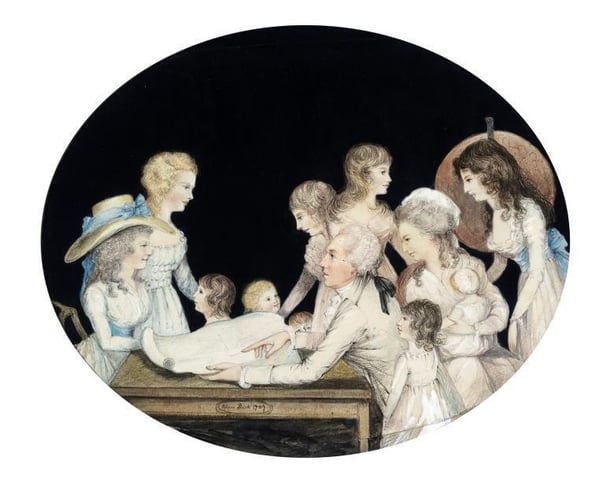
Portrait of the Edgeworth family, 1787 by Adam Buck (1759-1833). Elizabeth is standing between her parents gazing at her sister, Maria. © National Gallery of Ireland.

Many of the diaries that survive were intended for a much wider audience than we might think, and most weren't really private at all. Diary after diary speaks to a current or future audience, addressing unknown potential readers. Elizabeth Edgeworth, the sister of bestselling author Maria, used her diary to contribute to her family legacy and record her view of the 1798 Rebellion. She even provided a glossary of terms for future readers.

Elizabeth Clibborn, a Quaker woman who would go on to have at least 15 children, considered the possibility of her diary being read in future by her own daughters, hoping it might provide them with support and advice if they themselves had children. 'Perhaps my dear girls may in perusing these lines receive some information in rearing their dear offspring if entrusted with any'.

Several of the diarists wrote openly about friendships and grievances, before recalling the likelihood that others could read their words and interpret them in certain ways. Mary Mathew from Co. Tipperary, for instance, wanted to set the record straight about her companion for future readers – 'don't let them imagine from this & some other things I have wrote that we don’t live in the greatest harmony together.’

          Title page for Mary Shackleton Leadbeater 1772 diary. Image courtesy of the National Library of Ireland (NLI MS 9295)

Many women used their diaries as a way to manage their mental health

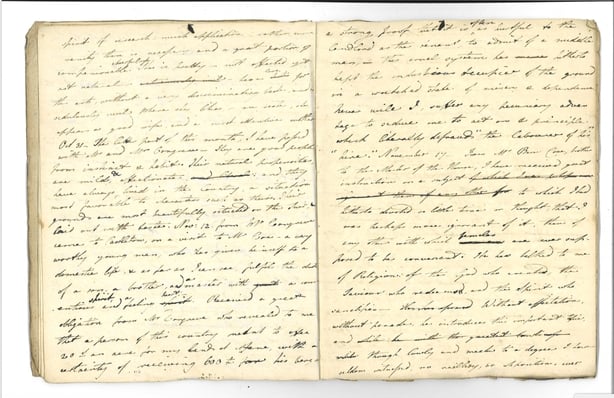
We find multiple instances in the diaries of writers describing themselves as feeling 'pressed down' and suffering from melancholia. Several of the women explicitly used the diaries to try to cope with their emotions and to reduce stress. Anne Jocelyn's diary opens with the explanation that the diary entries were written to 'help to keep off fruitless and unavailing thoughts and give a better employment to my mind'.

Diaries also provided a platform for processing grief. Many were written in response to a diarist’s experience of loss and bereavement, including Jocelyn’s, which began after the death of her husband of over four decades, as well as the short diary of Theodosia Tighe Blachford. The diaries also chart women's experiences of pregnancy, pregnancy loss and infertility, with several also including heartbreaking entries recording the loss of beloved children and babies, such as those written by Melesina Chenevix St George Trench.

Pages from Melesina Trench's diary written during her time in Ireland. Image: Hampshire Record Office 23M93/1/5

Diaries provided testimony when other platforms were unavailable to women

We often encounter the diarists attempting to articulate their experiences of what we'd now describe as harassment and non-consensual touch. We find young women being pulled on to young men’s laps against their will in the diary of Co. Kildare’s Mary Shackleton (later Leadbeater), and others being plied with alcohol, as in the writings of Marianne ffolliott in Co. Sligo.

The diaries gave women a space to set down their own experiences and to give voice to those of others. The diary of Dorothea Herbert records her version of the abuse suffered by her sister Sophia Herbert Mandeville at the hands of Sophia’s husband, drawing on the language of amatory fiction and Gothic novels to convey the horrors of the situation.

Elsewhere, Elinor Goddard's entries employ euphemism in noting William Fownes's pursuit of Sarah Ponsonby (Fownes was her guardian), before Sarah ran away with Eleanor Butler of Co. Kilkenny, the woman who would become her life partner. Butler's own diaries, kept over many years, record the women's lives spent living together in Llangollen in Wales.

Diarists don't always tell the truth

We need to remember that diarists don’t necessarily provide a true reflection of the world around them. The period’s diarists, being largely drawn from women of significant wealth and means, recorded a certain version of the world they lived in. In an Irish context, we can note the absence of references to rural disaffection or unrest, as well as frequent silence on the widespread poverty that existed.

Such descriptions are instead present in the diaries of those women who visited Ireland from abroad, such as Margaret Boyle Harvey and Elizabeth Quincy Guild coming from America, which are filled with reference to poverty and mud cabins. The environments created instead give us an insight into the diarists' vision of their worlds and their perspectives and opinions. They often display great flair in composing their entries, playing with language and frequently emulating the novels they were reading. Rather than considering them exclusively as historical sources, we can approach these diaries as literary works which gave women a space to showcase their own creativity.

Dr Amy Prendergast is the author of Mere Bagatelles: Women's Diaries from Ireland, 1760–1810 (Liverpool University Press)

https://www.rte.ie/brainstorm/2025/0627/1474665-18th-century-irish-women-diaries-elizabeth-edgeworth-dorothea-herbert-melesina-trench/

Tuesday, July 2, 2024

Diaries offer insight into Anglo-Irish life

From southernstar.ie

THE diaries of the daughter of a Skibbereen landlord, Lionel Becher Fleming, have formed the basis of a fascinating new book, which will be launched in Castletownshend this week.

The Memoirs and Diaries of Judith Isobel Chavasse: An Account of Life in West Cork and Waterford (1867-1935) was written by Dr Rachel Finnegan, who acquired the diaries two years ago, after they had lain uncovered for more than four decades. Judith Isobel Chavasse, née Fleming, was born in Ballydevlin in Goleen in 1867 and lived in New Court House in Skibbereen, as well her marital home at Seafield House in Castletownshend, until her death in 1935.

Rachel told The Southern Star she was gripped from the moment she opened Judith’s first diary entry. In 1890, at the age of 23, which began with: ‘Father died a few minutes before the New Year.’

The book chronicles Judith’s childhood and early adult years through her memoirs, written towards the end of her life, and describes her courtship and married life through an almost complete set of diaries from 1890 to 1933. The final two years of her life, when she stopped keeping her diary, are told through the diaries of her husband, Major Henry (Hal) Chavasse (1863-1943), who survived her for another eight years.

Judith Chavasse with her family at Seafield House, Castletownshend, in January 1916. Courtesy: Chavasse Papers.

Judith’s days were deeply intertwined with her extensive circle – the Fleming, Reeves, Townshend, Coghill, Becher, Haythornthwaite, Fitzgerald, Somerville-Large, and Somerville families, including novelist Edith Somerville – and filled with her efforts in parish and war work.

The biography delves into Judith’s personal trials, her struggles with domestic life and ill-health, and her devotion to the grand houses that framed her life story, including her mother’s childhood home – Tramore House in Douglas in Cork – and Whitfield Court in Kilmeaden, Co Waterford, where she lived for the first 15 years of her life and raised four sons (a fifth died in infancy). The story of Judith’s privileged life is set against the backdrop of the turbulent times of the Boer War, the First World War, and the Troubles.

The book will be launched by artist and local historian Margaret O’Dwyer on Wednesday July 3rd from 6.30pm to 8pm, at the Warren Gallery in Mary Ann’s Bar in Castletownshend.

Copies are available from local bookshops or direct from the author and publisher at pocockepress.com.

https://www.southernstar.ie/history/diaries-offer-insight-into-anglo-irish-life-4297720