When Betsy Lerner began her unfiltered readings, she found an unexpected following and a new sense of connection
Betsy Lerner doesn’t see herself as aTikTokstar – though the New York Times described her as one – or an influencer. That means payment and swag – all she’s had is a free pen. “I really do it for myself,” she says, “and for the people who follow me”.
Lerner, 64, has for 20yearsworked as a literary agent for writers including Patti Smith and Temple Grandin. She’s an author of nonfiction and now of a debut novel, Shred Sisters – “a love letter to loneliness”. But the “doing” she’s talking about is on TikTok, where she has amassed 1.5m likes for videos in which she reads from the diaries she wrote in her turbulent 20s.
“You don’t know who you’ll love, who will love you, what you will do for work, what is your purpose,” she says in one post. “This morning I found one line in my diary that just sums [your 20s] up: ‘I feel as if I don’t know who I am, today.’”
Lerner posts in her dressing gown, without makeup. Initially she explored BookTok to support her authors. But with her own novel forthcoming, she started posting, camera off, and got no followers. “A friend told me, you need to be on camera and think of it as your own TV channel … I thought, ‘Well, maybe I will read from my old diaries.’”
She’d kept one from the age of 11, after reading Anne Frank’s The Diary of a Young Girl. “I wrote my first poems in there. I vented. I tried to analyse myself …” Her journals from the ages of 12 to 18 were lost when her car was stolen, but those from her 20s – about 30 volumes – were stowed in a crawl space in her attic.
“My diaries are very sad. They’re all about being lonely, looking for love, looking for friendship, trying to figure out who I was,” she says.
Lerner describes herself as “a late bloomer”. She was accepted on to Columbia’s MFA poetry programme at 26, entering publishing in her late 20s when most editorial assistants were fresh from college. “I didn’t fall in love till I was 30. I’d never had any significant relationships … I lost a lot of my teenage years and most of my 20s struggling with depression.”
‘It’s all about trying to connect and communicate’ … Betsy Lerner, photographed in New Haven, Connecticut. Photograph: Nicole Frappier/The Guardian
When she was 15, her parents had taken her to a psychiatrist, and she had been diagnosed with bipolar disorder. “I didn’t want to accept that I had this illness. I fought it a lot,” she says. Her 2003 memoir, Food and Loathing, documents her relationship with her weight, food, depression and more, and at one point in her late 20s describes her straddling a ledge on a bridge above the Hudson River.
The turning point came at 30. She found a psychopharmacologist – who “figured out” the right lithium dosage (they’ve worked together for 35 years) – and she got married.
Her diaries stopped. She had written them alone in bed at night. But now, “I just didn’t feel that sad and lonely any more”, she says.
For years, Lerner says, “I gravitated toward a lot of intensity.” Now, “I prioritise stability over everything.”
She had never thought she’d write a novel. But in 2019she came through “four very tragic deaths”. She lost her mother, then her teenage niece and nephew, Ruby and Hart Campbell, who were killed by a drunk driver, and her best friend, the writer George Hodgman, who died by suicide. “I still don’t know who I’m grieving for at any given time,” she says.
In the aftermath of these deaths she started to write Shred Sisters, partly inspired by the online workouts – shredding – she and her two sisters did during Covid to take care of each other, and as “a way of working through all of that grief”. She is already writing another novel, and for as long as there is material in the diaries, and there is TikTok, she will continue to share them. “It’s all about trying to connect and communicate,” she says.
“There’s a constant stream of comments from kids in their 20s who identify with my struggles. That’s really what keeps me going. I feel this connection to these kids … I try to say, I felt the same. Hang in. Some heart emojis. Just a little something to say, ‘You’re recognised.’”
For a 73-year-old man who is experiencing memory loss, his many journals are keeping his story alive
"We are important and our lives are important, magnificent really, and their details are worthy to be recorded … our task is to say a holy yes to the real things of our life as they exist.." ("Writing Down the Bones," Natalie Goldberg)
I met my friend Chris Thiem in 1981 at a writers' retreat in northern Minnesota. The retreat was led by Natalie Goldberg and it was called "Writing Down the Bones" which a few years later became the title of Goldberg's bestselling book on writing. Our little group of writers were the original Bones. Goldberg made a big impression on us, and we stayed together as a writing group for many years.
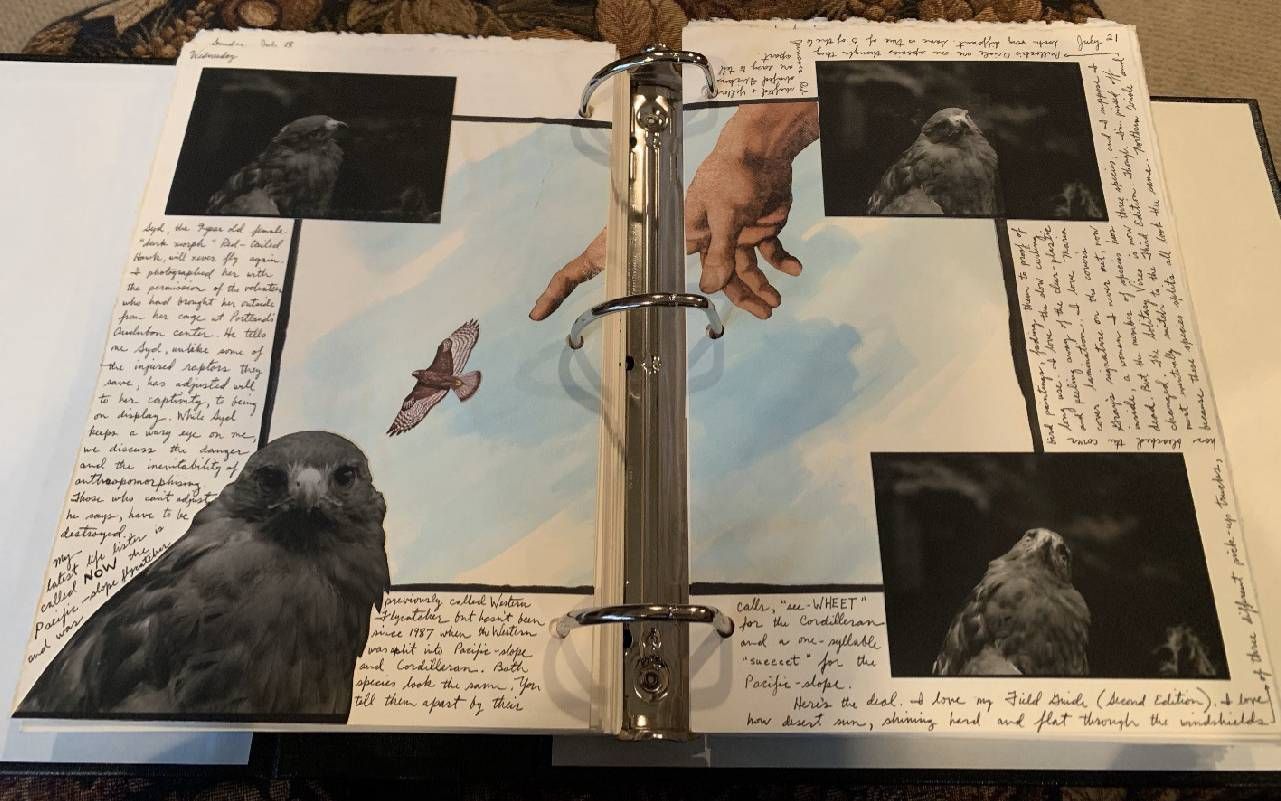
One of Chris Thiem's journal entries | Credit: Dan Gjelten
Chris was a self-described "underpaid teacher of English and a coach in a small Catholic high school" in Mankato, Minnesota. He has lived his entire life in Mankato with the notable exception of his four years at the University of Montana, which he attended on a track scholarship. He was a talented runner and stayed fit his entire life until joints began to deteriorate and limit his activities in his sixties.
I often envied Chris over the years — my life included year-round work and child raising in St. Paul, and I would observe him as he'd take solo road trips in the summers out west (always west – his time in Montana left a permanent love of that landscape) in a pickup that served as a place to sleep overnight. He went there to look for birds and take photos and run the hills. I sometimes wanted to be him - handsome, lean, fast, free. I would receive postcards from his travels with a few lines describing what he was seeing and doing.
"Today I did something out of character. At Nature Conservancy land along the Yampa River, I followed an overgrown path that eventually dead-ended at a rocky point that divided the flow of the Yampa. I was hot and frustrated in my birding. To make the best of it, I stripped off my clothes and slipped into the numbing cold pull of the Yampa. It wasn't until I had my clothes off that I saw the Spotted Sandpiper working a sandbar upriver from me."
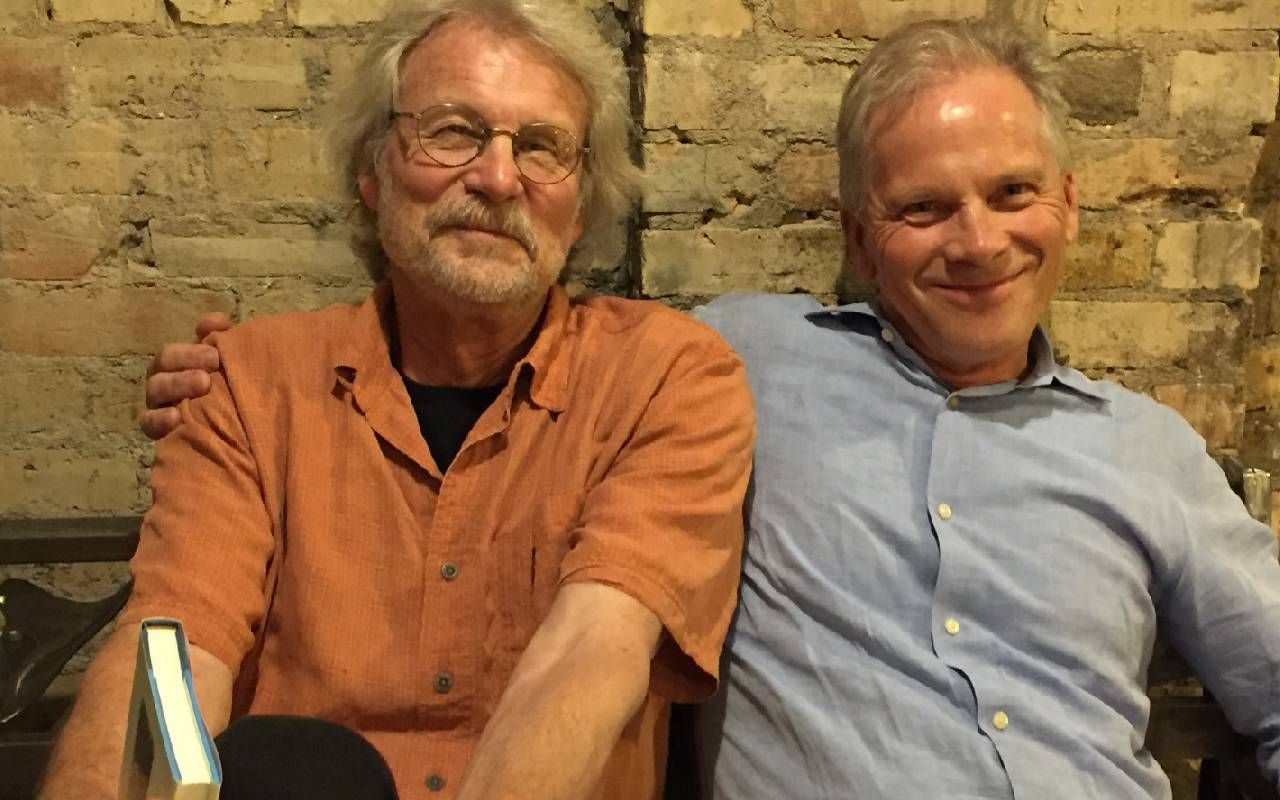
Chris and I have stayed in touch over the decades, corresponding via cards and letters (his photos became postcards) — all of which I've kept — and with regular face-to-face visits. Now at 74, Chris is starting to experience memory loss. That isn't unusual, of course. But my friend is unusual — in many ways, he is both an average guy and a remarkable artist, though he'd only agree with the first part of that description.
Chris Thiem and writer Dan Gjelten | Credit: Lisa Burke
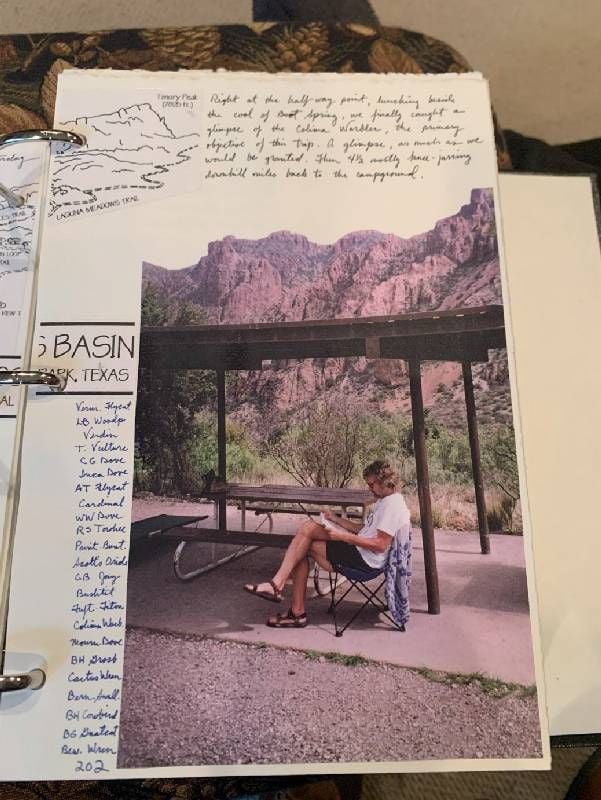
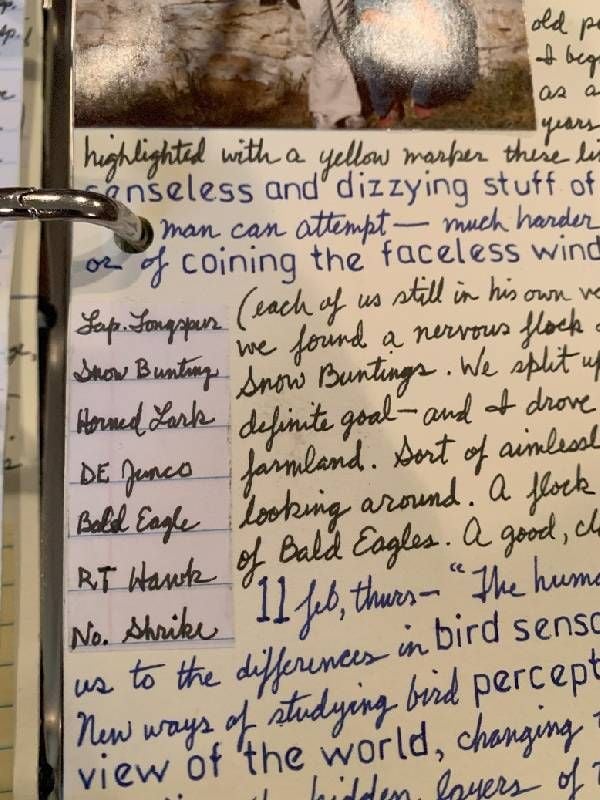
Over the last 25 years, Chris has created ("obsessively" he says) journals which contain his daily writing, quotes from his reading, his photos (processed and printed in his basement darkroom), snippets of letters he's received, his bird lists, keepsakes like diagrams his doctor father made by hand while studying in medical school, his mother's recipe for rice and cheese casserole, a 1974 Track and Field News cover with record setting distance runner Steve Prefontaine, poems, postcards, a cut out from a map of Montana and so much more — the real things of his life — all carefully and artisanally assembled.
Life in 3 Ring Binders
The 3 ring binders (there are 24 of them) are now a physical manifestation of his memories, not just of the last 25 years, but of his entire life. His handwritten words cover the page from edge to edge, sometimes upside down or circling the images. Occasionally, his handwriting changes to a special font emphasizing certain words.
His daily life always, it seems, includes reading (especially poetry) and thoughts of his wife, Patti.
"For the time being, I am reading Helen Vendler's careful explication of selected poems by Emily Dickinson. No predicting the direction my reading will take. Trying also to understand [Robert] Bly's ghazals with, as yet, no definition of what a ghazal is. Suppose I could just enjoy the strangeness of each stanza of three lines. And then, of course, take those 5 pills she brings me in the morning while I sit beneath this lamp and read. Is it true that my life depends on this brief morning ritual? Come to my aid, Emily and Robert!"
And birds! Always lists of birds, an interest that apparently began in his childhood, evidenced by the insertion of an early drawing into the book.
"Here's the deal. I love my Field Guides (Second Edition). I love how desert sun, shining hard and flat through the windshields of three different pick-up trucks have bleached the cover bird paintings fading them to proof of long use. I love the slow curling and peeling away of the clear-plastic cover lamination. I love Maria Gray's signature on the cover's inside, a woman I never met, now dead. But the number of species has changed. The Solitary Vireo is now three species, and I suppose I must eventually switch to the Third Edition …"
Chris started the journals in 1999. I asked Chris recently why he started this decades long project, and he told me "I just wanted to make a book … for myself." At the writers' retreat where we met, we both got in the habit of writing in spiral notebooks — "I was searching - you, too," he said. And the writing "kept us more or less truthful…I wonder if you should be writing about both of us. How friendships happen and last for years. Even, I think, about our weaknesses, what we love, what we didn't get done, why I drifted west in summers, why birds! … maybe it just can't be explained."
Credit: Dan Gjelten
He had no intention that anyone would see his books. (Patti and I have, but few others — until now.) For the record, I have Chris' permission to write this and have tried not to include anything too personal – and they are extraordinarily personal, a record of his life, including his rich inner life.
"Oh! Memory! There's no telling how much I can forget to do…
Chris is clearly proud of the books, though he will often say "they are nothing special" and "no one would be interested in this" and "they are just a way for me to remember, especially the people I have known." He has many deep relationships with friends and old classmates, and many former students continue to write to him and address him as "Mr. Thiem." Even if he says the books are "nothing special," he has taken great care in creating and caring for them. Each notebook is in an archival box, and they are shelved in his office, which is also home to his library of novels and poetry.
He and Patti have recently moved to a different house in Mankato and the desk where he had worked on his journals for years did not fit through the door in the new house, a development he described as "crushing." He told me several times that Patti is getting him a new desk.
Credit: Dan Gjelten
My admiration of his journals leads me to ask what will become of them, as Chris and Patti have no children. "I can imagine they'll be dumped in a fire somewhere," he says - facetiously, I'm sure. I told him the pages could be digitized and preserved — "that's not me" he replies, a man who does not use a computer or a smart phone.
To me, the collection is authentic folk art, creatively and intimately representing a life that has been both outwardly typical but also rich, artistic and literary, which is to say, extraordinary. Chris has lived a life that has been full of thoughtful encounters with nature, art and his students. His journals uniquely document his encounters with words, images, music, friends and the natural world.
Natalie Goldberg taught us that "writers live twice. They go along with their regular life … but there is another part of them that lives everything a second time. That sits down and sees their life again … "
Now Chris sometimes sits in the evening, maybe "sipping something," listening to Van Morrison singing "Madame George" ("the love that loves to love/say goodbye, goodbye"), paging through his journals and reviewing the faces and the landscapes of his past — clear and beautiful, solid and permanent in those pages even as they fade in his memory.