Showing posts with label Franz Kafka. Show all posts

Wednesday, May 1, 2024

What we learn about Kafka from his uncensored diaries

From theguardian.com

On the centenary of his death, a new English translation of the great writer’s journals reveals some surprising details 

After his death on 3 June 1924, a letter was found in Franz Kafka’s office in Prague addressed to Max Brod. “Dear Max, My last request: Everything I leave behind me ... in the way of diaries, manuscripts, letters (my own and others’), sketches and so on, to be burned unread.”

His friend did not honour Kafka’s wishes. “Brod was unshakably convinced of their immeasurable value to contemporary and future humanity, and he was right,” says Ross Benjamin, whose new translation of the Czech writer’s diaries is published in this centenary year of Kafka’s death.

Two months after Kafka died, Brod signed an agreement to publish his friend’s novels. The Trial came out in in April 1925, The Castle in 1926 and Amerika in 1927. The title of the last of these was Brod’s not Kafka’s: in a 1915 diary entry, Kafka had called the novel Der Verschollene (The Missing Person).

Brod later edited a bowdlerised edition of Kafka’s diaries that, for the best part of a century, has been the basis of German editions and the English translation which, overseen by Hannah Arendt, appeared in 1949. Brod removed passages with homoerotic undertones, put a blue pencil through passages about brothel visits, excised unkind descriptions of Kafka’s fiancee, and elided sslurs on those still living, not least Brod himself.

“Kafka’s worldwide reception was shaped by a misrepresentation of what he had actually written,” writes Benjamin in his translator’s preface.

Instead, he reveals Kafka warts and all – as a sexual, troubled, sometimes self-loathing, literary experimenter – and a man more knowingly compromised than Brod thought it proper for his readers to meet.

Here are some of the fresh details that can add to our understanding of the author of Metamorphosis.

Dabbling in nudism

During a stay at a nudist sanatorium, Kafka notes that he stands out among the naked men by keeping his swimming trunks on. “I’m known as the man with the swimming trunks”. Finally, he ditched even those in order to be sketched, writing an entry that Brod trimmed: “Served as a model for Dr Schiller. Without swimming trunks. Exhibitionist experience.” Such modesty, Benjamin surmises, might have been because of shyness, or to do with being circumcised, but not because of the thesis advanced in Alan Bennett’s play Kafka’s Dick, that he had a small penis. Benjamin says: “He writes a lot about his body and his discomfort with his body (unusually tall for the time period, not an ounce of fat, etc) but not about his penis.”

Homoerotic observations

At the same nudist sanatorium, Kafka described “2 beautiful Swedish boys with long legs, which are so formed and taut that one could really only run one’s tongue along them”. Brod rendered the passage thus: “Two handsome Swedish boys with long legs.” And then there is this, Kafka’s description of a fellow train passenger, that Brod saw fit to delete: “His apparently sizeable member makes a large bulge in his pants [ie trousers].” For all that, it’s not yet the moment to dust off those “Uncensored diaries reveal gay Kafka” headlines, counsels Benjamin: “Perhaps the most that such passages tell us is that Kafka was capable of admiring and – at least imaginatively – desiring male bodies.”

          Photo of Franz Kafka on his grave at the New Jewish Cemetery, Prague. Photograph: Radim Beznoska/Alamy

Brothel talk

During one visit, Kafka noted a girl by the door, “whose scowling face is Spanish, whose putting her hands on her hips is Spanish and who stretches in a bodice-like dress of prophylactic silk. Hair runs thickly from her navel to her private parts.” Brod omitted the last sentence, which perhaps says more about his than Kafka’s erotic compunctions.

In a later entry, Kafka is among congregants at Prague’s Altneu synagogue on the evening of Yom Kippur when he notices the family of the owner of the brothel he visited a few days earlier. Brod’s editing of this entry – losing the name of the brothel – distorts Kafka’s meaning. “Where Kafka unflinchingly implicated himself in the impurity and false piety he found in the synagogue, “ says Benjamin, “the retouched text portrays Kafka was judging the other congregants from a loftier, less compromised position.”

Internalised antisemitism

Between 1911 and 1912, Kafka attended more than 20 performances by a travelling Yiddish theatre troupe, befriending one of the actors, Jizchak Löwy. In this, Kafka stood out against the prejudice of assimilated German-speaking Jewish bourgeoisie like his father towards impoverished, Yiddish-speaking Jews from the east. One diary entry Brod excised reads: “Löwy – My father about him: He who lies down in bed with dogs gets up with bugs.” Benjamin points out that such antisemitic tropes to do with hygiene, insect infection not to mention comparisons with animals, resurface in Kafka’s fiction. Hence Gregor Samsa waking up as a giant insect in Metamorphosis.

Brod cut another entry in which Kafka implicates himself in his father’s prejudices “L. confessed his gonorrhoea to me; then my hair touched his when I leaned toward his head, I grew frightened due to at least the possibility of lice.”

Contempt for his fiancee

“If F. has the same repugnance for me as I do, then a marriage is impossible,” wrote Kafka in an entry Benjamin has reinstated. The woman in question, Felice Bauer was twice engaged to Kafka before he, suffering symptoms from the tuberculosis that would kill him, broke it off with her in 1917. Brod kept many disobliging diary entries about Bauer, such as this one: “Bony, empty face that wore its emptiness openly. Bare throat. A blouse thrown on. Looked very domestic in her dress although, as it turned out, she by no means was. (I alienate myself from her a little by inspecting her so closely ...) Almost broken nose. Blonde, somewhat straight, unattractive hair, strong chin.” However, he cut one passage in which Kafka said she looked like a maid.

Workplace ennui

One day while working at the Accident Insurance Institute, Kafka found himself struggling to find a word for a bureaucratic report. In the diary he wrote: “At last I have the word ‘stigmatise’ and the sentence that goes with it, but still hold everything in my mouth with a feeling of disgust and shame as if it were raw meat, cut out of my own flesh (so much effort has it cost me). At last I say it, but retain the great horror that everything in me is ready for a literary work and such a work would be a heavenly dissolution and a real coming alive for me, while here in the office for the sake of so wretched a document I must rob a body capable of such happiness of a piece of its flesh as being like robbing his body of a piece of its flesh.”

What is Kafka up to in this suppressed passage? “He’s self-dramatising, perhaps with some degree of comic hyperbole,” says Benjamin, “and at the same time elaborating on an image that becomes part of his literary repertoire, the poetics of (often tortured and butchered) corporeality we find throughout his work.”

The literary process

Brod removed Kafka’s first great short story, The Judgment, from the diaries. This tale reverses the natural order by having a toothless, decrepit father throwing off his bedclothes and sentencing his son to death. Benjamin reinstates the story, which now sits alongside an entry expressing Kafka’s elation at writing it in a single sitting on 22 September 1912. It represented for him “the total opening of body and soul,” in which “the story evolved as a true birth, covered with filth and slime.”

Where Brod was convinced the function of a diary was therapeutic, involving the expulsion of the intolerable on to paper (“When you keep a diary you usually put down only what is oppressive or irritating,” he wrote in his postscript). Benjamin reckons Kafka was doing something more literary. It was “one of the places where he transformed what he called “the tremendous world I have in my head” into literature.

Brod’s vanity

“Although I have used the blue pencil in the case of attacks on people still alive, I have not considered this sort of censorship necessary in the little that Kafka has to say against myself,” wrote Brod in his postscript to his edition of the diaries. But a passage reinstated by Benjamin reveals otherwise. Kafka noted that a Berlin reviewer called the novelist Franz Werfel “far more significant” than Brod, and that Brod “had to strike out this sentence before he brought the review to the Prager Tagblatt [a Prague daily newspaper] to have it reprinted.” None of this appears in Brod’s edition.

Finally, I asked Ross Benjamin what he would have done if he had been Max Brod. He says he wouldn’t have burned anything either, and adds that Kafka had put his great friend in “a terrible bind”. “He knew the friend he was instructing to do this was the person least likely to be able to bring himself to do it,” says Benjamin. “From the time they met as university students, Brod had recognised his genius, championed his work, prodded him to publish against his own resistance, and been instrumental in the publication and promotion of his work while he was alive. And so giving Brod this task could be seen as a crowning act of ambivalence by the genius of ambivalence we know Kafka to have been.” Just possibly, Kafka made his request knowing it would go unhonoured.

Sunday, November 19, 2023

Kafka’s diaries: a chronicle of suffering

From thearticle.com

By Jeffrey Meyers

Franz Kafka belongs with the great diarists: Samuel Pepys, James Boswell, Goethe, Virginia Woolf, Anne Frank and Sylvia Plath.  His Diaries (Schocken, $45/£38), newly and expertly translated by Ross Benjamin, provide the deepest insights into his tormented character and complex fiction.  Benjamin notes that the surviving diaries consist of “twelve quarto notebooks and two bundles of loose paper filled with dense handwriting, crossings-out, corrections, and insertions squeezed in wherever possible.”  Kafka wrote, “an advantage of keeping a diary consists in the fact that one becomes aware with reassuring clarity of the transformations one incessantly undergoes.”  Yet his diary both confirms his existence and undermines his confidence: “I’m moved by reading the diary.  Is the reason for it that now in the present I no longer have the slightest certainty?”

Virgil had asked friends to destroy his unfinished poetry, Auden had asked friends to destroy his private letters, and their wishes, like Kafka’s, were wisely ignored.  But Kafka’s reputation is not based on what he actually wrote.  Max Brod, his closest friend, was more famous than Kafka in their lifetime, but is now largely forgotten except for his role in rescuing, editing, distorting, rewriting and publishing Kafka’s work.

For example, Brod not only deleted Kafka’s statement that Franz Werfel was a far more significant writer than Brod, but also struck out any hint of homoeroticism: “His apparently sizeable member makes a large bulge in his pants” and “2 beautiful Swedish boys with long legs, which are so formed and taut that one could really only run one’s tongue along them.”  Benjamin’s edition corrects Brod’s distortions and restores the original text.  Though Benjamin does not translate German titles, quotations and poems, nor provide a useful glossary of the main characters, his explanatory notes are useful and he’s tracked down the most obscure references.

Kafka’s main subjects are his oppressive father, poor health, sexual frustration, agonising relations with his fiancée Felice Bauer, comic scenes, embryonic stories, inability to write, extreme misery, fears of torture and execution, and longing for death.  He lived in the cultured city of Prague and was bilingual in German and Czech.  He was well educated and did important work as an expert lawyer in an insurance company.  Handsome and amusing, popular with men and attractive to women, he led a comfortable life in his parents’ middle-class home, and was adored by his mother and sisters.  But he also suffered intensely from noise at home and in the street; from constipation, headaches, insomnia and depression; from his father, office work and duties in the unhealthy family asbestos factory that kept him from writing; from impossibly high literary standards that he could not meet—and from his own tortured personality.

He does not mention (as one might expect) Spinoza, Schopenhauer, Nietzsche, Mann or Rilke.  He has enticingly brief references to the perfectionist Flaubert and to the emotional extremists he most admired. Here is Kierkegaard: “As I suspected, despite essential differences his case is very similar to mine at least he is on the same side of the world.  He confirms me like a friend.” And Dostoyevsky: “so reminiscent of my unhappiness. . . . His designation of mental illness is nothing but a means of characterisation.  The Karamazov father is by no means a fool but rather a very clever, albeit wicked man who is almost Ivan’s equal.”

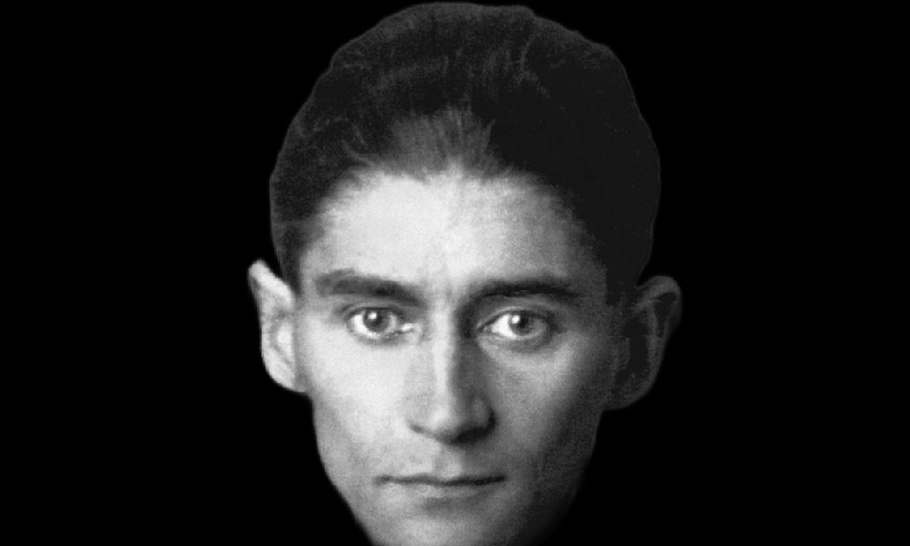
                                                        Image using the last known photograph of Franz Kafka, Most likely taken in 1923

Kafka includes almost nothing on music and art, but he attends many lectures and is very keen on Yiddish theatre.  Always self-absorbed, he’s strangely indifferent to the outbreak in August 1914 of the Great War that would destroy the Austro-Hungarian Empire: “Germany has declared war on Russia.—Swimming school in the afternoon. . . . To those who are fighting, I passionately wish all evil.”  In December he laconically adds: “The defeats in Serbia, the senseless leadership.”

Kafka often writes about not writing instead of writing what he wanted to write.  One entry reads: “Wrote nothing.”  He had to suffer in order to create, but couldn’t always suffer enough.  His stories describe bursts of irrational behaviour that were forbidden in his strict hierarchical society.  His minutely detailed observations are modelled on the logical deductions of Sherlock Holmes.  Kafka’s style is exact, precise, incisive; his clarity is pristine, his meaning obscure.

He gets annoyed when his father boasts about his own childhood suffering: “For years, due to insufficient winter clothing, he had open sores on his legs, he often went hungry, when he was only ten years old he had to push a cart through the villages even in winter. . . . The fact that I haven’t suffered all this permits not the slightest conclusion that I have been happier than he, that those sores on his legs entitle him to be arrogant.” His father wounded him out of love and intensified Kafka’s guilt.  In his forties, he still feared his father and skipped dinners to avoid confronting him.

The Diaries include his entire story “The Judgment”, in which a father’s accusations drive his son to commit suicide by throwing himself off a bridge.  Other entries suggest “the only solution is a leap out the window” or a soft-landing: “jump down from the high window, but onto the rain-soaked ground, where the impact won’t be deadly.”  Kafka describes the difficult parturition of this story as “a veritable birth covered with filth and slime”.  When he read the story to friends, “my hand moved around uncontrollably and genuinely before my face.  I had tears in my eyes.”

Even before he was diagnosed with tuberculosis in 1917, the hypochondriac Kafka despaired about his body and associated it with shame and misfortune, with ugliness, dishonour and sadness: “There’s no doubt that a main obstacle to my progress is my physical condition.  With such a body nothing can be achieved.  I will have to get used to its perpetual failure.”  He experienced psychological as well as physical pain and displayed his sores like a leper: “my eyelashes trembled in my face, in the left corner of my forehead I felt a tension as from a painless gunshot. . . . The tension that often lies over the left half of my skull feels like an inner leprosy.”  Always sensitive to disease, while travelling in Italy in September 1911 he noticed the cholera epidemic that killed the hero of Thomas Mann’s Death in Venice that year.

The severe coughing fits that made Kafka double up with pain and his first tubercular haemorrhage in July 1919 forced him to confront reality and retreat to a sanatorium.  But he distrusted the incompetent and infuriating doctors, who were “so ignorant of healing that they stand like schoolboys before the sickbeds”.  There was no cure for his disease until the 1940s, and the serums, vaccinations and operations were worthless and even dangerous.  He grimly concluded, “I cannot count the doctor as a humanly personal helper.”

So he desperately and rather pathetically turned to naturopathy, which included nudity, air baths and vegetarianism.  His mother whimpered like a cat when he didn’t eat enough and he raged against her intolerable nagging.  A picky eater among the greedy German-Slavic Wurst-Fresser, he was disgusted by raw meat, as if it were cut out of his own flesh, yet perversely craved the very thing he loathed and wanted to devour it like an animal: “If I see a sausage labeled as an old hard Hauswurst, I bite into it in my imagination with all my teeth and swallow quickly, regularly and heedlessly like a machine.”  A slab of Wurst made him ecstatic and he dreamed of “the biting into and simultaneous licking of the unpeeled salami stump.”

Most of Kafka’s sexual descriptions are squalid.  But one saucy wench flattered him as if he were a cute girl: “Oh, if only I could see you naked one day then you must be especially pretty and kissable.”  He was impressed by the potency of a man who told him “how he must slowly stuff his large member into the woman.  His trick in earlier days was to exhaust the women until they couldn’t go on.  Then they were without a soul, animals”—completely passive and subject to his will.  Kafka’s curious friend questioned a woman in the same way the priest had questioned Molly Bloom to get vicarious pleasure in Ulysses: “How was it?  I want to know down to the last detail.  Did he only kiss you?  How often?  Where?  Didn’t he lie on you?  Did he touch you?  Did he want to take off your clothes?”

In the bordello he notes intimate and crude details: “Hair runs thickly from her navel to her private (or not so private) parts.”  He’s fascinated by the  brusque behaviour of a repulsive but serviceable whore: “The only woman suitable for him is the dirty, oldish complete stranger with wrinkled thighs, who extracts his semen in an instant, puts the money in her pocket and hurries into the next room.”  In a passage from America, a graphic moment of aggressive foreplay disgusts the protagonist, Karl: “she shook him, listened to his heart, offered her breast for him to listen to hers, but couldn’t get Karl to do so, pressed her naked belly against his body, searched with her hand, so disgustingly between his legs, then thrust her belly against him several times, he felt as if she were part of him and perhaps for that reason a terrible helplessness had seized him.”  Venereal disease always threatened to punish the fornicator: “Fear of infection, he kissed her down below, even now he sees himself decaying.”

Kafka’s love for Felice Bauer, a successful Berlin businesswoman whom he met in Prague, was also a symptom of his disease.  The promessi sposi were engaged and disengaged in 1914, and repeated this wretched pattern in 1917.  The first impression of his heart’s desire was quite negative: she actually seemed repulsive.  She looked like a maidservant, had a bony empty face, an almost broken nose and stiff charmless hair.  She had the gall to correct his Austrian German and rudely called his sisters “shallow.”  He never experienced with her, as he had with other women, the sweetness of a beloved, “only boundless admiration, subservience, sympathy, despair and self-contempt”—all lethally combined with what he considered her fear of and disgust for him.

The unsuitable suitor Felice was a withdrawn, taciturn, dissatisfied person, horrified by the idea of happiness, who foresaw only lasting and hopeless misery.  He was unable to force her to accept his abysmal opinion of himself, felt guilty about his inability to marry her and the unhappy years she’d suffered on his account.  He confessed, “I have done the wrong for which she is being tortured and moreover wield the torture instrument.”

Striving to be logical rather than emotional, he compiled a list of arguments against marriage.  He had to spend most of his time alone; he could not live with anyone; he feared a wifely connection would swallow him up; the sight of nightshirts on his parents’ bed suggested sickening sex; he hated everything (including Felice) that didn’t relate to literature; marriage would prevent him from giving up his office job and devoting himself entirely to writing.

Even if she loved him—and did she?—he didn’t deserve her devotion.  He confessed, “I love her, as far as I am capable of it, but this love lies buried to the point of suffocation under fears and self-reproaches.”  In a self-condemnation that denied the Joy of Sex, he famously declared, “Coitus as punishment of the happiness of being together.”  One escape route was suicide, though he wouldn’t blame her even if “the apparent immediate cause of it should be F.’s behavior.”  Finally, and most cruelly, he compared Felice to his fatal bacilli: “the lung wound is the symbol of the inflammation which is called Felice.”

Unlike most lovers, Felice inhibited rather than inspired Kafka’s writing.  Despite her distractions, he tried to recapture his dreamlike inner life and strived for the clarity that made ordinary events seem mysterious.  Writing for Kafka was both a liberation and a punishment that made him feel as if a wild beast were waiting to devour him: “I will jump into my novella even if it should cut up my face. . . . [There’s] the tremendous world I have in my head.  But how [can I] free myself and free it without being torn to pieces?”  When he finally managed to complete a work he immediately saw its imperfections, its stunted and irremediable defects.  He read “In a Penal Colony” aloud and was “not completely dissatisfied, but for the blatant ineffaceable flaws.”

Yet surrealistic comedy often burst through and relieved his pervasive gloom.  He delighted in real weird names: Tschisik, Utitiz, Shhite.  He wanted to ascend a flight of stairs with somersaults.  An old wooden ruler had the same edge as a bumpy country road.  A moment of intimacy was interrupted by fear of vermin: “May Bettina rest her head on your arm?  If Bettina has no lice.”  Diners who carelessly ate a finely prepared roast cat began to meow after the meal.  During a deadly reading of inferior stories, “people kept leaving one by one as if another reading were being given next door.”

The writer provoked a stampede by threatening to read yet another story and announcing a five-minute intermission.  He then “read a fairy tale that would have entitled anyone to run from the farthest point of the hall straight through and over all the listeners.”  Kafka’s excited family announced the birth of a grandson “as if the baby had not only been born but had already led an honourable life and had its funeral.”  But mirth could not move a soul in agony.

Kafka includes long excerpts from his unfinished novel America and records many themes that evolve in his fiction.  Like the character in the story “A Hunger Artist”, a man “is constantly starved, only the moment belongs to him, the perpetually continued moment of torment.”  Like the underground man in “A Burrow,” he burrowed away in his shelter, “dug a hollow in the sand in which he felt quite comfortable. . . . But all the preparations he was making to secure the hut against the animals and keep himself safe for the winter had to be abandoned.”  Like the parable “Before the Law,” “It had been impossible for him to enter the house, for he had heard a voice saying to him, ‘Wait until I lead you.’ ”  He foreshadows “The Metamorphosis” with this: “I myself have a strong capacity for transformation, which no one  notices” and “can only creep onward no better than an insect.”

Passages foreshadowing The Trial emphasize Kafka’s feeling of complete helplessness as if he were imprisoned behind locked doors.  He fears “we are outside the law, no one knows it and yet everyone treats us accordingly.”  Though weak, he must defend himself against the prevailing injustice.  A harsh verdict is handed down, “but one should still keep in mind that the first judgment always stands on shaky ground and that one should not let it perhaps muddle all future judgments.”  Nevertheless, the strange but severe penalty is carried out: “the man condemned to death is stabbed there in his room by the executioner without the presence of other people.”

Kafka experienced both a demonic need to create with an inability to write, and expertly analyses his sterility without finding a solution to his dilemma.  Goethe’s great achievement, instead of liberating him, “permeates me and keeps me from doing any writing.”  Anxious and restrained, he lacks sufficient time, is always under pressure, rarely starts anything and finishes nothing.  When he manages to write, his sentences are dry, broken off and unusable.  Everything is fragmentary and worthless, and he feels “condemned to this inferiority by the circumstances of his life.”  He crosses out most of his work and puts it aside for a more propitious time that never comes.  As “a screeching ink-spraying [not-ink-flowing] stroke goes through the whole thing,” the tubercular compares his “wicked, pedantic, mechanical [stories] to an only barely breathing fish on a sandbank”—destined for a slow and painful death.

For Kafka, a specialist in self-torment, life was a perpetual Yom Kippur, a Day of Atonement.  Open his heart and you would see ’graved inside there Misery.  The perpetual alien is a Jew among gentiles, a German among Czechs, a tubercular among the healthy, an outsider even in his own family.  He whimpers like a sick cat, wants to be dissatisfied, can’t resist the tiniest worries and “nervous states of the worst sorts dominate him without cease.”  All his undertakings end in misfortune, and he’s trapped as his wretched life “flashes before his open eyes with steel colours, with taut steel bars and airy darkness between them!”  Echoing Christ’s last words on the Cross, he laments “the pain over my forsakenness that came into me so piercingly and forcefully.”

As his via dolorosa continues, Kafka finds it impossible to sleep, remain awake or endure life.  He suffers weakness, longs for self-annihilation and feels the “tip of the flame of hell penetrating the floor” and ready to thrust him among the eternally damned.  He feels a strange dissociation between his external self and his real creative being, “the terrible uncertainty of my inner existence.”  His most famous aphorism doubts his essential identity and recalls Rimbaud’s “Je est un autre” (I is someone else): “What do I have in common with Jews?  I have scarcely anything in common with myself and should stand completely silent in a corner, content that I can breathe.”

Suffused with a permanent agony that verges on the comic, Kafka assumes vicarious power and punishes his guilt as both torturer and victim: “A large old knight’s sword with a cross-shaped hilt was stuck in my back to its handle” and “a spike crookedly jutted out of my shattered forehead.”  The coup de grace, as in Nineteen Eighty-Four, is self-created: “rats that tear at me and that I multiply with my gaze.”  The torments continue as he’s pulled through the “window of a house by a rope around the neck and yanked up, bleeding and tattered, through all the ceilings.”  Gagged, bound and tortured, he’s finally “stabbed deeply with something sharp, surprisingly here and there, wherever their whim prompted.”  The masochistic Kafka enjoys the self-inflicted punishment for his indelible guilt: “the pleasure again in imagining a knife twisted in my heart.”

The only escapes from these endless torments are insanity, suicide or death.  He could never hope to do what he believed he was required to do and, feeling quite worthless, was prepared to die at any moment: “Dying would mean nothing but sacrificing a nothingness to nothingness.”  He’d nearly obliterated himself while still alive, and told Max Brod that “on my deathbed, provided the pains are not too great, I will be very content.”  As Kafka lay dying, he told his last doctor, “Kill me, or else you are a murderer!”

https://www.thearticle.com/kafkas-diaries-a-chronicle-of-suffering 

Saturday, June 10, 2023

‘All I am is literature’ – Franz Kafka’s diaries were the forge of his writing

From theconversation.com

By Linda Daley

Picture the scene. It is the closing years of the Austro-Hungarian empire, before the Great War changed such scenes forever. A young man with sound prospects is to meet his fiancée’s father for the first time.

The convention of the day would require him to lay out his credentials and his family’s pedigree for the match to proceed agreeably. But in response to the imagined and real interrogation, both of which generate feelings of guilt and shame about his intentions, the young man instead declares to his prospective father-in-law, by way of a letter: “All I am is literature, and I am not able or willing to be anything else.”


The Diaries – Franz Kafka, translated by Ross Benjamin (Shocken)


Franz Kafka (1884-1924) was nearly 30 years old and engaged to Felice Bauer when he made this exorbitant claim. It was the first of three engagements: twice to Felice and later, quite briefly, to Julie Wohryzek. The decision to put his thoughts in a letter was entirely consistent with the epistolary nature of his relationship with Felice. They saw each other infrequently during their four years together.

Notably, Franz did not declare to Herr Bauer: “I am a lawyer working for a workers’ insurance company, but my real passion is fiction writing.” Nor did he say: “I have a responsible and reasonably well-paying day job, but spend my nights writing stories in my parents’ apartment in Prague where I live.” Missing was the schmoozing of: “Literature is my primary interest – along with your daughter, of course.”

Each of these statements would have been true, although none would have struck the same kind of truth as his actual declaration – to himself as much as to his addressee – that he was, as he wrote in his diary, “nothing but literature”.

The letter to Herr Bauer never arrived. Felice intercepted it.

Uncanny writing

What Kafka expresses in the letter is a commitment to something other than a life to be lived and shared with Felice, something other than what today would be called a lifestyle. As his dairies repeatedly show, Kafka’s life, his existence, was literature, and that existence was not shareable as a “lived experience”.

He was often in pain, fatigued, or simply distressed by his body’s puniness. He despaired of the obligations of family life, the noisiness and nosiness of his parents and siblings. He was deeply conflicted by the necessity to undertake the paid work that sapped his energy. Each of these things he saw as challenges, counter forces, to his writing.

Yet this hardworking, clever, funny and eventually chronically ill young man was not a hermit. He had friends, admirers, colleagues and lovers aplenty.

Kafka’s sensibility was aslant to the conventions of bourgeois life, but it chimed with a certain European modernity that was, around that time, expressing its disenchantment with the world. His existence was entirely directed towards what was, for him, both the necessary and the uncanny nature of writing.

For Kafka, writing was a strange way of thinking and being in the world. It was a force to which he could only submit, an existence that joined up with and tore away from his own. It was so much more than a mode of expression. It was more than an activity undertaken to build the kind of literary legacy that his friend and fellow writer Max Brod (1884-1968) desired for him.

Felice and her father each recognised this paradoxical relation to life in Kafka. In his diaries, describing the “tribunal” where his engagement to Felice was broken for the first time, Kafka noted: “Her father grasps it correctly from all sides.”

                                                               Franz Kafka, 1923


Kafka’s literary legacy

In 1917, Kafka was diagnosed with the tuberculosis that would eventually kill him just before his 41st birthday. The small number of stories he published during his lifetime amounted to no more than 300 or so pages. The most well-known are The Judgement (1913), The Stoker (1913), The Metamorphosis (1915) and In the Penal Colony (1919).

Brod became Kafka’s literary executor. He managed the posthumous publication of his friend’s three incomplete novels The Trial (1925), The Castle (1926) and The Man Who Disappeared (1927) – also known by the title Amerika. He also took possession of the 12 notebooks that constitute Kafka’s “diaries”, bundles of papers, and some letters.

Kafka’s instructions were to burn the lot. Brod’s refusal has long been the subject of speculation.

Perhaps more than those of any other published writer, the diaries of Franz Kafka have a special value in providing insight into his modest but profound literary output. Ross Benjamin’s new translation of Kafka’s dairies makes available the German critical edition published in 1990, which corrected the elisions, amendments and misrepresentations in the edition Brod published as two volumes in 1948 and 1949.

What a joy it is to read Kafka disentangled from Brod’s oversight. But why was he entangled in the first place? Kafka was hardly a household name during the mere 15 years he was publishing, beginning with The Aeroplanes at Brescia, which appeared in the Prague newspaper Bohemia in 1909. It was another four years before his short fiction began to appear in print.

Kafka was aware of the limited interest in his writing beyond a small group of loyal supporters, at the centre of which was Brod. This was confirmed in an embarrassing episode when the well-known Czech writer Carl Sternheim, with whom Kafka shared a publisher, was awarded a literary prize, but directed his publisher to hand the prize money over to Kafka on the presumption that Kafka was impoverished.

Kafka initially refused the money because he felt it was being bestowed by someone unfamiliar with his work to avoid the bad optics of the prize going to an already wealthy author during wartime. Publicly, he said he was not as poor as the poorest eligible writer. Privately, he called it an act of misplaced charity, although he did eventually accept the money. Without any immediate need of it, he invested it in war bonds. It was the only literary honour Kafka would receive during his lifetime.

Kafka’s publisher Kurt Wolff was a keen supporter of his writing. But when war broke out in 1914 – just as Kafka’s writing was hitting its straps – Wolff enlisted.

The publisher to whom Wolff handed the management of his business, Georg Heinrich Meyer, was also enthusiastic about Kafka’s writing. But according to Kafka’s biographer Reiner Stach, Meyer was probably quite ignorant of its real worth. Meyer had a background in the business side of publishing; he showed little interest in cultivating relationships with authors or discussing the literary content of their work.

It thus fell to Brod to establish Kafka’s posthumous legacy as a literary genius. He ensured that few would now question Kafka’s place in the pantheon of modernist writers. But in doing so he tightly entwined his own literary reputation with that of his friend.

He did this in his own writing, first in a fictionalised account of their friendship, The Kingdom of Love (1928), in which Kafka is figured by the character Richard and Brod by the character Christof. Brod also wrote an “objective” biography of Kafka (1937), in which he states:

I lived still with my unforgettable friend […] I asked him questions and could answer myself in his name.

Brod’s writings about their friendship established a mythologised Kafka, who lived on, fictionally and biographically, through Brod’s name. His influence over Kafka’s estate was not simply one of editorially securing the works’ publication. In a short story collection, Brod included an appendix guiding readers on how to interpret the stories, believing only he held the key to unlocking the meaning of the genius’s work.

A forge for sentences

Ross Benjamin acknowledges that Brod’s relationship with Kafka was valuable in securing an international reputation, beyond the small and enthusiastic readership he had while he was alive. But this also meant Kafka’s reception was influenced too heavily by Brod’s concern with his own reputation.

Benjamin’s new translation of Kafka’s diaries, in their presentation and arrangement, enables English readers to see them, for the first time, as the forge of his craft. It builds on the German critical edition, as well as decades of work by many scholars. We can now read in the diaries Kafka the writer rather than Kafka the author.

Restored is the sentence craft as it was being forged, smithy-like, across the 12 quarto and octavo notebooks that Kafka called his Tagebücher (diaries), written between 1909 and 1923. Restored are the frequently ungrammatical and sometimes half-legible sentences that Brod often completed or replaced with the syntax of High German. Restored are the homoerotic observations, descriptions of visits to brothels, and negative comments about well-known people, including the odd barb directed at Brod himself.

Most pleasurably, the new translation restores our sense of proximity to the pen and ink. It allows us to experience the falling off and starting again of sentences, the sometimes awkwardly expressed passages, the unreadable words due to ripped notebook pages, and the arresting effect of marooned and perfectly complete passages that are reforged across several pages.

Consider the following being hammered and shaped in the early drafting of the story Description of a Struggle:

You I said and gave him a little push with my knee (with this sudden burst of speech some saliva flew out of my mouth as a bad omen) don’t fall asleep.

The same sentence is repeated, word for word, many entries later. But on that same notebook page quotation marks are toyed with and a sentence is added:

“You” I said and gave him a little push with my knee (with this sudden burst of speech some saliva flew out of my mouth as a bad omen). I haven’t forgotten about you he said and shook his head even while opening his eyes.

In an entry that begins “He seduced a girl in a small town in Isergebirge”, we learn from the critical note attached to it – one of 1,400 meticulously detailed notes – that the passage is likely crafted from direct observation during one of Kafka’s work travels, and that it possibly builds upon an actual liaison he had with a young woman (referred to as G or W, the notes tell us) during those same travels. A little later, we read:

Nothing, nothing. In this way I make ghosts for myself. I was involved, even if only slightly, solely in the passage […] For a moment I thought I saw something real in the description of the landscape.

What matters more than the status of the seduction passage – whether it is a sliver of fiction or a sliver of Kafka’s life – is the feeling we have of being just behind Kafka’s shoulder watching him re-read and re-evaluate what he has written.

The diaries include writing in a variety of genres: descriptions of theatrical performances, recollections of dreams, fiction tryouts, reviews, observations of other people, annotations of other writers’ work, essays on various topics. Combined with the lack of signposting, the effect is that the writer’s “I” is disaggregated and distanced from the writing. Notice the displacement in this entry, for example:

A person who has no diary is in a false position in the face of a diary. When, for example, he reads in Goethe’s diary that on 11 January 1797 the latter was busy at home all day with various arrangements, it seems to this person that he himself has never done so little.

It is often unclear in the notebooks whether the “I” or the “he” that announces itself on the page is Kafka, or one of his characters, or someone he is ventriloquising. The dairies require us to suspend our familiar habit of asking who is speaking and trying to place who is being referred to. Instead, it becomes necessary to focus on the image the passage brings alive.


The law of the diary

It is striking to hold the two editions of Kafka’s diaries alongside each other to see how the new translation, in reclaiming the liveliness of the writing, also produces the occasional discombobulation that results from his writing practices.

Kafka frequently returned to old notebooks to make entries after new ones had been started. This criss-crossing is reproduced in the new edition, which is organised by notebook, not by year as in the Brod edition.

Reading naturally goes forward. This parallels the way we habitually think of the movement of a life and its recording in a journal. With the criss-crossing of entries across the notebooks, however, the reader’s attention needs to be sharp. Where a life or a book might move in a one-way direction, the craft of writing does not. Kafka’s notebooks reflect the flux of writing, faithfully restored in the new translation.

Maurice Blanchot tells us the only “formidable law” of the diary is that it must respect the calendar. To note the date, Blanchot says, is to record the passing of time and provide the illusion that the writer lives twice: once by warding off forgetfulness and the despair of having nothing to write; twice by noting that they are writing in their diary about having nothing to write.

Frequently, Kafka abides by this law:

Wrote nothing […] Wrote almost nothing […] Awful. Wrote nothing today. No time tomorrow.

Within a few weeks, however:

This story “The Judgment” I wrote at one stretch.

And later still:

It has become very necessary to keep a diary again.

As the notebooks start increasing, the dating falls away, transgressing Blanchot’s law completely.

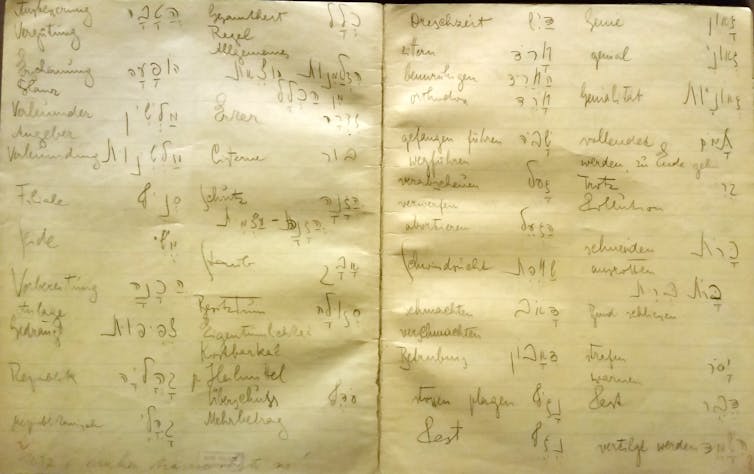
Pages from one of Kafka’s notebooks with words in German and Hebrew. National Library at Givat Ram, Jerusalem/Wikimedia Commons


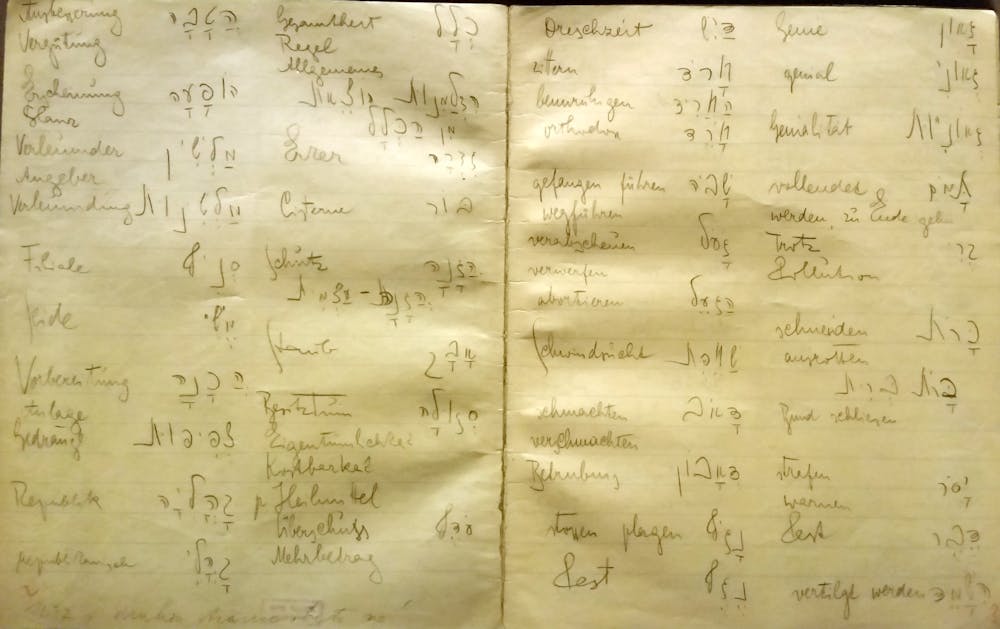
Pages from one of Kafka’s notebooks with words in German and Hebrew. National Library at Givat Ram, Jerusalem/Wikimedia Commons

A new literature

Kafka’s occasional reflections on his diary-keeping are less about the personal insights, or what might be called the conscience, of the writer. They are not defined by their confessional sincerity. Rather, they enable him to self-display. The diary entries provide him with a visualisation of the movement of his thoughts and their alignment on the page.

The diaries act not only as a forge for Kafka’s writing; they also forge a new possibility for the diary’s place within literature. In several entries, Kafka comments on his intention to start an autobiography, implying he did not see the writing he was doing in the notebooks as having an autobiographical purpose.

He also makes the allusive suggestion that diary-writing has its analogue in the literature being produced by his Jewish contemporaries in Warsaw and Prague.

This new literature, Kafka says, is united by a Hebrew mother tongue assimilated within the dominant German language culture. It was a literature seeking modes of expression for the effects of that assimilation. Kafka viewed the experimental writing of his peers as a form of literature that can be viewed as the

diary keeping of a nation, which is something completely different from historiography […] the detailed spiritualization of the extensive public life, the binding of dissatisfied elements.

Diary writing can be seen as a means of self-formation, not only for an individual, but also for a “small nation” of a marginalised language culture. It offers new and uncertain modes of expression. Kafka adds:

literature is less an affair of literary history than an affair of the people […] everyone must always be prepared to know, to defend the part of literature that falls to him and at least to defend it even if he doesn’t know or bear it.

Decades later, Gilles Deleuze and Felix Guattari would mine this entry in Kafka’s diary to coin their idea of “minor literature”. They argued that major or dominant languages, such as German and English, not only produce the spoken dialects of the minority cultures they incorporate or colonise; they also enable new modes of literary expression by writers from minor cultures writing within those major languages.

Kafka spoke High German; his writing bore little or no trace of Prague-German. But this diary entry opens up the possibility of a new way of conceptualising the politics and poetics of literary expression. Such an understanding is now central to literary criticism in colonial and postcolonial contexts.

Blanchot tells us there is no law without its transgression. The new version of Kafka’s strange and extraordinary diaries reminds us how diaries are not usually intended for any reader other than their writer, who is usually their only reader. Ross’s translation will continue to ensure the transgression of that law too.

It is just shy of a century since Kafka’s death. What could be more fitting than the appearance of these diaries in a faithful translation, showing them to be much more than an accompaniment to Kafka’s stories or a calendar of his existence? They are an inexhaustible source of literature itself.

https://theconversation.com/friday-essay-all-i-am-is-literature-franz-kafkas-diaries-were-the-forge-of-his-writing-196573