Showing posts with label WW1. Show all posts

Sunday, November 19, 2023

Kafka’s diaries: a chronicle of suffering

From thearticle.com

By Jeffrey Meyers

Franz Kafka belongs with the great diarists: Samuel Pepys, James Boswell, Goethe, Virginia Woolf, Anne Frank and Sylvia Plath.  His Diaries (Schocken, $45/£38), newly and expertly translated by Ross Benjamin, provide the deepest insights into his tormented character and complex fiction.  Benjamin notes that the surviving diaries consist of “twelve quarto notebooks and two bundles of loose paper filled with dense handwriting, crossings-out, corrections, and insertions squeezed in wherever possible.”  Kafka wrote, “an advantage of keeping a diary consists in the fact that one becomes aware with reassuring clarity of the transformations one incessantly undergoes.”  Yet his diary both confirms his existence and undermines his confidence: “I’m moved by reading the diary.  Is the reason for it that now in the present I no longer have the slightest certainty?”

Virgil had asked friends to destroy his unfinished poetry, Auden had asked friends to destroy his private letters, and their wishes, like Kafka’s, were wisely ignored.  But Kafka’s reputation is not based on what he actually wrote.  Max Brod, his closest friend, was more famous than Kafka in their lifetime, but is now largely forgotten except for his role in rescuing, editing, distorting, rewriting and publishing Kafka’s work.

For example, Brod not only deleted Kafka’s statement that Franz Werfel was a far more significant writer than Brod, but also struck out any hint of homoeroticism: “His apparently sizeable member makes a large bulge in his pants” and “2 beautiful Swedish boys with long legs, which are so formed and taut that one could really only run one’s tongue along them.”  Benjamin’s edition corrects Brod’s distortions and restores the original text.  Though Benjamin does not translate German titles, quotations and poems, nor provide a useful glossary of the main characters, his explanatory notes are useful and he’s tracked down the most obscure references.

Kafka’s main subjects are his oppressive father, poor health, sexual frustration, agonising relations with his fiancĂ©e Felice Bauer, comic scenes, embryonic stories, inability to write, extreme misery, fears of torture and execution, and longing for death.  He lived in the cultured city of Prague and was bilingual in German and Czech.  He was well educated and did important work as an expert lawyer in an insurance company.  Handsome and amusing, popular with men and attractive to women, he led a comfortable life in his parents’ middle-class home, and was adored by his mother and sisters.  But he also suffered intensely from noise at home and in the street; from constipation, headaches, insomnia and depression; from his father, office work and duties in the unhealthy family asbestos factory that kept him from writing; from impossibly high literary standards that he could not meet—and from his own tortured personality.

He does not mention (as one might expect) Spinoza, Schopenhauer, Nietzsche, Mann or Rilke.  He has enticingly brief references to the perfectionist Flaubert and to the emotional extremists he most admired. Here is Kierkegaard: “As I suspected, despite essential differences his case is very similar to mine at least he is on the same side of the world.  He confirms me like a friend.” And Dostoyevsky: “so reminiscent of my unhappiness. . . . His designation of mental illness is nothing but a means of characterisation.  The Karamazov father is by no means a fool but rather a very clever, albeit wicked man who is almost Ivan’s equal.”
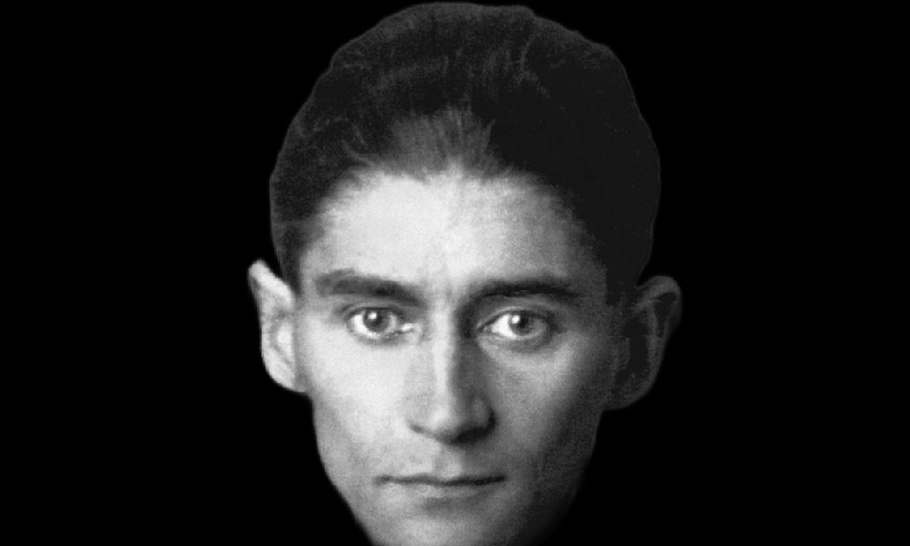
                                                        Image using the last known photograph of Franz Kafka, Most likely taken in 1923

Kafka includes almost nothing on music and art, but he attends many lectures and is very keen on Yiddish theatre.  Always self-absorbed, he’s strangely indifferent to the outbreak in August 1914 of the Great War that would destroy the Austro-Hungarian Empire: “Germany has declared war on Russia.—Swimming school in the afternoon. . . . To those who are fighting, I passionately wish all evil.”  In December he laconically adds: “The defeats in Serbia, the senseless leadership.”

Kafka often writes about not writing instead of writing what he wanted to write.  One entry reads: “Wrote nothing.”  He had to suffer in order to create, but couldn’t always suffer enough.  His stories describe bursts of irrational behaviour that were forbidden in his strict hierarchical society.  His minutely detailed observations are modelled on the logical deductions of Sherlock Holmes.  Kafka’s style is exact, precise, incisive; his clarity is pristine, his meaning obscure.

He gets annoyed when his father boasts about his own childhood suffering: “For years, due to insufficient winter clothing, he had open sores on his legs, he often went hungry, when he was only ten years old he had to push a cart through the villages even in winter. . . . The fact that I haven’t suffered all this permits not the slightest conclusion that I have been happier than he, that those sores on his legs entitle him to be arrogant.” His father wounded him out of love and intensified Kafka’s guilt.  In his forties, he still feared his father and skipped dinners to avoid confronting him.

The Diaries include his entire story “The Judgment”, in which a father’s accusations drive his son to commit suicide by throwing himself off a bridge.  Other entries suggest “the only solution is a leap out the window” or a soft-landing: “jump down from the high window, but onto the rain-soaked ground, where the impact won’t be deadly.”  Kafka describes the difficult parturition of this story as “a veritable birth covered with filth and slime”.  When he read the story to friends, “my hand moved around uncontrollably and genuinely before my face.  I had tears in my eyes.”

Even before he was diagnosed with tuberculosis in 1917, the hypochondriac Kafka despaired about his body and associated it with shame and misfortune, with ugliness, dishonour and sadness: “There’s no doubt that a main obstacle to my progress is my physical condition.  With such a body nothing can be achieved.  I will have to get used to its perpetual failure.”  He experienced psychological as well as physical pain and displayed his sores like a leper: “my eyelashes trembled in my face, in the left corner of my forehead I felt a tension as from a painless gunshot. . . . The tension that often lies over the left half of my skull feels like an inner leprosy.”  Always sensitive to disease, while travelling in Italy in September 1911 he noticed the cholera epidemic that killed the hero of Thomas Mann’s Death in Venice that year.

The severe coughing fits that made Kafka double up with pain and his first tubercular haemorrhage in July 1919 forced him to confront reality and retreat to a sanatorium.  But he distrusted the incompetent and infuriating doctors, who were “so ignorant of healing that they stand like schoolboys before the sickbeds”.  There was no cure for his disease until the 1940s, and the serums, vaccinations and operations were worthless and even dangerous.  He grimly concluded, “I cannot count the doctor as a humanly personal helper.”

So he desperately and rather pathetically turned to naturopathy, which included nudity, air baths and vegetarianism.  His mother whimpered like a cat when he didn’t eat enough and he raged against her intolerable nagging.  A picky eater among the greedy German-Slavic Wurst-Fresser, he was disgusted by raw meat, as if it were cut out of his own flesh, yet perversely craved the very thing he loathed and wanted to devour it like an animal: “If I see a sausage labeled as an old hard Hauswurst, I bite into it in my imagination with all my teeth and swallow quickly, regularly and heedlessly like a machine.”  A slab of Wurst made him ecstatic and he dreamed of “the biting into and simultaneous licking of the unpeeled salami stump.”

Most of Kafka’s sexual descriptions are squalid.  But one saucy wench flattered him as if he were a cute girl: “Oh, if only I could see you naked one day then you must be especially pretty and kissable.”  He was impressed by the potency of a man who told him “how he must slowly stuff his large member into the woman.  His trick in earlier days was to exhaust the women until they couldn’t go on.  Then they were without a soul, animals”—completely passive and subject to his will.  Kafka’s curious friend questioned a woman in the same way the priest had questioned Molly Bloom to get vicarious pleasure in Ulysses: “How was it?  I want to know down to the last detail.  Did he only kiss you?  How often?  Where?  Didn’t he lie on you?  Did he touch you?  Did he want to take off your clothes?”

In the bordello he notes intimate and crude details: “Hair runs thickly from her navel to her private (or not so private) parts.”  He’s fascinated by the  brusque behaviour of a repulsive but serviceable whore: “The only woman suitable for him is the dirty, oldish complete stranger with wrinkled thighs, who extracts his semen in an instant, puts the money in her pocket and hurries into the next room.”  In a passage from America, a graphic moment of aggressive foreplay disgusts the protagonist, Karl: “she shook him, listened to his heart, offered her breast for him to listen to hers, but couldn’t get Karl to do so, pressed her naked belly against his body, searched with her hand, so disgustingly between his legs, then thrust her belly against him several times, he felt as if she were part of him and perhaps for that reason a terrible helplessness had seized him.”  Venereal disease always threatened to punish the fornicator: “Fear of infection, he kissed her down below, even now he sees himself decaying.”

Kafka’s love for Felice Bauer, a successful Berlin businesswoman whom he met in Prague, was also a symptom of his disease.  The promessi sposi were engaged and disengaged in 1914, and repeated this wretched pattern in 1917.  The first impression of his heart’s desire was quite negative: she actually seemed repulsive.  She looked like a maidservant, had a bony empty face, an almost broken nose and stiff charmless hair.  She had the gall to correct his Austrian German and rudely called his sisters “shallow.”  He never experienced with her, as he had with other women, the sweetness of a beloved, “only boundless admiration, subservience, sympathy, despair and self-contempt”—all lethally combined with what he considered her fear of and disgust for him.

The unsuitable suitor Felice was a withdrawn, taciturn, dissatisfied person, horrified by the idea of happiness, who foresaw only lasting and hopeless misery.  He was unable to force her to accept his abysmal opinion of himself, felt guilty about his inability to marry her and the unhappy years she’d suffered on his account.  He confessed, “I have done the wrong for which she is being tortured and moreover wield the torture instrument.”

Striving to be logical rather than emotional, he compiled a list of arguments against marriage.  He had to spend most of his time alone; he could not live with anyone; he feared a wifely connection would swallow him up; the sight of nightshirts on his parents’ bed suggested sickening sex; he hated everything (including Felice) that didn’t relate to literature; marriage would prevent him from giving up his office job and devoting himself entirely to writing.

Even if she loved him—and did she?—he didn’t deserve her devotion.  He confessed, “I love her, as far as I am capable of it, but this love lies buried to the point of suffocation under fears and self-reproaches.”  In a self-condemnation that denied the Joy of Sex, he famously declared, “Coitus as punishment of the happiness of being together.”  One escape route was suicide, though he wouldn’t blame her even if “the apparent immediate cause of it should be F.’s behavior.”  Finally, and most cruelly, he compared Felice to his fatal bacilli: “the lung wound is the symbol of the inflammation which is called Felice.”

Unlike most lovers, Felice inhibited rather than inspired Kafka’s writing.  Despite her distractions, he tried to recapture his dreamlike inner life and strived for the clarity that made ordinary events seem mysterious.  Writing for Kafka was both a liberation and a punishment that made him feel as if a wild beast were waiting to devour him: “I will jump into my novella even if it should cut up my face. . . . [There’s] the tremendous world I have in my head.  But how [can I] free myself and free it without being torn to pieces?”  When he finally managed to complete a work he immediately saw its imperfections, its stunted and irremediable defects.  He read “In a Penal Colony” aloud and was “not completely dissatisfied, but for the blatant ineffaceable flaws.”

Yet surrealistic comedy often burst through and relieved his pervasive gloom.  He delighted in real weird names: Tschisik, Utitiz, Shhite.  He wanted to ascend a flight of stairs with somersaults.  An old wooden ruler had the same edge as a bumpy country road.  A moment of intimacy was interrupted by fear of vermin: “May Bettina rest her head on your arm?  If Bettina has no lice.”  Diners who carelessly ate a finely prepared roast cat began to meow after the meal.  During a deadly reading of inferior stories, “people kept leaving one by one as if another reading were being given next door.”

The writer provoked a stampede by threatening to read yet another story and announcing a five-minute intermission.  He then “read a fairy tale that would have entitled anyone to run from the farthest point of the hall straight through and over all the listeners.”  Kafka’s excited family announced the birth of a grandson “as if the baby had not only been born but had already led an honourable life and had its funeral.”  But mirth could not move a soul in agony.

Kafka includes long excerpts from his unfinished novel America and records many themes that evolve in his fiction.  Like the character in the story “A Hunger Artist”, a man “is constantly starved, only the moment belongs to him, the perpetually continued moment of torment.”  Like the underground man in “A Burrow,” he burrowed away in his shelter, “dug a hollow in the sand in which he felt quite comfortable. . . . But all the preparations he was making to secure the hut against the animals and keep himself safe for the winter had to be abandoned.”  Like the parable “Before the Law,” “It had been impossible for him to enter the house, for he had heard a voice saying to him, ‘Wait until I lead you.’ ”  He foreshadows “The Metamorphosis” with this: “I myself have a strong capacity for transformation, which no one  notices” and “can only creep onward no better than an insect.”

Passages foreshadowing The Trial emphasize Kafka’s feeling of complete helplessness as if he were imprisoned behind locked doors.  He fears “we are outside the law, no one knows it and yet everyone treats us accordingly.”  Though weak, he must defend himself against the prevailing injustice.  A harsh verdict is handed down, “but one should still keep in mind that the first judgment always stands on shaky ground and that one should not let it perhaps muddle all future judgments.”  Nevertheless, the strange but severe penalty is carried out: “the man condemned to death is stabbed there in his room by the executioner without the presence of other people.”

Kafka experienced both a demonic need to create with an inability to write, and expertly analyses his sterility without finding a solution to his dilemma.  Goethe’s great achievement, instead of liberating him, “permeates me and keeps me from doing any writing.”  Anxious and restrained, he lacks sufficient time, is always under pressure, rarely starts anything and finishes nothing.  When he manages to write, his sentences are dry, broken off and unusable.  Everything is fragmentary and worthless, and he feels “condemned to this inferiority by the circumstances of his life.”  He crosses out most of his work and puts it aside for a more propitious time that never comes.  As “a screeching ink-spraying [not-ink-flowing] stroke goes through the whole thing,” the tubercular compares his “wicked, pedantic, mechanical [stories] to an only barely breathing fish on a sandbank”—destined for a slow and painful death.

For Kafka, a specialist in self-torment, life was a perpetual Yom Kippur, a Day of Atonement.  Open his heart and you would see ’graved inside there Misery.  The perpetual alien is a Jew among gentiles, a German among Czechs, a tubercular among the healthy, an outsider even in his own family.  He whimpers like a sick cat, wants to be dissatisfied, can’t resist the tiniest worries and “nervous states of the worst sorts dominate him without cease.”  All his undertakings end in misfortune, and he’s trapped as his wretched life “flashes before his open eyes with steel colours, with taut steel bars and airy darkness between them!”  Echoing Christ’s last words on the Cross, he laments “the pain over my forsakenness that came into me so piercingly and forcefully.”

As his via dolorosa continues, Kafka finds it impossible to sleep, remain awake or endure life.  He suffers weakness, longs for self-annihilation and feels the “tip of the flame of hell penetrating the floor” and ready to thrust him among the eternally damned.  He feels a strange dissociation between his external self and his real creative being, “the terrible uncertainty of my inner existence.”  His most famous aphorism doubts his essential identity and recalls Rimbaud’s “Je est un autre” (I is someone else): “What do I have in common with Jews?  I have scarcely anything in common with myself and should stand completely silent in a corner, content that I can breathe.”

Suffused with a permanent agony that verges on the comic, Kafka assumes vicarious power and punishes his guilt as both torturer and victim: “A large old knight’s sword with a cross-shaped hilt was stuck in my back to its handle” and “a spike crookedly jutted out of my shattered forehead.”  The coup de grace, as in Nineteen Eighty-Four, is self-created: “rats that tear at me and that I multiply with my gaze.”  The torments continue as he’s pulled through the “window of a house by a rope around the neck and yanked up, bleeding and tattered, through all the ceilings.”  Gagged, bound and tortured, he’s finally “stabbed deeply with something sharp, surprisingly here and there, wherever their whim prompted.”  The masochistic Kafka enjoys the self-inflicted punishment for his indelible guilt: “the pleasure again in imagining a knife twisted in my heart.”

The only escapes from these endless torments are insanity, suicide or death.  He could never hope to do what he believed he was required to do and, feeling quite worthless, was prepared to die at any moment: “Dying would mean nothing but sacrificing a nothingness to nothingness.”  He’d nearly obliterated himself while still alive, and told Max Brod that “on my deathbed, provided the pains are not too great, I will be very content.”  As Kafka lay dying, he told his last doctor, “Kill me, or else you are a murderer!”

https://www.thearticle.com/kafkas-diaries-a-chronicle-of-suffering 

Friday, October 1, 2021

Service & Sacrifice: WWI veteran's diary brings the past to life

From wpsdlocal6.com

MCCRACKEN COUNTY, KY — The last living World War I veteran, Florence Green, a British citizen who served in the Allied Armed Forces, died in 2012 at 110 years old. When we lose a veteran of any war, we lose a wealth of knowledge. But the past can be preserved and even be brought to back life.

William Anthony Kitchen

William Anthony Kitchen


William and Tony Kitchen helped us do that. These two are not strangers to our airwaves. William, a WWII veteran, rode on the B-25 "Mitchell" Bomber when it came to Paducah in June as part of Honor Flight Bluegrass' Barnstorming Tour Across Kentucky. His son Tony was by his side for the occasion. I learned after talking with them that they come from a long line of Service & Sacrifice. William's father served in WWI and kept a diary for five months, logging his trip from New Jersey to the front line in France. His son and grandson helped bring his words and experiences to life.

KITCHENS

William Kitchen and Tony Kitchen read passages from William's father's diary. He kept it during his time overseas during WWI


"Diary of William Anthony Kitchen, Army Field Clerk. In case of accident notify Mr. and Mrs. J.E. Kitchen, Edgar Springs, MO: my father and mother. I was born in Edgar Springs, MO, Sept. 19, 1894."

Saturday March 23, 1918

"We left New York this morning at about 3:30. I did not discover the fact until about 5 o'clock. I got up, dressed and went out on deck, but we were out of sight of land.

"All lights go out at 6 p.m., except in the saloon. just as soon as the door opens they go out in there too. So there is no chance for a light to be exposed to the enemy."

Sunday March 24, 1918

"And it was rock-a bye baby all last night. The boat all day too and seasickness is plentiful. Lots of heaving and losing all their nourishment."

Thursday March 28, 1918

"A ship stayed off the horizon for three or more hours this afternoon. It appeared to be following us for it neither gained nor lost ground. About dusk the cruiser went out after her and was gone about four hours before returning. No news yet as to what the strange craft was or what happened. The war zone will be reached in about two days now."

Sunday March 31, 1918

KITCHEN DIARY

"This is Easter Sunday. I had no idea when Easter was until last night. In harmony with the occasion, eggs were served at breakfast.

"We crossed the 30 degree line about 8 am today. This is not the actual war zone as prescribed by Germany, but it is so recognized by the United States as no chances are taken. All guns are uncovered and loaded ready for action. Everyone is now wearing their life preservers wherever they go."

Tuesday April 2, 1918

"A year ago tonight I was in Washington and heard President Wilson deliver his message calling for a declaration of war against Germany. Little did I think then that a year hence I would be on the ocean bound for Europe."

Thursday April 4, 1918

"A soldier and a sailor died on ship last night. We had a big battle with submarines this afternoon... suddenly at 12:20 pm the ship received a terrible jar... I was sure that we had been torpedoed.... I then looked about 1500 yards aft and saw great explosions in the water and columns of spray were shooting high into the air... it was the concussion of these explosions that was jarring the ship...."

KITCHEN SHRAPNEL

A piece of German shrapnel from WWI

Friday April 5, 1918

"Tied up at dock just before sundown and one of the first sights that greeted my eyes was some Austrian and German prisoners piling lumber... Many American soldiers and sailors were on the docks to greet us and the boys on the ship divided their cigarettes and candy with them.

"Several French soldiers just back from the front were around. Some of them looked to be 50 years old. They were rather dirty, unshaven, and presented a very untidy appearance. They were a pitiful sight and the saying 'France is bled white' is very near the truth if these soldiers are typical to the French army."

Thursday May 23, 1918

"Met a Mr. Brown of St. Louis who is in the YMCA. He was in Paris last night when the Germans made an air raid on the city. He said all the sirens mad a noise that caused one's blood to curdle. The barrage fire was fierce, in fact the worst he ever heard and he has been in air raids on London."

Wednesday May 29, 1918

"We packed up today to leave. It is not known yet where we go. The orders have been changed so much it's difficult to form an opinion...

"Some sharp flashes to the east. It was the cannoning on the front. No sounds could be heard, but the continued flashes plainly indicated that the artillery duel was raging with terrible fury."

Saturday June 1, 1918

MEUSE-ARGONNE OFFENSIVE

Meuse-Argonne Offensive, National Archives

"We traveled all night last night. I did not sleep a bit... only 3 miles from the front. It was lively too. A nice artillery duel was raging, and occasionally the Germans dropped shells on a hillside which was just across the way from where I was... a German plane attempted to come over, but the anti-aircraft fire sent him back....

"I saw some very pitiful sights, the fruits of war. Old men, women, and children with a few cherished belongings, perhaps all their earthly possessions, were streaming along the road en route to a place of safety...

"I have decided to discontinue keeping my diary from day to day as I consider it too dangerous. When the proper time comes, I will write a brief of the most important things that occur in the meantime."

William was there for the Battle of Chateau-Thierry, the Battle of Saint-Mihiel and the Meuse-Argonne Offensive. He wasn't in the trenches fighting, but he was in the trenches performing important secretarial work, like the number and names of casualties.

This isn't the last you'll see of William's son, William, and grandson, Tony Kitchen. Both men will travel to Washington, D.C., on October 20 with Honor Flight Bluegrass to see the monuments built in their honour. I'll be there with them, as will Brianna Clark, James Priewe and Mason Watkins, to document the emotional journey from Paducah to our nation's capital.

https://www.wpsdlocal6.com/news/service-sacrifice-wwi-veterans-diary-brings-the-past-to-life/article_5cc5cd72-1d7e-11ec-ad33-33d019a48bc4.html


Tuesday, April 27, 2021

The war-time messages that tell of the loves, laughs and longings of their authors

From stuff.co.nz

Hundreds of letters and pocket diaries – some perfectly intact, some falling apart – are stored away in shoe-boxes and folders across Marlborough. Maia Hart speaks to their safe-keepers to commemorate this year’s Anzac Day.

William Trickey Woods, World War I
William Trickey Woods and Leila Ethel May Woods (nee Mills) pictured on their wedding day.
MAIA HART/STUFF
William Trickey Woods and Leila Ethel May Woods (nee Mills) pictured on their wedding day.

When William Woods was blinded at Gallipoli during World War I, he was pulled from the front line and sent home to New Zealand.

He was admitted to the Queen Mary Hospital in Hanmer Springs, which was set up for returning wounded and sick soldiers. Hanmer Springs, along with Trentham, Featherston and Rotorua, were chosen as hospital sites by the Government.

It was there that he met Leila Ethel-May Mills, whom he later married. To Woods, she was simply “Lil”.

They kept in contact through writing letters when her job as a physiotherapist, or masseuse, took her to Rotorua, and he stayed in Hanmer Springs.

Despite being blinded, his letters had few mistakes. Lil learnt braille so she could reply.

A letter William Woods sent Leila “Lil” Mills, about four months before they married.
MAIA HART/STUFF
A letter William Woods sent Leila “Lil” Mills, about four months before they married.

July 21, 1917

“I am always looking forward and hoping to receive your dear thoughts through the post, and whenever I think how difficult it must have been for you at first to write braille and how many of your charming letters I have received, then I am more than ever certain that had I searched the whole world over I should nowhere have found another girl whom I could love and respect as yourself dear.”

Woods’ granddaughter Jill Rogers, of Marlborough, said her grandfather was an “amazing man”.

“He never had one trace of bitterness. You’d think if you were blinded, and you were so young, that you might be.”

Each of the letters told a story of the day, like on September 16, 1917, when Woods had an “earthquake for dinner... with the pork”. According to Woods, the “two blended together nicely”.

There were so many letters, Rogers hadn’t had the chance to read them all.

There are so many letters, Jill Rogers hasn’t had the chance to read them all.

MAIA HART/STUFF
There are so many letters, Jill Rogers hasn’t had the chance to read them all.

August 7, 1917

“Practically the whole of the morning I waited on Colonel Rhodes - who desired to converse with me for a few moments. He is very interested in Gallipoli and has been all over which we held there and knows the “Daisy Patch” well. I am rather glad now I waited to see him, for he is a fine chap and I think it just as well to keep in with these fellows.”

August 11, 1917

By the way dear did you see the “Aurora” - was going to add “Borealis” but the spelling of this word has tied me into three knots so hope you will get me - that the above is the correct terminology for the “Southern Lights”. They appeared 6 or 7 o'clock on Thursday evening - a good many people thought it was the reflection of a fire. The heavens between the ferry and Glenwye were all the colours of the rainbow between pink and green and were more beautiful to look upon that anything of this nature has been for years. I wished very much my sweetheart that you had been here to describe these things to me ...”

By Boxing Day 1917, the pair married.

“He was never sorry for himself, there’s no self-pity. He was the most able person,” Rogers said.

“Some people are able-bodied, but dysfunctional. He was disabled, but so highly functional.”

Leila Mills had to move to Rotorua to work after she met and fell in love with William Tricky Woods.
MAIA HART/STUFF
Leila Mills had to move to Rotorua to work after she met and fell in love with William Tricky Woods.

Being quite young at the time, Rogers didn’t remember her grandfather talking much about the war, just that he could “chop the finest kindling” and he would take her to the Farmer’s Tearooms, in Christchurch, to get a pie for lunch.

“My father was in World War II, and he served in Italy, and he did [talk] sometimes, when he had a few drinks.”

James Colin Jamieson, World War II

James Colin Jamieson was held in a prison camp in Poland during WWII.
BRYA INGRAM/STUFF
James Colin Jamieson was held in a prison camp in Poland during WWII.

Blenheim woman Denise Cooper stumbled upon her father’s World War II letters after both of her parents had died.

“They were in a plastic bag, I couldn't believe it,” Cooper said.

Each of the letters were sent by her father, James Colin Jamieson, to his mother.

July 24, 1940

My Dearest Mother. I have just had a nice cold shower and have changed my clothes and am feeling pretty perky and thought I would drop you a line or two. I have just put the socks on that Aunty Maude knitted for me and they are real good. When you see her you can tell her that they have stood the strain very well and as yet there are no holes in them.

A letter to Jamieson’s mum after he had been released to the United Kingdom.
BRYA INGRAM/STUFF
A letter to Jamieson’s mum after he had been released to the United Kingdom.

April 29, 1941

Dear Mum. Just a line to let you know that I am okay and in the best of health. We are in the island of Crete about 200 miles from Athens. I came through it all without a scratch though we were dive bombed and machine gunned and shelled almost everyday for a fortnight. I saw Big Jack and Auther Hooker the day we arrived here and we had a few drinks together and that night we shared our blankets. Jack is looking well even though they had a tough time. I hope you are not worrying yourself sick over me. At the first chance I will have my photo taken and let you see that I am well.

Not long after this letter Jamieson was captured in Crete in 1941 and taken to a prison camp in Poland.

“Reading the letters, I really did learn the real hardship they went through,” Cooper said.

“But my dad always said that the normal German soldiers who captured them, looked after him very fairly, he was pretty well looked after in the prison camps, compared to the other people.”

Jamieson’s daughter, Denise Cooper, found the letters in a plastic bag after her parents had died.
BRYA INGRAM/STUFF
Jamieson’s daughter, Denise Cooper, found the letters in a plastic bag after her parents had died.

He even got a cake on his 21st birthday, Cooper said.

“He always talked very fondly, for someone that was inside a prison camp. They were very good to him.”

About nine years ago, Jamieson sent the letters away to have them treated, to last longer.

“He was a very humble man. He never talked a lot about the war, unless he had a few to drink.

“I laugh at some of the letters, some of the expressions you wouldn’t get away with that today, some of what he said. Times have changed, he was pretty blunt.

“He quite surprised me that he wrote so much to his mum, he was very loving.”

Jamieson sent many letters home to his mother.
BRYA INGRAM/STUFF
Jamieson sent many letters home to his mother.

June 26, 1942

Dear Mum. I received your parcel two days ago and it was real good. It contained pullover two shirts, two sets of underclothes, two towels, three pair of socks, face cloth, eight soap tooth packs and brush razor blades, and ton of chocolates. I could give you a big hug and a kiss for that.

“My husband and I recently did a trip to Germany, and we went to a couple of the concentration camps. And I just realised how lucky my dad was, he never ended up in one of them,” Cooper said.

“He wouldn’t have been my dad if any of that happened. It really opened my eyes.”

Harry Bernyle Thomas Hoar, World War II

Mounted up ready to patrol: Harry Bernyle Thomas Hoar served for the HQ Company 35 Battalion in the South Pacific.

SCOTT HAMMOND/STUFF
Mounted up ready to patrol: Harry Bernyle Thomas Hoar served for the HQ Company 35 Battalion in the South Pacific.

Although Terry Hoar didn’t have the original handwritten diary and notebook of his father, as the original sat in the National Army Museum in Waiouru, he did have a photocopy.

The diary had hundreds of pages of notes that Corporal Harry Bernyle Thomas Hoar kept when he served for the HQ Company 35 Battalion in the South Pacific.

Terry Hoar didn’t remember his father doing much art growing up, but he was quite the cartoonist. The sketches showed plenty of humour too, despite the dark times.

A cartoon sits alongside a poem inside Harry Bernyle Thomas Hoar’s journal.
SCOTT HAMMOND/STUFF
A cartoon sits alongside a poem inside Harry Bernyle Thomas Hoar’s journal.

“He never talked to me much about the war, it was only really when he went to the RSA I think, and I never really went there with him,” Terry said.

“He never used to go there [RSA], but his doctor said to him, ‘what do you do after work?’

“He said, ‘I just go home’, but he said he should relax, have a chat, because they used to talk about the war, I think that helped more.”

A drawing from May 23, 1942.
SCOTT HAMMOND/STUFF
A drawing from May 23, 1942.

March 13, 1943:

“How they get on at night without mosquito nets I don’t know as when we first came here we were without them, and you never saw such a mess in all your life as the faces and arms of some of the chaps after they had had a feed of them. As I sit writing waiting for a job a Fijian is busy pounding away with a piece of solid steel on a block of wood hollowed out in the middle, on which is placed the cava root and pounded away until it is powder and that mixed with water makes a very popular drink ... which they call cava. If drunk in large quantities it produces a sort of paralysis of the legs but unlike our beer, leaves the mind quite clear.”

A somewhat cheeky cartoon drawn by Hoar.
SCOTT HAMMOND/STUFF
A somewhat cheeky cartoon drawn by Hoar.

Colin William Burt, World War II

Colin William Burt was killed in action during World War II.
SCOTT HAMMOND/STUFF
Colin William Burt was killed in action during World War II.

Then, there were some that never came home.

Mary Love’s uncle, Colin William Burt, was killed in action in April 1945.

Burt had served with the army as a Temporary Bombardier in the South Pacific, before he enlisted with the Royal New Zealand Air Force in 1943.

Love had a collection of her uncle’s pocket diaries and letters. It seemed Burt was keen to document the days.

“As I didn't receive this diary until 16th Feb, the period until then will not be in detail, but from memory. Of course I remember the memorable day when I was reduced to the ranks.”

Burt kept a pocket diary, keeping a record of what he did each day.
SCOTT HAMMOND/STUFF
Burt kept a pocket diary, keeping a record of what he did each day.

His 1943 diary included snippets about rifle range shooting, but also more chilled times about cricket, or the time in April when he got a haircut.

A letter he wrote while “at sea in the Indian Ocean” wasn’t dated, but detailed what leaving Wellington was like.

“I am going to try and give you a few lines on the trip so far as we have gone, a good one so far. When I got aboard at Wellington I tried to get up the bow of the boat, but couldn’t, too many there, so climbed the rigging just as the boat moved off the wharf but am sorry to say that I couldn’t get a glimpse of any of you.”

Love says she has got interested in learning more about her uncle as she has got older.

SCOTT HAMMOND/STUFF
Love says she has got interested in learning more about her uncle as she has got older.

“When the sea is rough at all you roll about in the bunk one side to the other and have to hold on in case of getting tipped out. I get a good appetite on board but don't get enough exercise. There is not much room with about eleven hundred aboard they are like flies around a honey pot.”

Growing up she was told her uncle was killed in England. But, a letter in her collection said he died in Italy.

“It was his body that was brought back to England and buried in Oxford, according to the letter,” she said.

Mary Love with a picture of her uncle, Colin William Burt, who died in April 1945, while on active duty.

SCOTT HAMMOND/STUFF
Mary Love with a picture of her uncle, Colin William Burt, who died in April 1945, while on active duty.

Love said she held on to the letters and diaries because their history was important.

“I’ve hung on to everything, history gets lost, so I think it’s important. I just wish I knew more.”