Showing posts with label student. Show all posts

Sunday, February 15, 2026

AI Educator: Why I Tell Students To Keep A Frustration Diary

From forbes.com

By Dan Fitzpatrick

There is a line from Mustafa Suleyman’s book, The Coming Wave, that I keep returning to. Suleyman, the co-founder of Google DeepMind, writes about children who grew up travelling by horse and cart in the late 19th century, but spent their final days flying on airplanes, living in houses heated by the splitting of the atom. All in one lifetime, from horse and cart to nuclear energy.

I mentioned this last week during a talk I gave for the UAE Girls in AI programme, founded by Abeda Natha, director of digital learning at GEMS Wellington International School. The students who joined me are going to live through something even more dramatic. The real question, I feel, is whether our education systems can get them ready for it or not.

A survey commissioned by Kingston University, which polled more than 2000 business leaders, found that 74 percent of those business leaders do not believe current graduates are prepared to succeed in a world of artificial intelligence. That is not a fringe concern; that is a near consensus.

What Has Changed?

To help the students make sense of this during my talk, I decided to walk them through some economics 101. That is, how the four factors of production have shifted across economic ages. Looking at the work of 18th century economist Adam Smith and then Alfred Marshall, we explored the classic framework of the four factors of production: land, capital, labour and entrepreneurship.

Going back to the feudal age, land was king. If you owned the land, you had the power. Then industry came along, the Industrial Revolution, and capital surged. You needed factories, machines, serious investment. At this time, labour became enormously more valuable than it ever had been because someone had to run those machines. Then the information age flipped it again. Suddenly you needed knowledge. Skilled, educated workers became the dominant factor.

Here is the thing. I think we are now entering the intelligence age. The economics are shifting again, quite radically. Capital requirements are collapsing. A laptop, a Wi Fi connection and a subscription to a powerful AI. That is your start-up kit.

Land barely registers for huge swathes of knowledge work. In the talk, I showed the students an image of a young woman sitting in a Starbucks with a laptop and asked them to look. All four factors of production were right there. The table was her land, her laptop was her capital, she was the labour, and the idea in her head was entrepreneurship. The barriers to build something have never been lower.

If capital costs have cratered and land is becoming irrelevant for digital work, what is left? I think it is entrepreneurship. By entrepreneurship, I do not mean in the sense of the Silicon Valley pitch deck, seed round culture. I mean entrepreneurial thinking, the ability to spot a problem, the creativity to imagine a fix, and the nerve to try building it.

In the session with the students, I gave them a simple exercise. Finish this sentence: “Someone really should make it easier to…” Then write down the first thing that pops into your head. Do not overthink it. Notice the friction in your daily life. This is where it starts.

I encouraged them to keep what I call a frustration diary. Every time you think this is annoying or why is there not a better way to do this, write it down. Then pick one a week and ask three questions. Who else has this problem? Would someone pay to fix it? Could I build a first version of this solution within a week?

That last question would have been laughable five years ago. In fact, it would have been laughable 12 months ago. Not anymore. A teenager with an idea and access to a powerful AI agent can prototype faster today than a funded start-up could manage even five years ago.

Humans Of The Gap

There is a concept I keep coming back to in my work, something I call the humans of the gap. As AI fills more of the capability space, writing code, generating content, crunching data and more, there is a temptation to place ourselves in the gaps, to get skilled in what AI cannot yet do. I get this question from parents almost weekly. What should my child be learning?

It is rooted in a flawed idea that we can thrive in the gaps where AI cannot perform yet. I think this is futile. The capability of AI will continue to increase and squeeze us out of those gaps. Instead, our human abilities become more valuable. Our judgement, our empathy, our ability to earn trust.

When talking with the students, I introduced them to an idea I have worked on with other groups: “the AI entourage”. I asked them to imagine that money was not an issue. Who would be in their entourage? What skills would their team have? The thing is, money is increasingly not the constraint. Any professional with AI “know-how” can work alongside a team of agents.

Think of it as an amplification layer. One person directing an AI entourage can handle work that used to require an entire department. The human directs. The AI executes. We outsource the doing, not the thinking.

This is a critical message for schools. In too many cases, we are still training students to be the doers, to store all knowledge, to follow instructions, and to produce standardised outputs. In the intelligence age, the doing is increasingly automated, and the value lies in directing, deciding, and imagining. It requires a fundamentally different educational model from what many are used to.

The Liminal Space

I then moved on to something that matters just as much as the skills conversation. The awareness that we are in a liminal space right now. We are somewhere between the old world, where a degree automatically led to a career, where knowledge was the currency, where institutions could afford to move slowly, and a new world that has not quite taken shape yet.

In that in-between zone, it can feel disorienting, anxious, and uncertain. There is also something else in that overlap space. A chance to create the future. Not just react to it, but create it. For young people feeling overwhelmed by change, that is a powerful reframe. We can be agents in what comes next.

Finally, I shared the Japanese concept of Ikigai, a framework for finding your reason for being at the intersection of what you love, what you are good at, what the world needs, and what you can be paid for. In this intelligence age, I would argue ikigai matters more than ever. When barriers to building are low, and AI handles much of the doing, the question that matters most is not what job should I get. It is what problem do I care about enough to solve? That is a question no AI can answer for you.

What does this mean for schools?

Every idea I shared with the UAE Girls in AI, from the economic shift to the frustration diary to the AI entourage, challenges how many schools currently operate. We are still preparing students for the information age. In some cases, we are still preparing them for the industrial age. Asking them to memorise, follow instructions, produce standardised outputs.

The intelligence age demands something different. Entrepreneurial instincts, creative problem solving, comfort with ambiguity and the ability to work with AI as a genuine partner. If graduates are falling short, then adding a coding module or hosting an AI awareness day will not be enough. The response needs to be structural and cultural. We need to rethink what we assess, how we teach and what we are actually preparing young people for.

Are we playing a finite game, optimising for exam results and university placements? Or are we playing an infinite game, building humans who can thrive at 25, 35, 45 and beyond?

William Gibson once wrote that the future is already here. It is just not evenly distributed. Some young people are already using AI, building things, thinking like entrepreneurial founders. Others are hearing these ideas for the first time. Some have yet to hear them at all. The distribution of the future depends in large part on the educators who choose to shape access to it.

The stakes have never been higher.

https://www.forbes.com/sites/danfitzpatrick/2026/02/14/why-i-tell-students-to-keep-a-frustration-diary/

Tuesday, November 11, 2025

"We Regret to Inform You That Your Middle School Diary Has Lapsed into the Public Domain"

From mcsweeneys.net

By Andrew Wood

This letter is to inform you (the author) that your intellectual property (middle school diary) has officially entered the public domain due to your failure to secure a copyright for these works.

What does this mean for you?

Essentially, the materials you authored from sixth through eighth grade are now free and available to the populace (everyone) for adaptation, publication, and general enjoyment.

We understand that this notice may elicit certain feelings (confusion, embarrassment, anger), but the copyright services have been available to you at all times. Our records indicate that you took a field trip to Washington, DC, in 2008, which would have been an ideal opportunity to stop by our headquarters and secure the necessary rights.

You may be wondering how these materials came into our possession in the first place. You will recall that during your last visit home, your mother (Sheila) told you she was cleaning out the attic and asked if there was anything you wanted to take. You failed to answer in the affirmative, so the materials were disposed of (dumped into a bin at the local Goodwill), where a copyright field agent is stationed at all times to sort through donations for any sensitive works.

Why are we here at the Copyright Office bothering with seemingly trivial materials like your diary at all? Well, like many of our fellow federal agencies, we have grown concerned with the current (massive) (sweeping) (devastating) government layoffs. So, in an effort to appear more useful and occupied than we typically are, we have expanded our jurisdiction to what we are calling “non-creative civilian works”—i.e., shopping lists, Sticky Note reminders, children’s letters to Santa, and, in your case, diaries.

You will be pleased to hear that your work joins the ranks of other celebrated materials to enter the public domain, including Ulysses, Mrs. Dalloway, and The Great Gatsby. While it may be a tad premature to classify your diary as a “literary classic,” we believe it to be a polarizing work.

We should clarify: In most instances, the materials that come across our desks are swiftly processed and passed along. But in the case of your diary… well…. we just couldn’t put it down.

“New Fall obsession” is the phrase most commonly heard around the water cooler when describing your work. Heartbreak, angst, public humiliation—your diary truly has it all. We even have a weekly book club meeting to pore over the countless juicy details within. I especially love the imagery you use to describe seventh-grade crush Tommy Buchannon’s frosted tips.

You might also be pleased (devastated) to know that several Hollywood studios are interested in adapting your diary for the big screen. In fact, we were able to procure one of the screenplays Sony Pictures commissioned. It makes the bold choice of opening during Trisha McMillan’s sleepover when you called your mom to pick you up after accidentally peeing yourself during that pillow fight.

Unfortunately, you will not be entitled to any compensation or residuals. But having your sordid story come to life for all to see should be rewarding enough. We have included an advance copy of the hardcover edition of your diary, which Simon & Schuster will be releasing this winter. We think the photo of the time you laughed so hard in the school cafeteria that milk came out of your nose makes for a perfect cover. And Margaret Atwood’s blurb—“A devastating portrait of American adolescence”—will certainly move some books.

If you have any questions or concerns, feel free to contact our offices via phone (disconnected) or email (unmonitored).

—The US Copyright Office

https://www.mcsweeneys.net/articles/we-regret-to-inform-you-that-your-middle-school-diary-has-lapsed-into-the-public-domain

Tuesday, October 28, 2025

Student Life - Diaries of a Thought Son: “I’m (almost) feeling 22"

From theoxfordblue.co.uk

By Jaami Al-Choudhury 

In light of my upcoming birthday next week, I wanted to share some reflections on turning 22, and what I’ve learned about myself in the lead up to this moment. I’d like to caveat this by saying (I feel) that some of my most formative character development moments have happened during my Oxford years, but that isn’t to discount what I’ve learned outside of the Oxford bubble.

                                                                                                    Image Credit: Victor Eero

Lesson 1: Friends and boundaries

I think first and foremost, in the last year I’ve really come to understand the true meaning of friendship, and with that, the importance of boundaries. Recently, I decided to cut off a close friend of over 10 years because we shared an uncomfortable holiday together after the end of my first year. Instead of facing the hard truth that my former friend had put me in an uncomfortable position, he decided to brush it under the rug with the lines, “We’re alright. We’ve been friends for 10 years. It’s not that deep right?” But to me it was deep, and truth be told our friendship didn’t survive that holiday, as I believe we only spoke once after the trip. This isn’t to dissuade you from taking holidays with your friends. I’ve been on multiple holidays since with one of my closest friends in college, which not only have taken me on the trips of a lifetime, but have also allowed me to make some beautiful memories.

I’m confident that in the years to come we’ll both cherish the memories when we’re 80, hopefully sitting in a piazza somewhere sipping on Hugos, reminiscing over the life we’ve lived, and most likely creating new memories. I don’t intend to slow down at 80, health permitting. Circling back to boundaries, I genuinely do think the hallmark of a true friendship is that you set your limits and help your friends to understand your thought process, because if you don’t have open communication, things go unsaid, and a year will pass where you haven’t spoken. Personally, I find it difficult to let people into my inner circle, because I understand that there are many facets to who I am.  I’m like a “marmite figure” so to speak – you either love me or hate me, and I’m okay with that. As such, I’m not the kind of person who can drift from having a deeply personal friendship with someone to seeing them on my timeline every once in a while, as if what we lived together didn’t happen. Whilst I’m grateful for the memories, I like to move forward instead of back into the past. Some might find that harsh, but I think given my lived experiences, it truly is the healthiest way to preserve my mental health.

Lesson 2: The work-life balance

Since returning to Oxford after spending my second year abroad, I think I’ve got a new lease on life in terms of maintaining a work-life balance. Despite crashing out over collections, I think I’m finding work more manageable. In my heart I know nothing productive is going to come from me working beyond 9pm – and even that to an extent feels late. Perhaps this has to do with the fact that my tutorials are slightly more spread out this year; in first year, we did an essay a week because of the way the joint honours system is structured, but now I have essay deadlines in odd weeks. This affords me some more time to work on essays in even weeks, in addition to the myriad (of) translations, presentations and grammar exercises I’m still doing. Even with 2 essays per odd week, I’m finding that with good time management I can make it work and still enjoy myself. 

The other side of the work life balance has definitely shifted. I can’t speak for all third years, but despite being abroad last year, I’ve still gone on more nights out than I ever did in first year. Maybe I’ve changed, but I’ve still yet to have a really good club night. I know we’re barely into week three, but ever since coming back I’ve felt more comfortable staying in, putting a film on my projector, and just curling up on the sofa with a blanket, a glass of wine and being surrounded by my close friends. Maybe brat summer part two was the wrap – or maybe I’m still settling in. Either way, I take comfort in the fact that my work is getting done and that I’m using my spare time to be around my friends, who really are the reason why I smile and call Oxford home.

Lesson 3: “Your man is not in Oxford”

I thought for the final lesson of this piece, I’d think back to a particularly entertaining moment in first year: going out for my first ever May Day. Whilst most people usually do the whole rotation of clubs drunk, I had an essay due in the next two days. So, instead of pre-ing with friends, I spent the first portion of the night with my good friend SOLO. After spending a decent amount of time on the essay, I left for ATIK with a group of friends from college. It was there where I told one of my friends about my lack of a love life (let’s be so for real), and the gruelling situationship I had spent first year on with a guy from the other place. After trying to maintain some hope that I could maybe have an Oxford boyfriend, my friend chimed in, and said in his rather drunken state, “Your man is not in Oxford”. Whilst I’ve only been back for what feels like five minutes, I wouldn’t disagree. Whilst I would love to be in a relationship during my time here, I think three years on, the dating scene is as dire as it was the moment we/I arrived. There are the lucky few who get to be those Oxford couples, who are paraded by college social media teams years after we graduate, who have the classic ‘freshers’ meet cute, or those who meet in some shared society and go on to get married and live their fairy-tale, and the bystanders like me who get to cheer them on from the sidelines. With my current workload, and a projected 12 tutorial term on just one side of my degree in Trinity, I’ll leave the lovebirds to it. If I have one takeaway from this fabulous quote which to this day brings me a lot of laughter, I would say it’s time to stop looking. If you spend your time at Oxford obsessing over finding a man/woman/enby, chances are you’re probably not going to find them.

So, now that I’m slightly older and wiser, I’ve come to appreciate that there are some friendships that endure a lifetime, and others that are there solely to teach you a life lesson. I’ve also learned that no deadline is worth compromising/harming your mental or physical health, that staying in is a lot more appealing, and that I’m not going to spend the rest of my final two years obsessing over the fact that I couldn’t be more single. I’m happy, healthy, in the best company and, truth be told, there’s no place I’d rather be than back in Oxford with my chosen family. I hope you’ll raise a glass for me if you’ve made it this far. “Here’s to 22.”

https://theoxfordblue.co.uk/thought-son-life-lessons/

Thursday, September 25, 2025

My college diary

From middleburycampus.com

By Christy Liang

“You are a writer. Don’t tell your parents that.” My English advisor, Professor Robert Cohen, told me these words as I sat in his office, talking about my recent turn towards Buddhist thought and how I’ve unclouded my judgment of the outside world over the summer. 

Before college, I knew with an unshakable certainty that I wanted to be a writer. I’d browse through all the creative writing classes and imagine myself in them, enthralled and radiant with enthusiasm. All I wanted to do was turn my wayward feelings and swirling thoughts into words, to press permanence on what is bound to pass. Writing — both personal essays and short stories — always brought me immense joy and helped me establish in clearer, richer terms who I am and who I’d like to be. 

After a couple of lukewarm creative writing workshops at college, however, I found myself drifting away from the idea of writing as a career, or rather, writing as something that can be taught in an academic setting. Words have always come to me from deeply intimate corners of my selfhood, on their own accord or prompted by my overpowering disposition of inward searching. I love the way sentences unfurl like a stream from an unnameable, yet visceral center within me. In brief moments, as I write, the interior and the exterior coalescence. It is quite magical. I feel imbued with an aliveness akin to the feeling of a really good conversation, a long, meditative walk or running through the woods as the sun’s about to set.

Then I realized that writing is a deeply personal act to me. That it matters the most when I feel compelled to write, not towards an audience or to fulfil an academic task, but because my innate striving for meaning distilled from lived experience brings me back to the page, again and again. As a result, I thought I’d start journaling. 

                       Journaling by Lake Dunmore this past weekend.  Photo by Christy Liang | The Middlebury Campus

In late August, I stumbled upon Tao Lin’s My College Diary published in The Paris Review and had an absolute blast reading it. I found it so real, unfiltered, full of laughs and the poignancy of growing up. It captured the chaotic yet ultimately aestheticized tenor of college life so well that I immediately thought of doing something similar. 

For the longest time, I was sceptical about keeping a diary. I thought I’d feel stifled by the banality of writing down what happened, what I ate, or whom I talked to. But Tao Lin showed me something different, that a diary tracks the psychological undertones of your ever-shifting existence, that it could be terribly refreshing to look back on an entry a month, a year, or even a decade ago and think: “Wow that’s how I was feeling.” I  also thought about how these documentations of day-to-day happenings, moods and reflections may inspire future creative projects. 

So, I started journaling and keeping a digital diary simultaneously. I’ve found it to be a deeply centring and affirming act, one that reminds me I can always take root in my interiority, which is, in fact, infinite. To my pleasant surprise, I’ve also found that in these highly personal mediums, my language acquires a special lightness. Unburdened by academic jargon and any intention to impress, I write almost lyrically, with phrases running around like little rabbits on the field. The line between prose and poem often gets straddled; past, present and future converse with one another. Most importantly, what induces fear, anxiety, or sadness becomes invariably tamed after getting channelled out. 

Nothing lasts, after all. We’re just taking a seat in a theatre, watching as experiences happen to us. 

A couple nights ago, I wrote in my journal: “I feel like a thing, a lovely, shifting thing held all around by a porous membrane, floating soundlessly through the theatre of life filled with giggles, sparks of insight, and love ripening through avenues imaginable and beyond.”

May we all be seen and held by something larger, something gentle, something deeply within.

https://www.middleburycampus.com/article/2025/09/my-college-diary 

Sunday, August 24, 2025

Diary of a Gen Z Student: Leaving Cert results aren’t the be-all and end-all

From irishexaminer.com

By Jane Cowan

It’s normal for results day not to pan out the way you might have envisioned it 

The day before my Leaving Cert results were due to come out, I chopped about 8in off my hair. A bob seemed like a suitable distraction. Because I needed to feel something other than the total nausea that I had thinking about those Leaving Cert results.

It worked for a good hour, while I freaked out about making such a drastic, life-altering decision. Then I quickly returned to my previous state of panic at the thought of receiving grades that I thought would determine the rest of my life.

I had always been a diligent student. I worked hard, never missed a homework assignment, and studied for every class test. In sixth year, I would watch the news in German, just to keep on top of my vocab.

As someone who had always performed well in school, it was expected that I would also achieve highly in the Leaving Cert. It was a pressure I felt from my peers, my teachers, my family, and myself.

Throughout most of my schooling, academic achievement never felt like I had achieved anything. It felt like some sort of minimum requirement. Being able to get good grades had become inextricably wound up in my identity.

Other things that made up my identity seemed less important: being one of four children, having a love for books and films, playing the piano, swimming, having great friends, and cooking for my family. None of those things were as crucial to how I viewed myself as the ability to achieve academically. So it felt like a lot more was riding on my results than getting into college.

That pressure was something I couldn’t really admit to, because admitting to it seemed like saying that I had never been that clever to begin with. For most of sixth year, I didn’t sleep more than five or so hours on any given night. My skin broke out with the stress. I sacrificed my hobbies, in favour of academics. I found it really difficult.

But I was convinced that getting the grades I needed to get into my college course would be this moment of total elation. I thought it would somehow prove that I could live up to the expectations that people had of me. I hoped academic achievement from the Leaving Cert would really count for something.

Still, on the morning I opened my results and realised I would get into the university course I wanted, I couldn’t figure out why I wasn’t happy about it. I had checked all the boxes that I was supposed to. I was looking forward to going to college but I didn’t feel like I had accomplished anything. I was just vaguely relieved that it was all over — but not proud of myself.

Jane Cowan: 'Throughout most of my schooling, academic achievement never felt like I had achieved anything.' Picture: Moya Nolan


Fast-forward to today, and I’m about to enter my final year of college. I’ve reflected a lot on Leaving Cert results day over the years. I’ve learnt a lot about academic validation since then. It’s probably something that happens when you leave school, that you can see life as a lot bigger than academics or any one exam result.

My priorities have shifted. Of course, I still want to do well in college. You’ll often find me spending late nights and early mornings in the library. But I also want to enjoy my life around college as well. I’m no longer waiting for an exam result to tell me how I should feel about myself, something I couldn’t conceptualise for myself on the day of the Leaving Cert results. I didn’t realise that academics being just one area of my life was an option.

I know that today there are students probably feeling how I felt on Leaving Cert results day. Like the achievement you worked towards was underwhelming more than anything. Or maybe you didn’t achieve what you were hoping you would; that can feel like a rupture in your identity. I’ve been there. But over the years, I’ve learned to hold those things with a little more levity. I’ve been rejected for a scholarship in college. I’ve gotten disappointing grades in exams. But once you start to see things that don’t work out as being part of the process, and an inevitable part of everyone’s life, you can gain some perspective. It’s normal for results day not to pan out the way you might have envisioned it.

And despite how it can feel on results day, your whole life hasn’t just been decided. Points aren’t supposed to tell you how you should feel about yourself. In a few years, those grades probably won’t seem all that important.

https://www.irishexaminer.com/lifestyle/people/arid-41690790.html

Monday, March 24, 2025

A deep dive into diaries

From varsity.co.uk/arts

Sadia Batool asks how we should read the diaries of great artists and whether or not we should read them at all 

In a practical criticism supervision on Mark O’Connell’s fourth issue of Tolka: The City of the Dead, the topic of diary writing came up. We began talking about the age at which we each took to the habit. One of my peers recalled first writing during the pandemic and imagining her work being featured in future history textbooks or archives. It is this thought that calls into question the very founding principle of the diary – the belief in its own privacy. If we’re beginning to write with publication in mind, the intimacy and freedom that distinguishes the diary as its own thing ceases to exist.

Instead, we might define the piece in terms of its commitment to the calendar. The English ‘diary’ or ‘journal,’ German ’Tagebuch,’ French ’journal intime’ and Russian ’dnevnik’ all derive from the same root word, meaning ‘day.’ Even as the addressee becomes ambiguous, the first person quotidian narrative style remains. With the exception of these qualities, it is difficult to say anything about diaries which is true for almost all of them. We realise this when we try to categorise by genre. Take its imbalances between literary and historical writing, the spontaneity of reportage and reflectiveness, selfhood and events and subjectivity and objectivity, for example. By disturbing attempts to summarise its characteristics within formalised boundaries, the diary proves to be a misfit form of writing.

Having derived from bookkeeping and the practice of daily religious self-examination, the early modern diary can be seen as an account of one’s personal economy – financial, emotional, and spiritual. In the age of the Enlightenment, Puritans and Pietists used diaries to monitor their sinful selves (and as far as the latter was concerned) to bring about an internal conversion that might lead to salvation. Romantic diarists were inspired by a new historicist sense whereas Fin de Siècle positivists used them for scientific self-observation, tracing connections between the physical and the psychological. Only in the twentieth century does the diary completely absorb itself in the modernist impulse for deliberate self-creation.

‘The journal is a vehicle for my sense of selfhood… Therefore it does not simply record my actual, daily life but rather – in many cases – offers an alternative to it’José Vieira Couto de Magalhães / Public domain via Wikimedia Commons

Clearly, pains are taken to produce pieces for historical testimony, self-fashioning, and self-improvement. The first of these motives gives the mundane tasks of everyday life a new colour. In times of distress, victims have sought to log incidents to fully understand their effects and make sense of what’s happened. In both cases, diarists write with the intention to publish for posterity. Only if the latter is primarily concerned with survival, there is little reason for their being inauthentic. Calamities strip individuals of their identity so their writing becomes at once, historical testimony, and a means of self-construction.

Susan Sontag describes the diary as that which enables her to express herself more openly than to any person:

“The journal is a vehicle for my sense of selfhood… Therefore it does not simply record my actual, daily life but rather – in many cases – offers an alternative to it.”

This alternative is what appealed to Virginia Woolf, who began diary writing at fifteen all the way up to her death at 59. Right before her suicide, she left a note asking her husband to destroy all her papers. Instead, he sorted and saved a vast mass of materials, including manuscripts, essays, and most pertinently, diaries. The many mean and offensive remarks made the publisher at Granta declare that the “language used and views expressed in the diary… are those of the respective authors in their time.” If her diary was never intended for reading, her thoughts were never supposed to be criticised. As such, we cannot police her thoughts without being wrong ourselves.

W.H. Auden is also among supporters of the diary for the sake of disciplining “laziness and lack of observation.” This concern is the reason Tolstoy kept a diary from age eighteen to 82. His early diaries tried to develop a narrative template that would create an ordered account of his time. Each evening, he made an account of how today measured against the plan for tomorrow made yesterday. Their never matching left him in search of himself. The old Tolstoy however, attempted to transgress the confines of the temporal order imposed by the first person narrative form. Plath too began keeping a diary at the age of 11. Six years before her suicide, she captures its role:

“Just now I pick up the blessed diary of Virginia Woolf which I bought with a battery of her novels saturday with Ted. And she works off her depression over rejections from Harper’s (no less! – – – and I hardly can believe that the Big Ones get rejected, too!) by cleaning out the kitchen. And cooks haddock & sausage. Bless her. I feel my life linked to her, somehow. I love her – – – from reading Mrs. Dalloway for Mr. Crockett.”

What might’ve been dull to Woolf is vibrant to Plath. Woolf’s diary is just as consolatory as her own and proves to be more than the mere ‘warm up’ she deemed it. What was once a superfluous feminine pastime has proven worthwhile – taking new form entirely.

https://www.varsity.co.uk/arts/29345

Tuesday, March 18, 2025

Column: Diary of a Covid shut-in

From dglobe.com/news/local 

By Samuel Martin

From home to overseas, Covid was never far behind

WORTHINGTON — Even though Covid-19 has changed everyone’s lives in one way or another, it feels like a lifetime ago since I was in the thick of it. I came into the pandemic as a Minnesota West student and came out the other side a Media Studies major at the University of Sioux Falls. Friends have been made, family has been lost and toilet paper will no longer be taken for granted.

                                                    Samuel Martin                    
Tim Middagh / The Globe


I vividly remember my Ethics Theory and Practice professor Maureen Sander at Minnesota West telling us just weeks before the spring break of 2020 that there was a new illness in Wuhan, China that had spread throughout the country and was beginning to spread into Europe. She asked the class what we made of these reports and cases growing in number. I said nothing, thinking that it wouldn’t make its way across the Atlantic or Pacific. Just several weeks later, I and everyone else in the United States was proven wrong.

My family and I were spending what was my spring break in Mesa, Arizona, where my Grandpa and Grandma Martin went to snowbird, when I got news that my break would be extended by another two weeks. I was mixed on the move; two more weeks meant two more weeks of me playing guitar, which is always welcomed! On the other hand, it also meant two weeks of me not keeping up my progress in math, a subject I have never excelled in.

As we all know, those weeks turned into months. My grade in algebra plummeted to a D+ as I was unable to work one-on-one with my professor, Mike Wieslink. Our choir’s plan to perform “For Good” — originally to have been sung live at graduation commencement — had to be done from the comfort of our homes, where we recorded each of our voice parts to be put together in a video. Even graduation lacked pomp and fanfare. My family watched online as my sister and I graduated from college. My best friend, Max Langerud, and I had made plans to go biking around the lake that day and as soon as my name was called, I said, “Ay! …alright, I’m gonna go into town and bike with Max.”

One thing that struck me was how desolate everything was, especially in Worthington. I began playing Dungeons and Dragons with my dear childhood friends and the streets were nearly empty when I’d drive over to play our weekly campaigns at one of their homes. At Wal-Mart, the chaos and desolation among the aisles and store shelves weren’t too far from being something out of a “Mad Max” movie. Shelves were half-empty, items were strewn about… It still confuses me that toilet paper, of all things, was in such high demand. At one point, I took one of only four packs of toilet paper still left on the shelf.

After several months of ennui and being in a lockdown where I could only either call or meet up with people over Zoom, I finally started the next chapter in Sioux Falls, South Dakota, where I had transferred to the University of Sioux Falls. While masks were still required during my first year there, there were in-person classes again.

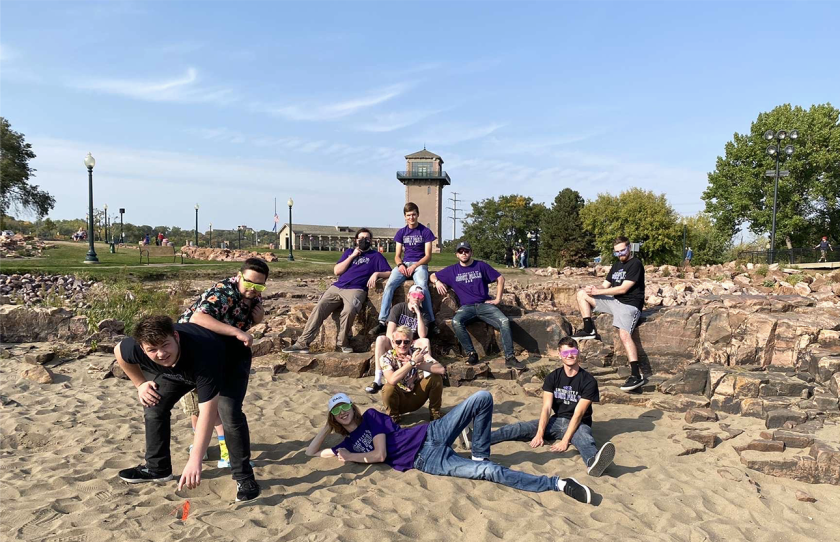
It didn’t take me long to make some of my closest and dearest friends. In less than a month, I became one of 15 members of an elite friend group known as the Goon Squad. At the first of our many Chili’s dinners — where we are now essentially on a first name basis with the staff and have gone through enough strawberry lemonade to quench a small village’s thirst — I realized I had found my people.

The Goon Squad.png

The Goon Squad at the first of its many photoshoots at Falls Park in Sioux Falls, South Dakota during the fall semester of 2020.                                                               
Samuel Martin/The Globe

However, even USF wasn’t immune to the hang-ups of Covid-19. In my first of three Madrigals at college, we would be lucky to have a full ensemble at rehearsal. At one point, I vividly remember being one of eight students at rehearsal while the other eight were in quarantine. As a result of the ongoing pandemic, we didn't have a live theatre dinner performance and instead filmed it to be aired on local TV the following month. In my regular coursework, over a week of my theology class was done online while my professor and his wife were in quarantine.

There was one loss from my life before Covid-19 that still creeps its way back into my life. On April 1, 2021. I lost my great-grandma Helen at the age of 93. She was one of my seven great-grandparents that I had met, and arguably the one I was closest with. At least once a month, we would have half-hour phone calls where she did most of the talking and I’d just nod my head and go, “Mm-hmm. Yep. Uh-huh.” We were so close that my dad joked that I was her favourite. In late 2020, she contracted Covid-19 and not long after would die from residual complications of the virus.

Just a month before, I was among the many students at USF who had finally gotten their first Covid vaccine, with the clinic offered in our on-campus library. I was also one of many who had an adverse reaction to it. I had a headache, a low grade fever and shivers, all of which went on for two days.

My first bout with Covid came just after I returned from a choir tour in Italy in May 2022. In order to return to the States, we all had to test negative the night before (it was the first time I had ever administered a test of my own). After flying out of Rome, we laid over in Paris for several hours before making our way to Minneapolis-St. Paul International Airport. It was on the bus ride back to Sioux Falls, South Dakota that something felt… off. I was sweating profusely and I had that tender soreness at the back of my throat that’s never a good sign.

After moving back home the next day, there was coughing and lots of it. I took a test that afternoon and saw two pink lines. I had tested positive. Also at home was my sister, who had contracted it in Florida while visiting a college friend. It was maybe just the next day that my mom tested positive and was quarantined in my room with me, where she slept for hours uninterrupted. Two days later, I saw that my dad was home, which was unusual for him on a Friday. Soon after, mom saw me sitting on the couch next to dad and asked why in the world we were sitting together. I just looked at her and said, “Dad tested positive this morning.”

What a weird time Covid was. I lost a loved one and gained over a dozen more. I traveled the world and came back with a souvenir I would’ve never dreamed of bringing back and sharing with my family. I had to learn how to be a student online. I had more free time than I knew what to do with at a time where I couldn’t do anything with it. And yet, I survived. In a way, that’s what life is. Losses, gains, adaptation, new journeys.

Life goes on, even — as I learned — in the middle of a pandemic that brings the world to a halt.

https://www.dglobe.com/news/local/column-diary-of-a-covid-shut-in

Thursday, July 25, 2024

Transit Diary: A week in the life of a Washington DC high school student

From ggwash.org

By Beckett Neustad

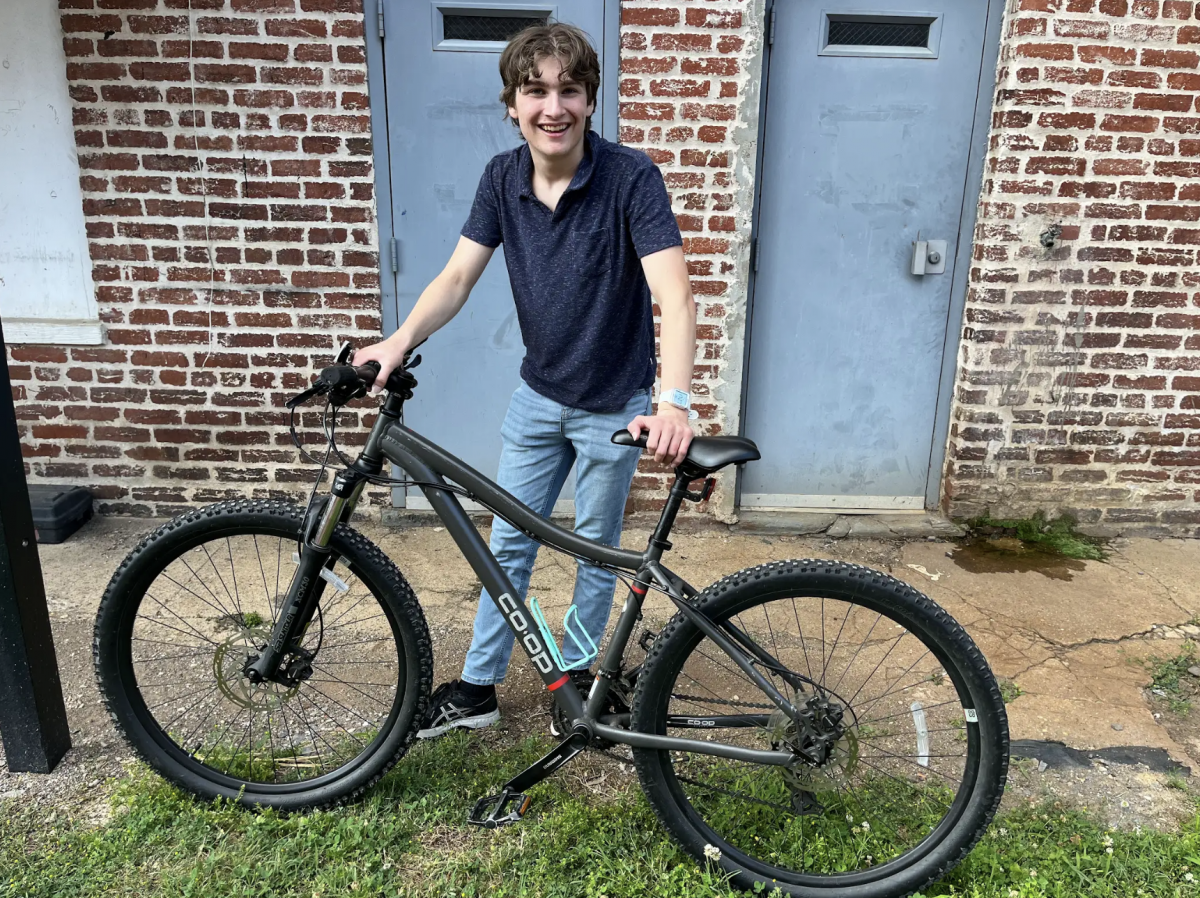
Beckett Neustad, pictured with his bicycle.

Transit Diaries is a series in which residents of Greater Washington track how they get around the region for a week, shedding light on what’s working well and not so well with our transportation systems. Read past Transit Diaries. 

Hello, my name is Beckett Neustad and I was an intern for Greater Greater Washington in the first half of 2024, and am a student at School Without Walls High School, located in Foggy Bottom. I live in the Eckington neighbourhood of Washington, DC, and typically commute via bicycle. I obviously spend most of my weekdays at school, but when I am not at school, I enjoy learning history, playing guitar and reading books. I also often spend my time doing homework, which is unsurprisingly a little less fun.

Day 1: Monday, April 29

I pretty much bike to school whenever I can. I am lucky to have a fairly direct route to my school with enough bike lanes to at least give the illusion of safety. Other than driving to school, which takes 30 to 45 minutes, my next best option is taking the Metro which usually takes roughly half an hour. Today I had to go to the GGWash Navy Yard offices at 1:30 pm for my internship, so I strongly considered taking the Metro from Foggy Bottom (where my school is) to Navy Yard. Ultimately, I decided to get out of my comfort zone and bike there.

I can’t say that the trip was easy. Navigating Southwest DC by bike wasn’t fun. Parts of I and M Streets were particularly bad. There was a lot of road work and the streets that weren’t being worked on were poorly paved. It didn’t help that I hadn’t memorized a route before setting out. The route I took turned out to be fine, but having to navigate in my head made things more stressful. In the end riding there ended up being a lot easier than the way back. I didn’t anticipate how difficult getting around the Capitol would be, leading me to take a roundabout route that added about 10 minutes to my journey.

Total distance travelled: Biking, 9.9 miles

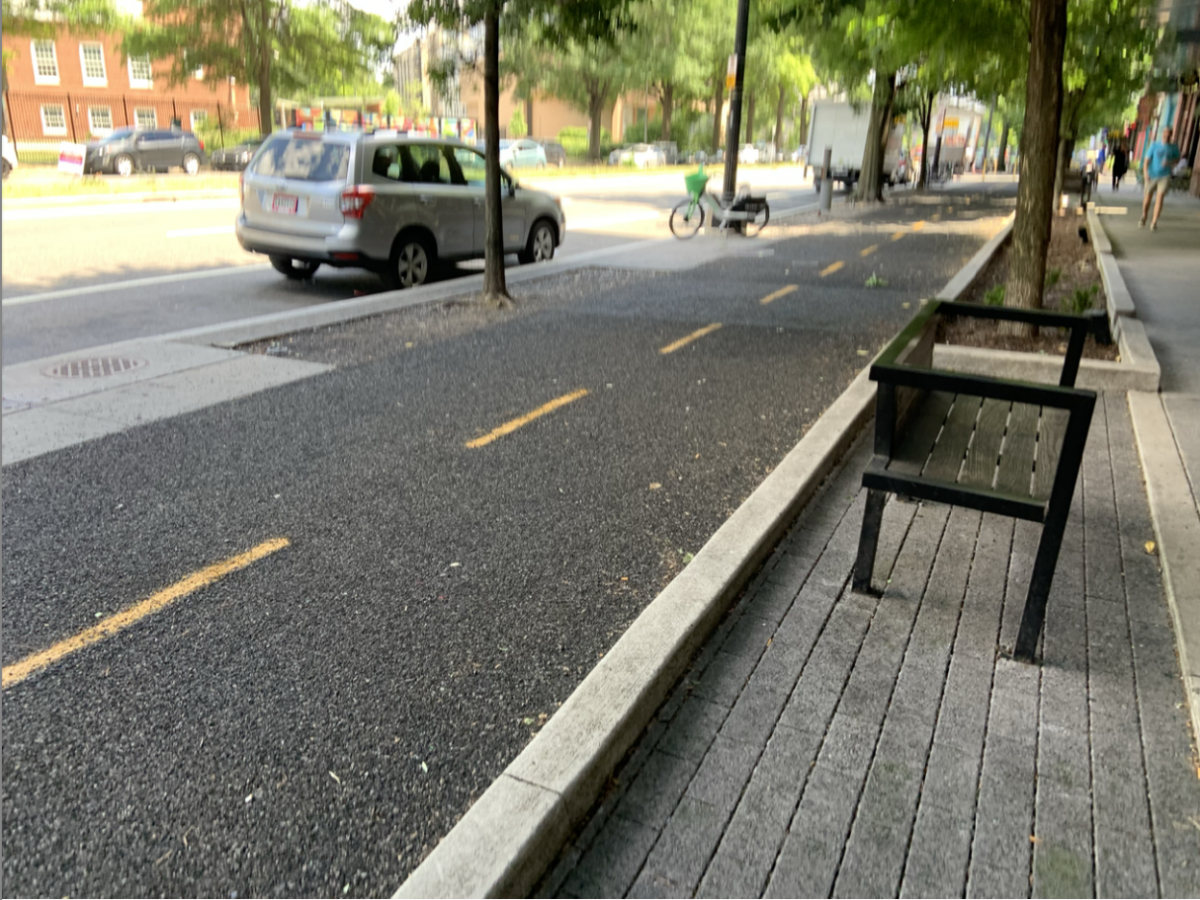
Highlights: Taking the bike lane on Raoul Wallenberg Place was very smooth and made that part of the commute very easy. I just wish the bike lane could continue on Maine Avenue so you could connect up with the trail at the Wharf. The trip to Navy Yard only took about 25 minutes, which was impressively fast considering the bad planning and bad infrastructure.

Hitch: As I mentioned before, the bike infrastructure in Southwest was not ideal and I found myself taking the sidewalks a lot.

Bike path along the Wharf. Image by the author.

Day 2: Tuesday, April 30

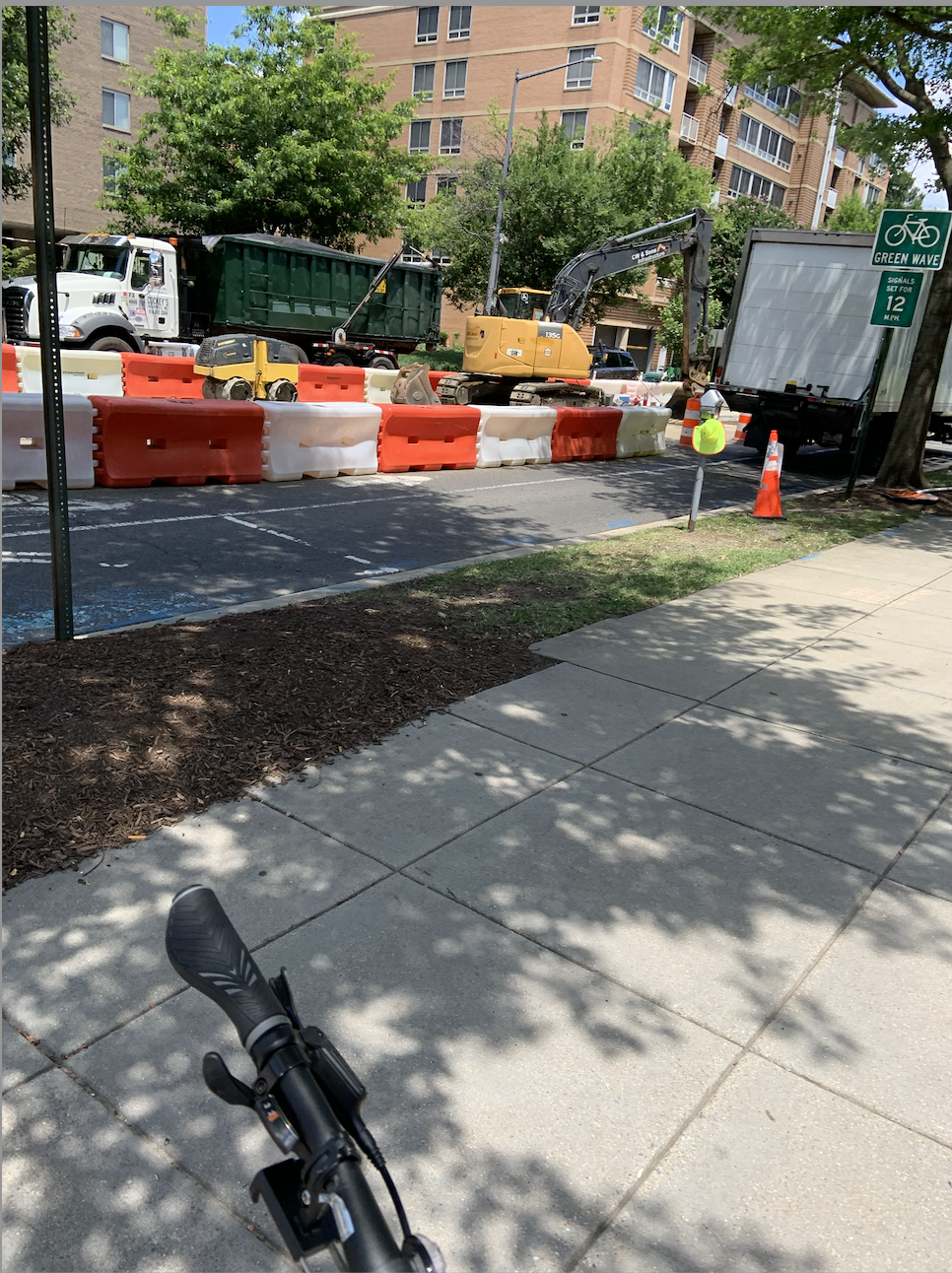
Today was GGWash’s Sweet Sixteen celebration and this made my commutes more interesting. I rode my normal route to school and back without any big hitches. For those who weren’t there, the Sweet Sixteen celebration was down at the Wharf. This necessitated my second trip through Southwest. Luckily, I learned from my previous mistakes and took a much better route around the Capitol, going around the eastern side instead of the western side. I also took an interesting route back from the Wharf, going northward on 12th Street, riding through the National Mall and taking the Metropolitan Branch Trail back.

Total distance travelled: Biking, 14.3 miles

Highlights: Taking the Mall back was very smooth. The sidewalks are wide so you don’t feel like you are at risk of hitting pedestrians. I just want to say that the MBT is absolutely amazing! It always has lots of activity and shows how projects that are geared toward walking and cycling can succeed.

Construction and a blocked bike lane means I take the sidewalk. Image by the author.

Day 3: Wednesday, May 1

After my two days of heavy commuting by bike, I was ready for a break. I did my normal biking commute to and from school. This is a good time to talk about what my commute is like. I like to think I have picked the best route to my school and back, both time- and safety-wise. On the way there, I take R Street until I get to Rhode Island Avenue, which I take to Logan Circle. I then turn onto Vermont Avenue, take it to Thomas Circle, and then turn onto M Street. I take M Street for a while before turning onto 20th Street and finally turning onto G Street, where my school is. On the way back I start by taking the reverse of my route to school, but I deviate from it by turning onto L Street and taking the bike lane there until I turn left onto 13th Street. I take 13th Street up to Rhode Island Avenue, which I take until I turn onto Q Street. I take Q Street all the way to First Street NW and continue on First to R, which takes me home.

Total distance travelled: Biking, 6.4 miles

Highlights: My commute is very fast by bike, solidly beating my time when driving or taking the Metro, despite the poor infrastructure through many parts of the ride.

Hitches: Biking along Rhode Island Avenue can be very scary. There are no bike lanes on the way to school and I have to ride in the third lane, sometimes having to dodge past illegally parked cars. The bike lane on L Street can also be very scary at times. The places where the bike lane shifts to the right to accommodate a left turning lane freaks me out since I have to look back each time to make sure cars aren’t changing lanes.

Day 4: Thursday, May 2

Boy, did I have a busy day in terms of transit! I did my normal commute without any problems in the morning, but my afternoon commute was disastrous! For context, I have wanted to get a new bike for a few months. My current bike is a mountain bike, which is great for mountain biking, but not for city riding. My mountain bike has also had a lot of issues with the gear shifter, which is what plagued my ride back from school. When I was crossing K Street and Connecticut Avenue and tried to shift gears, my chain came loose and got stuck in my gear shifter. This caused me to lose all my momentum and I almost flew off my bike. Luckily I was able to stabilize myself and make it through the intersection with only a few bruises. But my bike was broken. I managed to get the chain back on the bike and got home, but now I need a new bike as soon as possible.

On an unrelated note, today was also my mother’s birthday. We had scheduled a birthday dinner in NoMa, which we planned to walk to. It is a very short walk, but it involves going around Dave Thomas Circle, which is an absolute nightmare. It is being renovated, in a hopefully successful effort to improve traffic flow. Recently there have been people directing traffic during certain hours of the day, which has made things a lot safer. However they weren’t there when we crossed, forcing us to dodge traffic and walk in-between cars stuck in traffic. Other than that the walk was smooth and we took the MBT back, which was, suffice it to say, a lot safer.

Total distance travelled: 9.5 miles. Walking, 3.1 miles. Biking, 6.4 miles

Highlights: Not many highlights today but I can say that the MBT is still amazing. The next time it is suggested that we widen a freeway or road, we should widen this instead. It could certainly use extra capacity!

Hitches: My bike breaking was an obvious hitch, but at least that wasn’t due to poor urban planning. I am sure a lot of people reading this will know this already, but Dave Thomas Circle is one of the scariest places to be a pedestrian. I am hoping that the work will make things feel safer, but I have my doubts. In the meantime, it is terrifying to have to dodge cars in the middle of crosswalks and decipher unclear walk signals.

Day 5: Friday, May 3

I checked my bike last night and determined it would not be safe to ride to school in the morning, meaning that I would either have to drive or take the Metro. Readers of GGWash may be disappointed to know that I opted for the former. While the actual Metro ride is very fast, it involves 15 minutes of walking on either end, greatly extending the journey. This makes driving the second-fastest option after biking. Driving does have another upside: it gives me hours toward getting my provisional driver’s license.

For those who don’t know, there are two steps to getting a driver’s license in DC. First, you get a learner’s permit by passing a multiple choice test; then you need 40 hours of driving and to pass a driving test to get a provisional license. Finally, to get your full license you have to get another 60 hours of driving in. I am currently almost done with my hours and am planning to take my driving test soon, so driving to school does have a silver lining. In addition, because my father has to be in the car with me I don’t have to park.

Total distance travelled: 7.9 miles. Walking, 1.5 miles. Driving, 6.4 miles

Highlight: I took a walk around the GW campus during my lunch break today and the campus is quite pedestrian friendly.

Hitches: Rhode Island Avenue isn’t just a disaster to commute on by bike, it is also a disaster to commute on via car. Drivers are very aggressive and often try to pass you using the parking lane, only to have to honk their way back into traffic after getting stuck behind a parked car. This isn’t so much a hitch as bad urban planning, but there are several places on Rhode Island Avenue where there are crosswalks with no stop signs or lights where cars are instructed to stop for pedestrians. While this may be a good idea in theory, in practice it means that cars can zip past pedestrians who have to run across the six-lane avenue when there is a lull in traffic.

The Metropolitan Branch Trail (MBT).  Image by Joe Flood used with permission.

Day 6: Saturday, May 4

My only transit excursion today was going to get a haircut in Takoma Park. The Metro ride took about 25 minutes including walking on both ends. The ride went without any hitches and I made it in time for my haircut. My mother and sister met me there, and afterwards, I drove them back home, getting some more hours behind the wheel.

Total distance travelled: 11.7 miles. Walking, 1.7 miles. Driving, 4.8 miles. Metro, 5.2 miles

Highlights & hitches: The Metro trip was very smooth and fast. The walk to and from the Metro added a little to the duration, but otherwise I was very satisfied with it. Takoma Park is fairly walkable, there are some questionable intersections and the roads feel unnecessarily wide, but it has a car-free area and the sidewalks are passable.

Day 7: Sunday, May 5

This is by far my least interesting day. I spent most of the day on homework and preparing for exams. My one excursion was to my sister’s chorus recital near the American University law school. I drove there and back with my parents.

In terms of my transit decision making there was really no question that driving was by far the easiest choice. The second best option would have been to take the Red Line to AU, but this would have entailed a long walk from the Tenleytown Metro to my sister’s choir recital. A bike trip would have been difficult anyway and was impossible with my entire family going.

Total distance travelled: Driving, 13 miles

Highlights & hitches: The bike infrastructure in Ward 3 is very underdeveloped, making any bike trip difficult. It sure would be nice to have bike lanes on Connecticut Avenue.

While this may not be a highlight or hitch I think it is interesting that when traveling to places in upper northwest from where I live driving is clearly the easiest and fastest choice. Part of this has to do with the lack of Metro stops across upper northwest. The Red Line can take you to the most prominent areas of upper Northwest but there’s no way to get to areas far away from the Red Line without taking a long walk. A line going roughly horizontally across Northwest could help end this problem, though this would be far off in the future owing to WMATA’s current funding woes. Another part of this is the ease of access with a car. It is not hard to find parking and Massachusetts Avenue takes you most of the way there.

Final tally: 30 trips

ModeNumber of trips% of the total number of trips (rounded to nearest whole number)

Walking

827%
Biking1654%
Metro13%
Driving516%
Total300

Reflections

This was an interesting and informative experience. I had never really thought about my daily commutes like this. I found writing this diary very helpful for giving myself a document I can look back at to consider how I make choices on how I get around. This week was not necessarily representative of a normal week in my life, what with my bike breaking and having a lot of commuting to Navy Yard in the first two days. I was a little horrified by the fact that I drove the last three days, but this provided a good wake-up call for me and it was affected by circumstances beyond my control.

Keeping this diary also made me concentrate more on the things I would like to see changed. While I often think of these things when I am commuting, it was helpful to write these hitches down and think about possible solutions. My hope is that others will have encountered these problems and brainstormed their own solutions. Writing this has also made me appreciate the many ways in which our region is unique. We benefit from a great Metro system, and for all its flaws, my bike commute wouldn’t be possible in many other American cities. In the end, this reiterated for me the fact that the Washington, DC, region is great but it can be greater.

Beckett Neustad was a spring 2024 intern at Greater Greater Washington. A lifelong resident of the District, he first became interested in urban planning from his experience biking to school. He is also passionate about D.C. history and public policy. For fun, he likes to look at historic maps of D.C. to see how the city has changed over the years and ponder how we can improve it in the future.

https://ggwash.org/view/96372/transit-diary-a-week-in-the-life-of-a-dc-high-school-student