Showing posts with label Covid-19. Show all posts

Thursday, July 30, 2026

The Revelatory Cringe of Anthony Fauci

From theatlantic.com

By Gal Beckerman

The private notes of the man who oversaw COVID policy are deeply embarrassing—and surprisingly instructive 

My teenage daughter has a diary. It’s pink and, most important, has an elaborate lock on it. And if I could go back in time to 2020, I might send this exact sort of journal to Anthony Fauci. Every night, when he was finished sharing his thoughts about battling COVID, he could have locked it, scrambled the combination, and then buried it in his sock drawer, as I think my daughter does.

                                                                 Illustration by Jonelle Afurong / The Atlantic. Source: Peter Dazeley

Before this weekend, I would never have dreamed of comparing the former director of the National Institute of Allergy and Infectious Diseases with a teenage girl. But now that I’ve seen his diary, I’m convinced that my daughter has a more secure way of expressing her most private thoughts. I’m also willing to bet that she uses far fewer exclamation points than he does. “Stock Market crashing!” the president’s chief medical adviser writes on February 27, 2020. “Amazing day!” a few entries later. And on March 28, “WHAT A NIGHT!!!”

The contents of Fauci’s diary, revealed this past weekend and published online by Senator Rand Paul, are—there is no other way to put it—embarrassing to an excruciating degree. Eventually, we might read those notes differently, as a key text in the history of the coronavirus pandemic. But what we know right now is that during months when the country shut down, when panic and death dominated, Fauci was spending part of his time cataloguing his own growing fame with the excitement of a child star who had been asked to sign an autograph for the first time.

“Brewery in Georgia named a beer after me,” he writes. “Bobbleheads of me being made in massive quantities in China,” he adds on another day. “Intense publicity about me continues with stories of granmothers who have crushes on men. Petitions to vote me ‘Sexiest Man Alive.’” (All typos, just as embarrassing, are his.) He can’t seem to get enough of the attention. He compiles lists of famous people he has met or who have called to congratulate him. At times, reading this, I truly worried about someone who would take a call from Dionne Warwick to talk about vaccines in a moment when the country really needed him to be a bit more focused.

What makes this all the more unfortunate is that most of these excited personal asides come right under his listing of the figures for infections and deaths. “Global—3,300,000/230,000; USA—1,130,000/66,000,” the entry begins for May 3, 2020, two months into the pandemic. And then he proceeds to write, “Fauci-maddness continues with multiple articles and every sort of paraphernalia and restaurant and foods named after me.”

Those looking to discredit Fauci will surely make hay of these journal entries, which run from December 2019 to December 2022. Besides the self-regard, what Paul has picked on is Fauci’s openness in the early months of the pandemic to considering the lab-leak theory, which he disputed and delegitimized when talking with the press. “We’ve probably never ever seen people so completely at odds with their private thoughts, and then publicly proclaiming the opposite of what they were truly saying in private,” Paul told reporters this week.

The U.S. senator from Kentucky seems to forget, however, that this is what a diary is for: private thoughts. Fauci’s mistake was not in recording what was going through his mind and lifting his ego, but in doing so on government servers, which are never, ever private. For this, the 85-year-old has only himself to blame.

Would we want to live in a world, though, in which people couldn’t keep diaries? In 2020, Fauci found himself in a strange position: a man asked to become an avatar of science and authority when Americans were desperate for some semblance of certainty. He was at high-level meetings in the White House every day, on television constantly, portrayed by Brad Pitt on Saturday Night Live. What he put down in his diary was an unfiltered procession of his thoughts and observations as he was living them. And they are not all banal and self-obsessed. He was also describing his encounters with the president. He was working through his ideas. He was transcribing debates about policy and parsing transmission rates. It’s a diary. And if he seems to have been endlessly tickled by his own fame, this is also valuable data of a different kind—insights into the kind of complexity that we all contain. In retrospect, what seems unfair is that we expected one man to make the whole country feel safe, and then were surprised to find out that he’s only a human.

Many of us have probably kept a diary in our life. I did, in my 20s, although I’m sure that, as a self-serious young man, I insisted that it was a “journal.” I stopped as my life became more settled in my 30s and 40s, when the contours of my identity—of whom I would marry, what my children would be like, what career I would have—went from sources of anxious speculation to my actual reality. Most of us keep a diary at precisely those moments when we feel unmoored, when we feel assaulted by new stimuli or are forced to question who we are or what is happening to the world around us—phases such as adolescence, and wartime, and crisis. Fauci probably needed a private outlet for processing all that he was experiencing, and it’s a good thing that a diary can provide that. Would Twitter have been a better place for him to air his uncertainties, along with the details of calls from Barbra Streisand?

Some personal diaries do become public, ideally long after the subject is dead. The great ones don’t just provide private solace; they also reveal much about the times when they were written—precisely because their focus is on the personal. Think of what we learn about the plague in mid-17th-century London while we read Samuel Pepys detailing his many infidelities, or what Victor Klemperer exposes about creeping intimidation in Nazi Germany even as he is being petty and judgmental when it comes to other Jews. What makes those diaries such meaningful documents is that they are written by fallible people. They preserve consciousness before history has become history. They show what it was like to inhabit uncertainty.

I can’t claim that Fauci’s thoughts (both serious and silly) will have any lasting literary merit. In fact, I’m definitely not claiming this. But his not-so-secret thoughts do tell us something about the reality of the pandemic that he, and the rest of us, lived through—the frenzy and panic of it, and even the nervous exhilaration of living through what we all understood to be a sudden rupture in time. One day, historians might use this diary to help figure out what happens to a society under such pressure. They might see more clearly the way that people can become desperate for a saviour, and realize what a fantasy it is to imagine that such people exist.

https://www.theatlantic.com/books/2026/07/anthony-faucis-embarrassing-revealing-diary/688107/

Friday, July 3, 2026

Canada: Orillia author publishes pandemic diary chronicling COVID-19

From orilliamatters.com

By Tyler Evans

Langlois' memoir documents her personal experiences, volunteer work in local health care, and her perspective on the public health response during the pandemic 

Susan Langlois spent five years documenting the COVID-19 pandemic one journal entry at a time. Now, the Orillia resident has turned those handwritten observations into a nearly 400-page book she hopes will spark conversation about one of the most turbulent periods in recent history.

The retired biotechnology regulatory specialist recently released and self published Surviving the COVID Pandemic – Contents of a Diary, a memoir based on journals she began keeping at the outset of the pandemic in 2020.

Langlois said she felt compelled to document events as they unfolded because she believed the pandemic would become a defining historical moment.

"I said to my husband, 'I'm going to keep a journal. I've got to keep a journal and document events as they occur in real time,'" she recalled. "I thought this was going to be major."

A resident of Orillia for about 15 years, Langlois' professional background also influenced her decision to write. She spent 45 years in the biotechnology industry, working in regulatory affairs, clinical trials and quality management, and says that experience shaped how she viewed the pandemic response. 

Before retiring, she also volunteered extensively with Orillia Soldiers' Memorial Hospital, serving on several committees, including the hospital's ethics committee and patient advisory committee. She also chaired the Patient and Family Advisory Committee for the Couchiching Ontario Health Team.

Orillia resident Susan Langlois has released a self-published memoir based on journals she kept throughout the COVID-19 pandemic. She says the book chronicles her personal experiences and observations during the public health crisis. 

Langlois said she dedicated much of her retirement to volunteering after the hospital saved her life decades ago as a child.

"I had an inflammation of the liver, and my parents took me to Soldiers. They said I probably wouldn't live through the night," she said. "They pulled me through. When we moved here to retire, I said, 'I'm going to give back.'"

Throughout the pandemic, Langlois said she filled multiple journals with observations from her volunteer work, committee meetings and personal experiences. Encouraged by her husband and son, she spent the past year turning those journals into a book.

The resulting memoir spans 394 pages and recounts her experiences during the pandemic in Orillia while also examining broader public health decisions through the lens of her professional background.

Langlois argues in the book that governments, healthcare institutions and pharmaceutical companies made significant mistakes during the pandemic and says she hopes readers will examine those decisions critically. Many of the book's conclusions challenge mainstream public health guidance from the pandemic and reflect the author's perspective on events.

"I wanted to document things as they happened," she said. "It's not an opinion piece. It's like Anne Frank's diary. It's captured in real time."

The book also chronicles deeply personal experiences, including the death of her mother in long-term care during the pandemic and the isolation she says many families experienced because of visitor restrictions.

Langlois said she believes those stories will resonate with readers who experienced similar hardships.

"So many people were affected," she said. "People lost loved ones, people lost jobs, families were divided. I experienced almost every aspect of it."

She acknowledges the book may generate criticism, particularly because it references local institutions and pandemic-era decisions in Orillia, although she said she does not identify local individuals by name.

"There could be risks, but quite frankly, I don't care," Langlois said. "People have to speak up."

The book was released last week and is available through Amazon, Indigo, Barnes & Noble and the author's website. It is available in hardcover, paperback and e-book formats.

"My hope is that people read it and remember what happened," she said. "I don't want us to forget."

https://www.orilliamatters.com/local-news/orillia-author-publishes-pandemic-diary-chronicling-covid-19-12476260

Sunday, April 12, 2026

The diaries of a lockdown generation

From bps.org.uk 

When Nicola Madge, Honorary Professor, Kingston University London, and Chartered Psychologist and Associate Fellow of the BPS, had the idea to ask a group of over 70s to keep a lockdown diary, she had to act quickly. Here’s what happened…


At the beginning of March 2020 ... I had no idea that I would be embarking on a new, demanding research project, but then again, could any of us have envisaged what was ahead of us during this time?

As a retired professor, I was just at the point of anticipating the publication (and, as it turned out, cancelled launch event) of my newest book Sixty Somethings. The lives of women who remember the Sixties, when we entered a strange and unprecedented period in our lives. There was talk of a virus sweeping the world, and it was getting closer. By mid-March it was clear that it was coming for Britain. Were we prepared and how would we react? 

For my part, I woke up on Thursday 19 March 2020 knowing, like the rest of us, that the first lockdown was about to be announced and wondering what it would mean . Life was going to be more restricted, but I didn't want to just sit it out. I wanted something to do and something that was constructive. There was a suggestion, which in fact never materialised, that those over 70 years might be treated alongside the particularly vulnerable and told to stay at home while others went about their daily business. I began to wonder whether I could get a group of older men and women together to write diaries and record their thoughts, feelings and experiences as they happened. It would be a great historical record if I could. 

Conducting a diary project was pragmatic. Provided it was possible to recruit participants, diary entries would enable accounts to be written in the here and now rather than sometime later when memories might become distorted. It was also feasible in the context of the pandemic.

This approach also had a particularly personal meaning for me. I am the niece of Charles Madge, one of the founders of Mass Observation, a movement initially set up in the 1930s that, among other things, encouraged members of the public to write diaries to record their thoughts and experiences during the second world war. I was keen to follow in his footsteps, albeit in a more modern way. I have also kept a daily diary since I was nine and a half years old. 

The idea grew on me and I immediately drew up a plan for a project. If I was going to do this, I had to act quickly. The pandemic wasn't going to wait. As I was self-funding, and working alone, I could go at my own pace.  

I felt reasonably confident that I would be able to enlist men and women aged at least 70 to take part. Some of the 69 participants in the Sixty Somethings project would fall within the appropriate age group and might be willing to take part. In turn, they might know others who would like to join in. In addition, I had many other contacts that might wish to become involved or who could send the invitation to participate to others. If I was lucky, there would be a snowball effect. Feeling optimistic, I embarked on a recruitment drive on Saturday 21 March 2020. 

The response was enthusiastic and exceeded my expectations. Just over 70 participants were initially recruited, and 68 were finally included in the project. It was essentially a white and middle-class sample, with more than twice as many women as men. Most, but not all, diarists were fully retired, almost all said their living space was good or excellent, and the majority lived somewhere in England. I was fully aware that the participants were not representative of the age group or the population as a whole, but at the same time I could see that the project afforded an opportunity to study a specific demographic in considerable detail. These older diarists would also no doubt provide their perspectives on family and friends, local communities and the wider society. What the study might lack in breadth, it would make up for in depth.

Time was perhaps an important element enabling the project. The diarists, as I discovered, were an energetic group of older people with activities, projects, families and friends to keep them busy. Nonetheless, and for a while anyway, time took on a new meaning when familiar routines were curtailed. 

Anna: Friday 3 April 2020 

What did I do today? It's getting hard to account for time. 

Humphrey: Saturday 2 May 2020

As for the diary of events, or non-events more like, each day melds seamlessly with the next. Could this be what a prison stretch feels like? We know that the best thing is to take it one day at a time, but this way years could slip by.

It was thus opportune that it was just at this time that they were being asked to write diaries. It was a challenge, and it was an occupation. 

The invitation to participate outlined what would be expected. This was, first, to provide some basic demographic information, a pseudonym by which they would be known, and a retrospective diary entry to record their perceptions and reactions since they had first heard of the coronavirus. After this they would write their diaries as often as they could, but hopefully at least three times a week, for an initially unspecified time (which turned out to be the end of July 2020, four months later). They would also be asked to participate in two subsequent follow-ups (which actually became three!) as restrictions changed. Most diarists contributed to the project throughout although they varied in the extent of their contributions. 

I was in constant touch with the diarists and the project kept me occupied. I received some diary entries most days, which I read, acknowledged and logged. There was also a weekly email that I sent round on Thursdays to maintain the impetus and also suggest aspects of the pandemic that diarists might want to comment on. These were often issues raised by diarists themselves. For example, one diarist had asked whether fewer women than usual were wearing a bra during the pandemic. Another wondered whether anybody else had witnessed pets and other animals affected by the lockdowns. 

There were also challenges that were met with enthusiasm by the diarists. First, I instigated a lockdown recipe challenge. Most diarists sent in their favourite meals, with cooking instructions, which I then collated and sent round to all participants. My own recipe for this challenge was my signature dish of ham stuffed with leeks. Subsequent challenges, with entries again collated and sent round, were for a lockdown poem, and for Desert Island lockdown books, films and TV programmes. The project was not only charting an exceptional period in modern history but was fun. I became friends with the diarists even though I had never met most of them. They were confiding and humorous. I wish there had been a lockdown joke challenge! 

As the months rolled by, I needed to set a date for the end of the main stage of the project. I settled on the end of July. It was a relief in that I had gathered so much material that I didn't feel that I needed any more. But it was also sad, the end of a short era. The diarists too were mixed in their views. 

Araminta: Friday 24 July 2020

Another week gone. Where does the time go? I am glad this duty is coming to an end. At the beginning of lockdown, I felt it was important to keep a diary and I have kept my own private one going, but now, as with your diary, I find I am not making many entries.

Sardomike: Monday 27 July 2020

Here we are, writing the final entry, it's been like the Sword of Damocles hanging over one's head, the thought 'oh yes, I have a diary entry to do' but, once started – no problem, enjoyable to let the words flow.

Taranaki: Friday 31 July 2020

Dear Diary, I shall miss you! Today will be my last entry of this long-haul monologue about my life during the 2020 pandemic of the COVID19 virus. It has really helped me to organise and rationalise my thoughts and feelings during this truly ghastly period.

Will: Sunday 2 August 2020                                                                                               

The last day of the diary. It feels almost like a bereavement, having seen the diary as a part of my life for the last few months and as a way of encapsulating what I feel about the pandemic, the government's lamentable handling of it and about everything else that's going on in this country and more widely.

The end of July was, however, more of a reprieve than a finality. Two main follow-ups were to follow. The first was in September 2020 when most restrictions had been lifted and a vaccine was in sight, and the second was in February 2021 following two more lockdowns, the introduction of bubbles, the turnabout at Christmas 2020, and widespread vaccination. Some diarists wrote further entries following the so-called Freedom Day on 19 July 2021. 

Finally, however, the end arrived. The diarists had written around a million and a half words between them, and I had to make some sense of it all. My first task was to go through all contributions again, cataloguing them by broad theme and indicative content. Summaries were then used to plan the structure of the ensuing report. There was an interest in both commonality and diversity among the participants as well as relevant illustration. The purpose of the project was not to test a specific hypothesis but to provide a grounded account of lockdown life for a group of comfortably-off over seventy-year-olds living predominantly in England. 

The data were rich in interest, poignancy and humour, and I was keen to publish the study for the diarists, for social scientists and historians, and for myself. The next task was accordingly to start writing. I would be able to use only a fraction of the excellent material collected, and I needed to tell a story. As the virus was intangible, and had to be surmised rather than seen, I deemed that a, mainly and light touch, framework of symbolic interactionism and related social psychological perspectives was appropriate. Subjective meanings relating to the pandemic were derived from interactions not only with other people, but with the changed physical environment, and the messages conveyed through the media. Pragmatic adaptation and self-presentation, imbued with personal agency, were also very evident among diarists who reacted according to their own perceptions of the changed circumstances. The findings are also set within the political and legal context as well as alongside contemporary research and comment. 

I was, by the time of assembling and writing up the data, in communication with a publisher that was, in principle, interested in publication, but there were a number of review stages to pass through before the manuscript was accepted. It was a protracted task. The publisher was, however, helpful, and most of my wishes were taken into account. The only disappointment on my part was the high cost of the book which I had not appreciated when I embarked on the process. This was a downside of being self-financing and not having funds to reduce the cover price.

Overall, the project was an amazing personal learning experience. Despite having face-to-face contact with a very limited number of people, I was in daily contact with many people I had never met but who were sharing their daily realities with me. I could witness what I could not see. I had a vicarious insight into the reality of the pandemic for a particular demographic. This was a group who acknowledged that they were among the most fortunate, but also had their worries and anxieties, if not for themselves then for their family and friends. I became intrigued by strategies for sanitising shopping and by the myriad uses Zoom could be put to, and sobered by their thoughts on lockdowns and the management of the pandemic. Whatever else, I was most certainly educated and entertained.  

My overall reflections are that I am glad I carried out the project. It was fun and kept me busy at a time when we were locked down in our homes. But I am aware that I was able to carry it out only because I had not been dependent on getting funding and hence held up by the process. In the case of the pandemic, it was essential to get going quickly if the data collected were to be current. If I had still been a fully employed university professor, I would not have been able to conduct the research. The downside, of course, is that I did not have access to research assistance or administrative support. 

There are usually advantages and disadvantages in life and, in the instance of the diary project, I think that the former outweighed the latter. There was also icing on the cake. Nobody else, as it turned out and as far as I am aware, paid such attention to older men and women in their pandemic studies. I had ensured that they were not a neglected group.

  • Nicola Madge (2025) Lockdown Life. The pandemic experience for older diarists, Bristol: Policy Press is available from 20 March 2025.

Tuesday, March 18, 2025

Column: Diary of a Covid shut-in

From dglobe.com/news/local 

By Samuel Martin

From home to overseas, Covid was never far behind

WORTHINGTON — Even though Covid-19 has changed everyone’s lives in one way or another, it feels like a lifetime ago since I was in the thick of it. I came into the pandemic as a Minnesota West student and came out the other side a Media Studies major at the University of Sioux Falls. Friends have been made, family has been lost and toilet paper will no longer be taken for granted.

                                                    Samuel Martin                    
Tim Middagh / The Globe


I vividly remember my Ethics Theory and Practice professor Maureen Sander at Minnesota West telling us just weeks before the spring break of 2020 that there was a new illness in Wuhan, China that had spread throughout the country and was beginning to spread into Europe. She asked the class what we made of these reports and cases growing in number. I said nothing, thinking that it wouldn’t make its way across the Atlantic or Pacific. Just several weeks later, I and everyone else in the United States was proven wrong.

My family and I were spending what was my spring break in Mesa, Arizona, where my Grandpa and Grandma Martin went to snowbird, when I got news that my break would be extended by another two weeks. I was mixed on the move; two more weeks meant two more weeks of me playing guitar, which is always welcomed! On the other hand, it also meant two weeks of me not keeping up my progress in math, a subject I have never excelled in.

As we all know, those weeks turned into months. My grade in algebra plummeted to a D+ as I was unable to work one-on-one with my professor, Mike Wieslink. Our choir’s plan to perform “For Good” — originally to have been sung live at graduation commencement — had to be done from the comfort of our homes, where we recorded each of our voice parts to be put together in a video. Even graduation lacked pomp and fanfare. My family watched online as my sister and I graduated from college. My best friend, Max Langerud, and I had made plans to go biking around the lake that day and as soon as my name was called, I said, “Ay! …alright, I’m gonna go into town and bike with Max.”

One thing that struck me was how desolate everything was, especially in Worthington. I began playing Dungeons and Dragons with my dear childhood friends and the streets were nearly empty when I’d drive over to play our weekly campaigns at one of their homes. At Wal-Mart, the chaos and desolation among the aisles and store shelves weren’t too far from being something out of a “Mad Max” movie. Shelves were half-empty, items were strewn about… It still confuses me that toilet paper, of all things, was in such high demand. At one point, I took one of only four packs of toilet paper still left on the shelf.

After several months of ennui and being in a lockdown where I could only either call or meet up with people over Zoom, I finally started the next chapter in Sioux Falls, South Dakota, where I had transferred to the University of Sioux Falls. While masks were still required during my first year there, there were in-person classes again.

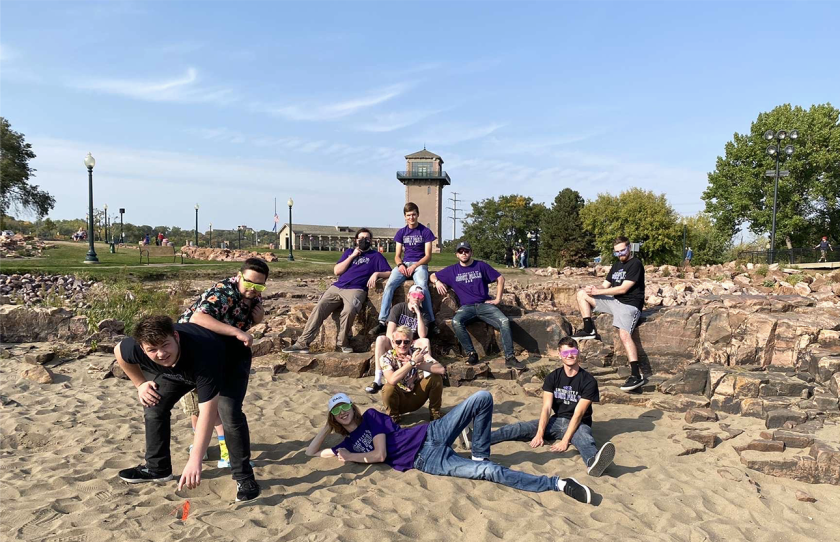
It didn’t take me long to make some of my closest and dearest friends. In less than a month, I became one of 15 members of an elite friend group known as the Goon Squad. At the first of our many Chili’s dinners — where we are now essentially on a first name basis with the staff and have gone through enough strawberry lemonade to quench a small village’s thirst — I realized I had found my people.

The Goon Squad.png

The Goon Squad at the first of its many photoshoots at Falls Park in Sioux Falls, South Dakota during the fall semester of 2020.                                                               
Samuel Martin/The Globe

However, even USF wasn’t immune to the hang-ups of Covid-19. In my first of three Madrigals at college, we would be lucky to have a full ensemble at rehearsal. At one point, I vividly remember being one of eight students at rehearsal while the other eight were in quarantine. As a result of the ongoing pandemic, we didn't have a live theatre dinner performance and instead filmed it to be aired on local TV the following month. In my regular coursework, over a week of my theology class was done online while my professor and his wife were in quarantine.

There was one loss from my life before Covid-19 that still creeps its way back into my life. On April 1, 2021. I lost my great-grandma Helen at the age of 93. She was one of my seven great-grandparents that I had met, and arguably the one I was closest with. At least once a month, we would have half-hour phone calls where she did most of the talking and I’d just nod my head and go, “Mm-hmm. Yep. Uh-huh.” We were so close that my dad joked that I was her favourite. In late 2020, she contracted Covid-19 and not long after would die from residual complications of the virus.

Just a month before, I was among the many students at USF who had finally gotten their first Covid vaccine, with the clinic offered in our on-campus library. I was also one of many who had an adverse reaction to it. I had a headache, a low grade fever and shivers, all of which went on for two days.

My first bout with Covid came just after I returned from a choir tour in Italy in May 2022. In order to return to the States, we all had to test negative the night before (it was the first time I had ever administered a test of my own). After flying out of Rome, we laid over in Paris for several hours before making our way to Minneapolis-St. Paul International Airport. It was on the bus ride back to Sioux Falls, South Dakota that something felt… off. I was sweating profusely and I had that tender soreness at the back of my throat that’s never a good sign.

After moving back home the next day, there was coughing and lots of it. I took a test that afternoon and saw two pink lines. I had tested positive. Also at home was my sister, who had contracted it in Florida while visiting a college friend. It was maybe just the next day that my mom tested positive and was quarantined in my room with me, where she slept for hours uninterrupted. Two days later, I saw that my dad was home, which was unusual for him on a Friday. Soon after, mom saw me sitting on the couch next to dad and asked why in the world we were sitting together. I just looked at her and said, “Dad tested positive this morning.”

What a weird time Covid was. I lost a loved one and gained over a dozen more. I traveled the world and came back with a souvenir I would’ve never dreamed of bringing back and sharing with my family. I had to learn how to be a student online. I had more free time than I knew what to do with at a time where I couldn’t do anything with it. And yet, I survived. In a way, that’s what life is. Losses, gains, adaptation, new journeys.

Life goes on, even — as I learned — in the middle of a pandemic that brings the world to a halt.

https://www.dglobe.com/news/local/column-diary-of-a-covid-shut-in

Friday, December 29, 2023

What COVID diaries have in common with Samuel Pepys’ 17th-century plague diaries

From theconversation.com

By Mary Rehman

People keep diaries for all sorts of reasons – to record events, work through difficult situations, or manage stress and trauma. The ongoing COVID inquiry shows diaries also have important political and historic significance. The UK’s former chief scientific adviser Patrick Vallance’s diaries have been a key source of evidence, exposing the chaos within government at the time.

In my PhD research, I’ve been exploring the COVID diaries of ordinary people, as well as diaries kept during the Great Plague of London in 1665-66. Though centuries apart, these diaries are full of insight into how people react to crises, and have surprising similarities.

From the first lockdown in March 2020, media outlets, archive centres and researchers encouraged people to record their pandemic experiences. Even BBC children’s entertainer Mr Tumble urged young viewers to start a diary.

This has resulted in a large number of COVID diaries being made available in archive collections around the UK, plus many more online in the form of blogs or social media. I’ve been looking specifically at 13 COVID diaries donated to the Borthwick Institute for Archives and the East Riding Archives, both in Yorkshire. Most were originally private documents, offering a more spontaneous, honest and intimate portrayal of pandemic experiences than their online counterparts.

Diaries written during the Great Plague are not so numerous. Of the few available, the most valuable is that of naval administrator Samuel Pepys (1633-1703), whose exceptionally detailed and candid journals form by far the most comprehensive first-hand account of plague-stricken London.

I have been reading Pepys’s diaries alongside the modern COVID diaries, and have been struck by the common themes in how people navigated their pandemic experiences.

Recording statistics

Throughout the COVID pandemic, statistics of cases and deaths were everywhere, and were key to how we judged the impact of the virus. As diarist JF wrote on June 5 2020:

It was time to watch the Corona Virus update and I was shocked to find that over 40,000 people have now died from the disease in this country and it’s not over yet!

Relatively accurate information was also widely circulated in 17th-century London via the “bills of mortality” – weekly lists of deaths according to cause and location. Pepys wrote on September 7 1665:

Sent for the Weekely Bill and find 8252 dead in all, and of them, 6978 of the plague - which is a most dreadful Number - and shows reason to fear that the plague hath got that hold that it will yet continue among us.

All of the modern and historical diaries I have looked at include these statistics – some sparingly, others with meticulous regularity.

The blame game

As cases rose, restrictions were enforced and the effects of plague and COVID loomed large in the lives of our diarists, narratives shifted to confusion and blame. Pepys was largely sympathetic to the government’s handling of the plague and, in February 1666, criticised those who flouted the rules and endangered others:

In the heighth of it, how bold people there were to go in sport to one another’s burials. And in spite to well people, would breathe in the faces … of well people going by.

COVID diarists reacted to those who didn’t follow guidelines in a very similar way, as DR wrote in March 2020:

Not everyone is playing it very well, though, with panic-buying, one last night at the pub and a mass exodus to the coast. Stupid and selfish in equal measure.

The response and actions of the UK government, and individual members of parliament, also afforded much attention. An anonymous diarist wrote in May 2020:

People are being allowed out more but the illness is still out there & there’s no treatment or vaccine yet … There are fewer deaths because of social distancing. If they let everyone get on with the ‘new normal’ surely more people will get sick?

Staying positive

A more optimistic theme to emerge in the diaries was the ability to find positivity amid the chaos. Pepys and modern diarists were thankful for the blessings of health, family and security. They praised those who went the extra mile to mitigate the impact of the pandemic on those around them, despite the risk to their own health. An entry from New Year’s Eve in 1665 reads:

My whole family hath been well all this while, and all my friends I know of, saving my aunt Bell, who is dead, and some children of my cozen Sarah’s, of the plague … yet, to our great joy, the town fills apace, and shops begin to open again. Pray God continue the plague’s decrease!

DW’s diary from April 2020 expressed appreciation for time out in nature, as well as sympathy for others living in more difficult situations:

It was lovely walking through the wood. The air was filled with birdsong. It made me realise how lucky I am to live in a village where I can walk from my front door into fields and woods along defined paths. It must be awful to live ten floors up in a high rise block with two children, and not be allowed out except for once per day.

                       Keeping a diary can be good for wellbeing, as well as recording history. Vergani Fotografia/Shutterstock


Comparing COVID with historical events such as plaguethe Spanish flu epidemic and the second world war was a core element of the pandemic narrative, and for good reason. History connects.

It is easy to look around us and see the vast differences between the world we live in now, and that which Pepys traversed almost 400 years ago.

But by exploring the innermost thoughts of people with an element of shared experience, we see that fundamental aspects of the human condition endure. When faced with uncertainty and upheaval, our instincts are to record, find answers, and reclaim joy.

https://theconversation.com/what-covid-diaries-have-in-common-with-samuel-pepys-17th-century-plague-diaries-219274