Keeping A Diary

Saturday, November 21, 2020

Alan Rickman’s Diaries Spanning 25 Years To Be Published

 From unilad.co.uk

Alan Rickman's Diaries Spanning 25 Years To Be Published 
                               PA/Warner Bros.

Alan Rickman’s 27 diaries, spanning a quarter of a century, are set to be published in one book. 

The late Harry Potter legend, who passed away in 2016 at the age of 69, was known for keeping a record of his musings.

In the early 1990s, the actor began writing a diary by hand, with the idea it’d be published sometime in the future. Soon, his ambition will be realised.

The Diaries of Alan Rickman are set to be published by Canongate, with Scottish Review of Books editor Alan Taylor on-board to edit the ‘witty, gossipy and utterly candid’ collection.

Rima Horton, Rickman’s widow, said, ‘The diaries reveal not just Alan Rickman the actor, but the real Alan – his sense of humour, his sharp observation, his craftsmanship and his devotion to the arts,’ as The Guardian reports.

Taylor described the thespian’s writings as ‘anecdotal, indiscreet, witty, gossipy and utterly candid, they make compulsive reading and offer a peerless insight into the daily life of a remarkable actor who was as beloved in the US as he surely was in the UK.’

The diaries provide an insight into Rickman’s life, whether it’s his upbringing or reviews of plays he attended, ‘some rapturous and others scathing’.

Canongate said in a statement ‘More than anything though, the diaries reveal the real Alan Rickman, funny, passionate, occasionally provocative, and give fresh insight into his art’.

Alan Rickman Harry Potter 
                        Warner Bros.
 

It added, ‘He wrote his diaries as if chatting with a close friend. They provide pitch-perfect vignettes: short, pithy paragraphs painting big pictures, and offering intriguing insights into himself, his peers and the world around him. They are intimate, perceptive and very funny’.

The Diaries of Alan Rickman will be published in 2022. 

https://www.unilad.co.uk/film-and-tv/alan-rickmans-diaries-spanning-25-years-to-be-published/

 
at November 21, 2020 No comments:
Email ThisBlogThis!Share to XShare to FacebookShare to Pinterest
Labels: famous

Derval O'Rourke: How to make your thoughts become actions

From irishexaminer.com

It is easy to feel gloomy at this time of year. Lockdown is not pleasant. We would prefer to be out and about meeting for coffee or a drink. There is a monotony to our lives. But you can still get out and exercise even in the rain, I promise! Every day is a chance to make new discoveries in your immediate surroundings and take this time as a phase in our lives that we can use to do other things. This week I’ll chat about journaling...

Derval O'Rourke: How to make your thoughts become actions

I have always loved journaling. Even before my training days, I used to keep a journal and have always found that writing down your thoughts and goals makes them seem so much more achievable. There’s something about having your goals down on paper that makes them real and more tangible. The world seems clearer. Journaling is good for keeping the spirit upbeat and focused.

Recently I launched my own journal! I’ve always wanted to do it but could never quite get my head around why my journal would be special. Then about two months ago I had a lightbulb moment where it started to come together in my head as a really practical but beautiful healthy lifestyle journal. 

Derval O'Rourke's Healthy Lifestyle Journal

     Derval O'Rourke's Healthy Lifestyle Journal

I used lots of practical resources such as portioning, shopping lists and goal setting but combined these with the beautiful illustrations of Belinda Northcote. My journal was designed and printed locally which I’m so proud of.


What is journaling?

You may have stopped using a diary once you reached adulthood. But the concept and its benefits still apply. Now it’s called journaling. It's simply writing down your thoughts to understand them more clearly. And if you struggle with stress, losing focus or the feeling of 'too many thoughts' in your head, keeping a journal is a great idea. It can help you gain control of your emotions and improve your mental health.

One of the ways to deal with any overwhelming emotion is to find a healthy way to express yourself. This makes a journal a helpful tool in managing your mental health.

Journaling can help you:

Achieve your goals
Once you have some clear goals, you then start working towards them. Revisit the journal throughout the day, but do not worry if you haven’t managed to achieve everything on the list. Be proud of what you have achieved and tackle what you can.

Keep you focused
By writing down all the thoughts in your head, you are putting them down on plain paper and this makes it 10 times easier to start organising them. Most of us have a near-endless list of tasks to get done every day and sometimes it can be overwhelming and difficult to know where to start. Seeing them written down, allows you to allocate a certain amount of time to them and set a realistic deadline to achieve.

Manage anxiety and reduce stress
By becoming aware of your thoughts and feelings, it becomes easier to take action. Recognising what is causing stress allows you to tackle it much easier. Journals help us to make our troubles clearer by identifying them and give us a sense of what needs to be dealt with, to help us feel our very best. Once you’ve identified your stressors, you can work on a plan to resolve the problems and reduce your stress.

Tips for first-time 'journalers' 
Writing down your thoughts and feelings might not sound appealing to you, or you might be very new to the idea of it and not know how to start. If that’s the case, you can try out a few other ways to use a journal to boost your productivity and wellbeing.

  • Simplify the journal and use bullet-point format.
  • Buy a journal that makes you want to write in it. I know when I have a fresh journal, I can’t wait to fill the pages with all my plans, tasks, and exciting projects.
  • Track something of interest to you. Maybe log your sleep, how long you slept, how you felt going to bed and waking up. Start small.
  • Bring your journal everywhere and jot down any random thoughts you have. Then at the end of the day, piece these smaller entries into a bigger one and summarise your day.
  • Have a space for a fun list. This could be a list of dinner recipes you want to try or a list of fun activities you’ve always wanted to try — a bit like a bucket list.
  • If your mind goes really blank and you have no idea what to write, look up some journaling prompts. Usually, by searching a topic and adding 'journal prompts' you’ll find a list of them. Pick your 3 favorite ones and answer them!

Fitness tip: Try to see if you can squeeze in a short workout before you go to work or your day starts. You can be so surprised with how much energy it will give you — and it can provide you with some mental clarity too.

Wellness tip: Treat yourself to a new journal and aim to write something small into it every day. Plan your days and write down your tasks to stay focused and reach your goals. I have a lovely journal on my online shop, available for purchase for €15. Visit my new exciting online shop Shop.Derval.ie

https://www.irishexaminer.com/lifestyle/food/arid-40080824.html 


at November 21, 2020 No comments:
Email ThisBlogThis!Share to XShare to FacebookShare to Pinterest
Labels: journal, lifestyle

Wednesday, October 28, 2020

New Parents, You Won’t Regret Keeping a Journal

From nytimes.com

A baby book may require too much time and energy, but you and your child will treasure a few notes about this time

                   Credit...Beth Hoeckel

After my daughter was born, I moved into my parents’ house in New Jersey for three weeks with my husband. As a clueless first-time parent, I knew I would need their guidance.

One morning when I was blearily changing my daughter’s diaper, I asked my mom when I started sleeping through the night as a baby.

She shrugged. “I have no idea,” she said.

Later I asked her when I started eating solid foods. “I think you had colic,” she said. That was my sister, I reminded her. Starved for any kernel of information about that first year, I asked her what she did remember.

She thought for a moment. Her lone recollection was that when she was pregnant, she craved Popsicles. And the cigarettes she had given up.

I wished she had written something, anything, down. It would have been gratifying to read an account in her voice as she faltered through parenthood as I was doing now. But at the time, she was an overwhelmed young mom herself, attempting to raise a baby thousands of miles from her own family in Alabama.

I kept thinking of my own daughter, and how, in the far-off future, she might welcome these little tidbits if she became a parent herself. I began to write down everything I could remember about her birth. I wrote about how it was misty and the birds were singing on that predawn May day that we drove to the hospital. How, when I arrived, I dramatically announced to the receptionist that I was in labour, expecting to be immediately rushed away on a gurney like I had seen in the movies. (“Uh huh, take a seat,” she said, barely looking up.)

Making sense of the ‘confusion and chaos’

Even though it was usually the last thing I wanted to do at the end of the day when I was bone-tired, I started jotting down a few lines, once or twice a week — although I assumed I would certainly remember the details of the most significant event of my life.

Recently, I read over what I had written the first year, and was astonished to realize I had completely forgotten a good three quarters of it.

Which is no surprise. While research on so-called “baby brain” is mixed, the effects of fatigue — the bane of new parents — on memory are well-documented, said Rachel Marie E. Salas, associate professor of neurology at Johns Hopkins.

The thought of journaling while caring for a newborn is admittedly exhausting. Others have good intentions, and duly buy a baby book to fill out — for the first child, anyway. “I remember being so upset that my mom made my older sister a photo album, complete with notes and a lock of her hair from her first haircut, and she never made me one,” said Katherine Bunker, a library associate in Fort Collins, Colo. After Bunker became a parent, she confessed, she made “a wonderful baby book for my first kid, complete with all sorts of milestones and details. My third kid has nothing.”

But it’s never too late to write down the story of your child’s birth or adoption and early years — even if you only remember impressionistic little bursts, or your kids are older. And given how wildly uncertain the future seems at this moment, it may be a good time to look backward.

While it’s true that parents who are worn out by working and remote learning aren’t necessarily craving a “pandemic project,” scribbling a quick sentence here and there not only provides a future keepsake for your child, it’s a form of therapy to make sense of the confusion and chaos that is parenthood. Eventually, these small recollections will form a larger narrative that tells your child’s story, said Morgan Stromberg, a marriage and family therapist in Chico, Calif., and a single father.

‘You belong. We belong.’

Stromberg created an email account for his daughter four months before her birth, when he decided on her name. “I did it because I wanted her to know she was loved from the first moment, and have access to stories from the man that knows her the best,” he said. Stromberg has been regularly sending emails for her to read when she is older. “This creates a sense of unity and safety with our children that molds their identity and aids in their sense of belonging,” he said. These accumulated memories and moments, he added, act as a foundation against the uncertainty of the larger world.

“I have a 6-year-old daughter, and I’ve written things down since she was born because my mother did it in the ’70s,” said Takara Rooks, a therapist in New York City. “She kept a journal while she was pregnant with me, and wrote a letter to me when I was six months old, telling me how wonderful it was to be my mother. I once asked her what prompted her to do this, and she said there had been a movie out where the woman had a baby, and then recorded a journal and died. And my mother just bawled her eyes out and said, ‘What if something happened to me?’ I commend her for doing that, because having a newborn is the hardest thing in the world.”

Family stories, Rooks said, speak to our psychological need to say, You belong. We belong. “My grandmother kept a diary every day of her life,” she said. “We are an African-American family, and we as African-Americans don’t usually have a record of our history because of slavery, because things were taken from us,” she said. “But our family does.”

But many people are nervous about their writing abilities, or don’t know how to get started. This was the case with my sister, so I suggested easy writing prompts that addressed her sons directly: the most epic tantrum you ever had, what I remember from your first week of life, the best compliment a person gave me about you, funny words that you used, why I wanted to have a child, a time that you made me laugh hard.

Or simply write a letter, from your heart. The intimacy of a person’s own voice is immensely powerful. It doesn’t even need to be written: You can record your recollections on your phone, and forward it to a low-cost transcription service, like Temi.com. Send the manuscript to a company such as Blurb.com, which will convert it into an inexpensive hard-bound book, which can include photos (and can also be stored on the company’s cloud if the book is lost).

“Keeping any sort of journal is time-consuming, especially when your kids are little and your time is not your own,” said Rooks. “But it is valuable, because it is the story of your child through you, through your mother, and through your mother’s mother. It allows your child to get a sense of who they are, based on who you are.”

We now have several of these family books on our bookshelf. When my daughter was younger, she wasn’t interested in them, preferring to tuck into Don’t Let The Pigeon Drive The Bus. But as she has grown older, she has read the books so many times that she has memorized many of the passages — my sneaky intention, fulfilled.


Jancee Dunn is the author of “How Not To Hate Your Husband After Kids.”

https://www.nytimes.com/2020/10/26/parenting/baby-book-journal.html

at October 28, 2020 No comments:
Email ThisBlogThis!Share to XShare to FacebookShare to Pinterest
Labels: journal

Monday, October 19, 2020

Diaries reveal what life was like for Glaswegians during WWI

From glasgowtimes.co.uk/news
By Barbara Neilson of Glasgow City Archives

Since Glasgow City Archives (GCA) closed to the public in March this year, we have been encouraging Glaswegians to keep a diary of their experiences of life in the time of Covid-19.

These journals will eventually our collections. Diaries are a powerful record of people, places and times. Collectively, our diary collections provide a range of perspectives across various time periods in Glasgow and beyond.

One remarkable series of diaries we already hold are the illustrated accounts of life in Glasgow during the First World War written by Thomas Cairns Livingstone (1882 – 1964). He was born and brought up in Rutherglen by his Northern Irish parents before moving to Glasgow as an adult. He was a mercantile bookkeeper and shipping clerk for Paterson, Baxter and Company. He married his wife, Agnes, in 1910. They had one son (Thomas Junior) and lived in Morgan Street, Govanhill.

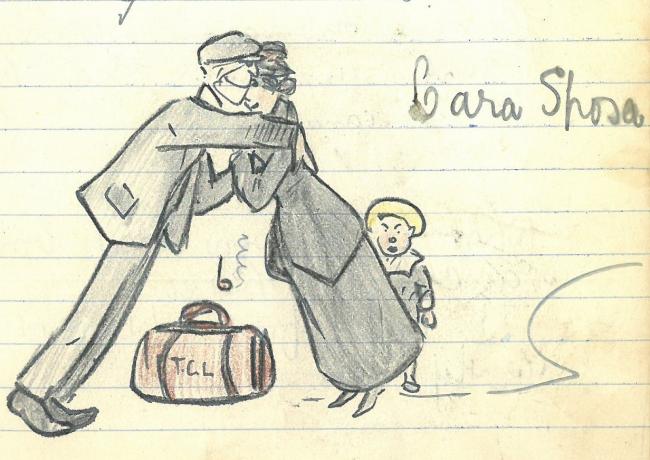
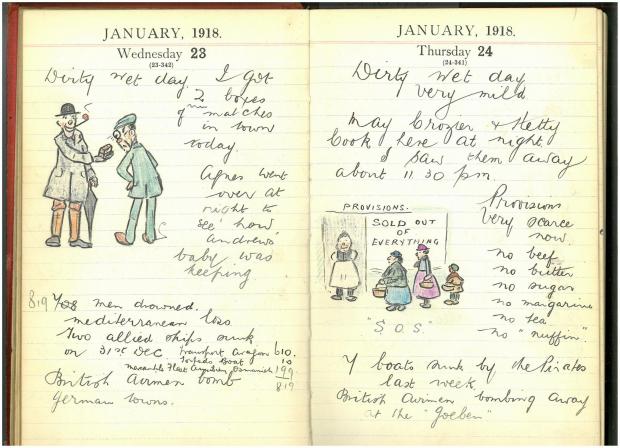
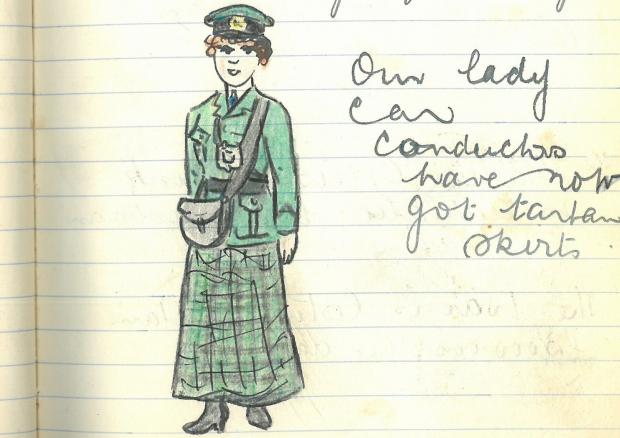
Livingstone illustrated his diaries. Pictures courtesy of Glasgow City Archives

                 Livingstone illustrated his diaries. Pictures courtesy of Glasgow City Archives

He was a dedicated diarist, producing nineteen volumes covering the period 1913 to 1933. These were purchased by GCA with the kind assistance of the Friends of Glasgow Museums in August 2016.

Glasgow Times:

Although Livingstone signed up to fight in World War One, he was declared medically unfit for active duty and was never mobilised. He remained in the city and, instead of a battlefield account of the war, his diaries provide a personal narrative of the conflict’s impact on Glasgow.

This would be remarkable enough, but the diaries are also hand illustrated by Livingstone himself.

His cheerful, coloured drawings in combination with his characteristic dry humour provide a contrast to the often grim topics he describes. His diaries document the shortages the city faced as, one by one, essential food and provisions grew scarce and were rationed. They also cover rising rents, the threat of air raids in Scotland, women workers, the economy and fundraising initiatives in the city.

Yet they also chronicle the family’s daily life together: their walks, the films they saw at their local cinemas, the evening sing-songs they shared and young Tommy’s early education at Victoria School. They are a reminder that daily life went on even against a backdrop of national and international change. Once our service resumes, Livingstone’s diaries will be publicly accessible to view in the archives searchroom on Level 5 of The Mitchell Library.

Glasgow Times:

It was never Livingstone’s intention to chronicle the home front, but it was a natural outcome of his habit of keeping a daily diary. If you have been inspired to start a diary during this time, please consider submitting it to GCA. We will accept paper and electronic diaries which can be accompanied by drawings or pictures (just like Livingstone’s). Further details are available on our website.

https://www.glasgowtimes.co.uk/news/18785367.diaries-reveal-life-like-glaswegians-wwi/


at October 19, 2020 No comments:
Email ThisBlogThis!Share to XShare to FacebookShare to Pinterest
Labels: WW1

Monday, October 12, 2020

How My Reading Journal Accidentally Became A Plague Diary

From bookriot.com
By Zoe Robertson

At the turn of the new year, I decided to invest in a modest Moleskine journal and told myself that I would document my most comprehensive, most astute thoughts about the books I finished in 2020. It was going to be great! I was already fatigued from staring at computer screens all day while researching for my degree, and looking to begin a stilted, messy breakup from Goodreads, so believed that reviving my teenage diary-keeping hobby would not only give me space to process my thoughts without a character limit or the embarrassment of being public, but give me a reason to avoid laptops (and inevitable doom-scrolling). 

My journal is nothing fancy; I don’t have any washi tape, stickers, or elaborate charts. I opted for basic bullet points covering some publishing information and any brief comments, funny observations, or crushing remarks on whatever random book comes my way. If anything, this bare bones approach has allowed me to fulfil my fantasies of keeping a nondescript, mysterious black notebook in the kitchen, packed with hastily scrawled notes, and have briefly imagined myself as a cloistered scholar of forbidden knowledge…when, in reality, I am just tallying up my stats each month for nobody’s eyes but my own. In reality, it isn’t a brooding mad scientist journal, but a plain stack of paper full of middling reviews.

Or, at least, that was the plan. 


I keep going back to an entry I made in March, in which I’m reflecting on Max Tegmark’s nonfiction manifesto about the future of technology and artificial intelligence, Life 3.0. I was frustrated by this book overall and found his insistence on the dangers of anthropomorphising to be unimaginative at best, suggestive of a larger issue regarding subjectivity at worst. In uncharacteristically steady hand-writing, I bitterly mused:

‘I think it’s interesting to read a nonfiction book which imagines a vaguely sanitised and luxurious future full of intelligent robots when the present day flounders with the failure of government officials and rising threats of misinformation […] Those in control don’t want to anthropomorphise the mortality rate. The people with underlying health issues. People with disabilities or immigrants. The working class. Cos [sic] that means admitting ignorance, carelessness – that thinking about us is too hard, too annoying.’

Thinking back to reading this book and writing this entry sends a chill through me, initially because of the early date (March 13, ten days before lockdown began in the UK) but more so because of the content’s theme: a pressing concern regarding threats to subjectivity and the systemic suppression of marginalised people into further obscurity, by a flustered elite, whilst in the midst of an unprecedented event. The dilution or erasure of the human element of this pandemic has continued to such an extent that case figures barely make the trending page on Twitter anymore, that general complacency reigns in public spaces, that large numbers of protestors and police brutality victims were reduced to aimless mobs by the media. Dehumanisation works in two ways – either your subjectivity becomes erased into insignificance and invisibility through lack of representation or you are absorbed into an impossible mass that is just as nameless, faceless, and easy to tar with a hateful brush. 

As time has progressed, the pages of this little thing have been filled with doodles, drafts of comic strip dialogue, transcripts of voice messages I’ve sent people, intermittent personal paragraphs about the state of my Masters degree or news bulletins. There are even metatextual winks and nods at an imaginary peruser, as though I’m chatting directly to someone else, someone in the future, no longer just to myself. It suggests that I’ve imagined a scenario in which this journal is all that’s left of my past life before I disappear into the woods, or will be my sole companion during an apocalyptic societal collapse, as if I’m carrying around my own expositional flavour text for a bandit to loot from my body if things take a turn for the RPG. On the surface, the contents remains the same: the title of a book, a dated entry detailing my opinions, a star rating. However, between the lines, I’m desperately emphasising my subjectivity amongst the rampant dehumanising movement of the world around me. 

This shouldn’t be surprising; for the majority of lockdown I had no other companion except myself and the books I had on my shelf. I lived alone, I was – and remain – unemployed, most of my friends scattered to the winds to escape to their homes and quarantine with family. We still communicate over the internet, but I didn’t expect the quiet unravelling that being physically alone had on me. When separated from everyday frames of reference, whether that be advertisements or just the presence of other people, I was left with no option but to make my own in the form of this journal. I love questioning what makes us who we are, and pondering the philosophy of subjectivity, but experiencing such a drastic shift in self-perception first-hand like this was terrifying. How do you prove that you exist when you’re the only one around? 

Reflecting on this, it is clear that my journal anticipates a reader. No, begs for a reader. Begs for someone other than me to hear what it has to say, confirm that it actually happened, confirmed that I actually happened, begging for this experience to be acknowledged rather than brushed under the rug. I know that so much of the news I’ve recorded in this book will be ignored by future historians. I know that so much of this experience will be diluted in docuseries or museums and I have already grieved for the loss of information. I live in a country fuelled by a selfish nationalism, that puts pride before its people, and I will be trodden on to make way for ingenuine celebration should we ever beat this disease. I watch the ways in which the reality of the present catastrophe is erased by deliberately evasive or distracting media headlines, by inconsistent political ramblings, and beg to be spared from that violence.

I don’t know when I began to treat this Moleskine like a living testament. In a sense, its flammable body is as weak and vulnerable as my own; can I really rely on something so destructible to preserve me? However, I am frankly fascinated at how my blasé choice to write down my thoughts on Jonathan Strange and Mr Norrell in January (which were all positive and glowing, by the way) has produced an item that has such hefty historical and social relevance to me. Like everything else this year, it was unpredictable. However, writing has always been a means to become immortal, to turn moments into crystal and amber that will endure time, so perhaps it is no wonder that I’ve leaned so heavily on the words of others and my own during this period of isolation.

It is impossible to separate the pandemic from this diary; from the chosen titles, to the frequency or infrequency of entries, the plague has even infected these very pages. However, I am inclined to believe that this act of writing and containing my thoughts is a means to cure some of its secondary effects – it combats the feeling of being dissolved in the mire of everyday horror, it confirms your existence, it speaks to a side of this Hell that is needed to understand the full scope of events. In anthropomorphising myself, in reclaiming my subjectivity, I can begin to heal from the wounds this year has dealt, from the deliberate objectification it has tried to crush me with.

I hope I’m here to reread this journal when I’m older, but, if I’m not: you don’t have to agree with my feelings on what I’ve read – that isn’t even the point of the journal – just agree that I was here to write it at all.

https://bookriot.com/how-my-reading-journal-accidentally-became-a-plague-diary/

at October 12, 2020 No comments:
Email ThisBlogThis!Share to XShare to FacebookShare to Pinterest
Labels: Coronavirus

Saturday, October 10, 2020

The power of writing to soothe private issues by Angie Lake

From femalefirst.co.uk

Angie Lake writes a piece for Female First upon the release of her new book Mina Mistry Investigates

If I had to describe what life was like as a child living with an anxiety disorder, it would be: “It was like having a hangover every day.”

My childhood was picture perfect until I was about eight. My family moved around between England, Saudi Arabia and Nigeria before finally settling in Spain. I remember the first couple of years being fairly stable and prosperous, with my Dad still working abroad and my mum running the house.

Dad came home from his last contract in the Middle East in 1990 when the Gulf conflict broke out. This marked the beginning of the end; everything started disintegrating at this point. I was ten years old at the time.

My parents began scrambling for work and money, and routines and tempers became frayed. You could cut the atmosphere with a knife around birthdays and Christmases.

At ten years old, keeping a diary had taken on a whole different meaning: writing in it was something that had to be done every day, so when mealtimes and bedtimes were starting to fall by the wayside, it was a consistent piece of routine to cling onto.

I have since spoken to a lot of people who have had similar experiences and, in most cases,, we can agree that there’s a point of inflection: a moment at which children pass from being the family’s main concern to becoming an additional problem.

When not having any friends or anyone to talk to started to become an issue, I opened up one of my horse and pony magazines and wrote to everyone in the pen-pals section. I did the same thing with all the magazines I had at home and I ended up with seventy-two pen pals.

When I needed someone to talk to, I’d just write. I’d write to organise my thoughts, to share my sorrows with my diary and to plan my actions. Being averse to confrontation, I’d often write letters to people to tell them how I felt; that custom persisted well into my adult life and I still write long letters and emails when I have an important personal matter to deal with.

I still keep diaries, make lists and plan things on paper: somehow an idea looks different when you see it written down.

I know that times have changed, and that social media tries to fill the gap left by distant families and pen pals, but not having these resources at that time was a blessing. I gained a strong sense of self reliance and I was able to discuss my cringiest thoughts with myself or with a pen-pal at the opposite end of the world. I may have felt vulnerable, but I didn’t feel exposed.

The psychological benefits from using social media pale in comparison to keeping a diary and writing letters, and I think that this is something we should be very aware of as we raise children in the digital age while they deal with their own private issues.

https://www.femalefirst.co.uk/books/mina-mistry-investigates-angie-lake-1261416.html

at October 10, 2020 No comments:
Email ThisBlogThis!Share to XShare to FacebookShare to Pinterest
Labels: motivation, youth

Friday, October 2, 2020

Do you ever get bored of being you?

From majorcadailybulletin.com
By Frank Leavers

The current pandemic has caused many problems in our world over the past months. Most of it very well reported and understood. From health issues, unemployment - social disruption and economic problems. Nevertheless, on a purely personal level for many people untouched by some of the real problems of health and wellbeing, some folk have been, or are still are, suffering from a sort of terminal boredom. However, for others of us it goes deeper than this.

For instance, do you ever get bored being you? If you are anything like me, on occasions I mentally float above myself and observe myself being both predictable and tedious. Do you know, it feels sometimes that I know what I’m going to say a month before I say it and my own particular ray-of-sunshine has confirmed that my thought patterns and mental reflexes are so obvious as to be beyond tiresome - more like sleep inducing. Let me explain. After living with oneself for many more decades than you care to remember, I maintain that within a person’s brain there is a sort of ‘reset’ facility that requires a person to chunter-on about the same subjects and hold the same mild prejudices for year after year. I thought about this the other day when talking to a couple of new, youngish (for me!) friends and found myself for once holding my tongue and actually listening to what they had to say. This in complete contradiction to my usual practice of maintaining and articulating an over familiar procession of cliches, truisms and age-old assertions.

If this is all true, how do I go about changing ‘Me’ or maybe you - if you also suffer from the same inevitable drift into yawn inducing dullness? Perhaps, I will pretend to be someone else. That’s it, I will become someone else - at least until this Covid business is all over. Now then, this is not to say that I want to change my lady love, or indeed friends that I have accumulated over the years - indeed, she’s lovely…well most of the time, and although they are not what you would describe as ideal, I suppose they will have to do. No, my problem is clearly Me - and to be perfectly honest I might have to let myself go. The pity is that there is no way of refreshing your personality so as to exclude the boring bits. For instance, it would be nice if when the news is on I don’t say the same things over-and-over again. I caught her the other day ‘mouthing’ the very words that I was using when some person or another on the television irked me.

Sometimes I lie in bed of a morning, and as I look down at my body I am moved to think - “Oh no, not you again.” I don’t know what I was expecting, but it would be a nice change, if it wasn’t just Me.

Let’s face facts, after more that six decades (God help me!) most people would get on their own wick wouldn’t they? I have this theory that if you had the chance, it would be pretty cool to be someone else for a change. Don’t get me wrong, I wouldn’t want to do it permanently because I would probably miss Me eventually.

But all the same, a change - can be as good as a rest and just think how good it would feel not to be lumbered, even for a short time, with your own silly obsessions and tiresome go-to opinions?

LET’S LEARN FROM IT!
It also has to be said that I doubt that my feelings of self-irritation are mine alone; because with various forms of lockdown continuing to be in place, my thoughts on this matter might not be as daft as they might have seemed just a few short months ago. Indeed, when certain enjoyable social facilities cease to be open to us, it is perhaps quite natural that we become much more inward looking than we would have imagined in the past. It is said that a good way to neutralise anxiety is to write down what causes these feelings. From keeping a diary to drawing up lists, they are supposed to be good for the soul. I will admit that writing regularly my thoughts about this pandemic has sometimes focussed my mind, not just on the realities of the current situation, but also reporting on how its absurdities has helped me cope. And so expressing your innermost feelings to nobody in particular is no bad thing. Making random lists are also a good idea, but it is said that - ‘to-do’ lists actually make you less likely to complete those annoying tasks. And if you’re making a list as to what stresses you out - only to discover that lists are top of your list - now, might be a good time to think of something else. Hey, here to help!

So there we have it; what we all need is an occasional break-from-ourselves. Anyone want to swap personalities with someone else for a few days? When at long last, this pandemic passes - it may in its wake, give us pause for thought in a number of different ways. Perhaps, primarily the fact that any disruption to our normal lifestyles will have effects on the way that we think about what is - and what is not important in life. Secondly, although Covid-19 is a fast-spreading physical disease, its side effects clearly leave a lasting mental reaction in many people. Wouldn’t it be good if we could all learn from it?

https://www.majorcadailybulletin.com/comment/opinion/2020/10/01/72899/you-ever-get-bored-being-you.html      


at October 02, 2020 No comments:
Email ThisBlogThis!Share to XShare to FacebookShare to Pinterest
Labels: Coronavirus, motivation
Newer Posts Older Posts Home
Subscribe to: Posts (Atom)

What's on the blog

17th century 18th century 19th century 20th century 21st century academic Afghanistan AI Alan Bennett Alexei Navalny alphabetical ancient history Anne Frank apps archive art astronomy Audre Lorde Australia awards Bangladesh Beatles Belgium Biennale Boswell Bruce Springsteen bullet journal business Cambridge Canada Captain Scott China Christmas cinema Coronavirus Covid-19 current affairs customisation D-Day daily routine decorating definitions design diary project digital domestic dreams Egypt Elton John emotions entertainment equipment Europe experimental family famous Farming fictional film food foreign language fountain pen France Franz Kafka gardening Gen Z goals gratitude journal Greece group chat handwriting Heath Ledger history humour Illinois illness illustrated India Iran Ireland Israel Italy Jack Kerouac Japan journal journalist junk journal Kennedy Kenneth Williams Korea letter-writing life story lifestyle Liverpool London loneliness Louisa May Alcott mental health Michael Palin mindfulness Monty Python motivation Multi-year music nature New York New Zealand Nigeria note keeping older opinion Orwell Oxford Pakistan Pepys Philippines philosophy planner politics prison purpose pyramids quotes realism religion routine royalty Russia Salvador Dali satire science Scotland scrapbook self smartphone social media Soviet sport stress student summer Sylvia Plath therapy Tolstoy transport travel Trump Turkey UK Ukraine USA VE Day Vietnam Virginia Woolf Vladimir Nabokov W H Auden war weather women working life writing WW1 WW2 youth

Popular Posts

  • How to Start and Keep a Journal
    From nytimes.com Tips from writers, artists and a social worker that might make the practice less daunting   It’s a familiar story: You buy ...
  • The Revelatory Cringe of Anthony Fauci
    From theatlantic.com By Gal Beckerman The private notes of the man who oversaw COVID policy are deeply embarrassing—and surprisingly instruc...
  • Leo Tolstoy’s failed project
    From meer.com/en  By Elizaveta Burnashova  Is it possible to capture ‘life as it is’? When you write an entry in your diary, what do you usu...
An Oxford Diary
If you enjoy this blog, please consider making a small $1 donation to help me keep it going. Paypal button is below. Thank you.

Search This Blog

Blog Archive

  • July 2026 (8)
  • June 2026 (3)
  • May 2026 (7)
  • April 2026 (9)
  • March 2026 (6)
  • February 2026 (7)
  • January 2026 (6)
  • December 2025 (12)
  • November 2025 (10)
  • October 2025 (11)
  • September 2025 (5)
  • August 2025 (15)
  • July 2025 (4)
  • June 2025 (5)
  • May 2025 (3)
  • April 2025 (3)
  • March 2025 (6)
  • February 2025 (4)
  • January 2025 (6)
  • December 2024 (5)
  • November 2024 (5)
  • October 2024 (6)
  • September 2024 (8)
  • August 2024 (2)
  • July 2024 (4)
  • June 2024 (4)
  • May 2024 (4)
  • April 2024 (3)
  • March 2024 (1)
  • February 2024 (4)
  • January 2024 (7)
  • December 2023 (3)
  • November 2023 (8)
  • October 2023 (3)
  • September 2023 (5)
  • August 2023 (5)
  • July 2023 (3)
  • June 2023 (5)
  • May 2023 (2)
  • April 2023 (1)
  • March 2023 (7)
  • February 2023 (6)
  • January 2023 (2)
  • December 2022 (4)
  • November 2022 (5)
  • October 2022 (1)
  • September 2022 (4)
  • August 2022 (6)
  • July 2022 (3)
  • June 2022 (1)
  • May 2022 (2)
  • April 2022 (2)
  • March 2022 (5)
  • February 2022 (4)
  • January 2022 (4)
  • December 2021 (3)
  • November 2021 (5)
  • October 2021 (5)
  • September 2021 (6)
  • August 2021 (5)
  • July 2021 (4)
  • June 2021 (5)
  • May 2021 (5)
  • April 2021 (6)
  • March 2021 (7)
  • February 2021 (7)
  • January 2021 (4)
  • December 2020 (6)
  • November 2020 (3)
  • October 2020 (5)
  • September 2020 (5)
  • August 2020 (4)
  • July 2020 (1)
  • June 2020 (4)
  • May 2020 (3)
  • April 2020 (4)
  • March 2020 (2)
  • February 2020 (4)

As an Amazon Associate I earn from qualifying purchases

The 6-Minute Diary, Mindfulness Journal
Simple theme. Theme images by luoman. Powered by Blogger.