Sunday, August 7, 2022

War turned this boy into an orphan. His diary is testament to his loss

From latimes.com

Before war came to his village, 12-year-old Tymophiy Z. had many of the usual tween preoccupations. And his closest confidant was his diary.

There was a special girl, Yarina, he wrote, but she ignored him. He loved the video game “Minecraft” and the family’s half-wild cats. He grumbled occasionally about his mischievous 6-year-old half-brother, Seraphim, who did not always live up to his angelic moniker. When his stepfather drank, it worried him.

Those boyhood musings were interrupted by a terrible noise in the sky on Feb. 24. Tens of thousands of Russian troops rolled across Ukraine’s borders, and suburbs of the capital, Kyiv — including Tymophiy’s farming village, Shevchenkove, some 30 miles to the northeast — were quickly overrun or menaced as the fighting drew near.

“Yesterday in the morning there was an air raid alert. You could hear in our village how planes were dropping bombs," Tymophiy wrote in a journal entry dated March 3. The family — he; Seraphim; his mother, Yulia Vashchenko, 37; and his stepfather, Serhii Yesypenko, 43, known as Serozha, hid in the cellar.

The parents began talking about trying to leave. But to where? They hesitated.

On the morning of March 8, less than two weeks into the war, the couple slipped out without waking the boys. The village market, a short distance away, was still open, and they needed the extra money they made by selling tea and other dry goods there.

After a few hours, Tymophiy wrote later, his mother called him. She was frantic. Russian armoured vehicles were rumbling through the village’s narrow lanes. She told him to grab Seraphim and hide in the bathroom. He didn’t know it then, but it would be their last conversation.

A bit later, Tymophiy’s aunt and uncle — Olena Streelets, 47, called Lena by family members, and her husband, Serihy Provornov, 63 — arrived and hurried the boys to their nearby house. They told the brothers that their parents had been called away to Kyiv, but that fighting made it impossible for them to return just now.

Tymophiy, whose full name is being withheld because he is a minor, was worried but not unduly so. The rush of events — the thunder of artillery, Seraphim’s antics, settling into their aunt and uncle’s cramped home — kept him distracted.

“I have gotten used to shells flying over my head,” he wrote on March 13. “We still don’t have electricity.”

Two pages with handwriting.
The diary of Tymophiy sits on a table at his family’s home in Shevchenkove, Ukraine.
(Kyrylo Svietashov / For The Times)

More days went by, and Lena and Serihy made excuses over Yulia and Serozha’s absence. It was Seraphim — the unnoticed little eavesdropper, overhearing low-voiced, anguished adult conversations — who blurted out the truth.

Tymophiy raged to his diary, his fury at first overwhelming his grief. In slashing red ink, he drew a horned devil with angry darts shooting from its eyes.

“I found out what happened to my mom and Serozha,” reads a March 14 entry, nearly a week after the deaths. “They were killed!”

His aunt and uncle had held back yet more unbearable news. The bodies of the couple — who died from large-calibre fire aimed nearly point-blank at their car by a Russian tank — lay mutilated, unretrieved and alone inside their silver Opel Vectra for three days while Tymophiy’s uncle tried to negotiate safe passage to collect the remains.

Like hundreds of other civilians killed by Russian troops in the once-placid Kyiv suburbs — many people slain execution-style, some corpses bearing signs of torture — Yulia and Serozha had to be buried temporarily in makeshift graves. Theirs was near a garden gazebo.

Shelling shook the village for nearly three more weeks, before the Russians pulled back as abruptly as they had come, abandoning their bid to seize the capital and regathering in the east.

The family wanted a proper funeral, but it had to wait for an exhumation and examination by forensics experts and investigators, who were collecting what was rapidly becoming a mountain of war crimes evidence. More than 1,300 bodies were recovered in the capital region alone. Russia continues to deny its troops deliberately targeted civilians.

Finally, among more than a dozen other fresh graves, the two were buried side by side in the village churchyard on April 12.

In the margins of his journal, its blue cover now decorated with drawings of a pair of ghosts and a boy’s sad face, Tymophiy wrote: “Dreams do not come true.”
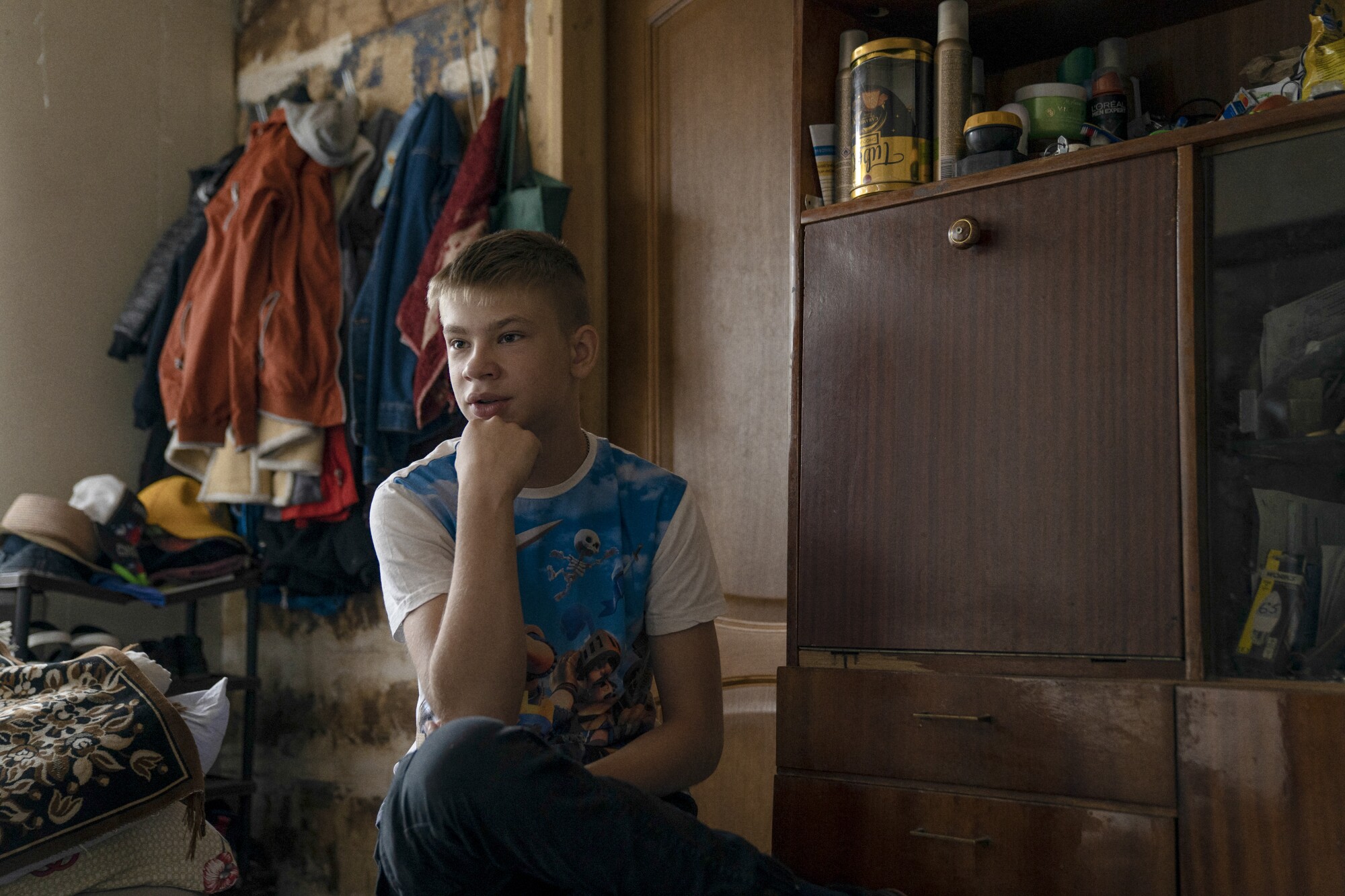

A boy in a room.

Tymophiy sits in his room.
(Kyrylo Svietashov / For The Times)

The war in Ukraine has been uniquely horrific for its children. About one-third of them, more than 7.5 million youngsters, are displaced from their homes, according to United Nations estimates. At least 348 children have been reported killed as of mid-July, Ukrainian officials said, but those numbers, which do not include an accounting from still-occupied areas, are acknowledged to be low, probably dramatically so.

It’s as if childhood itself has been scoured away and something terrible has taken its place.

“I would say that every single child in Ukraine, their lives have been touched by this war,” Afshan Khan, the regional director of UNICEF, the United Nations children’s agency, told reporters at the world body in June. “They’ve either lost a family member, or they have ... witnessed trauma themselves.”

In a brutal conflict heavily documented on social media and in news photographs, there was some reticence at first over circulating images of tiny corpses.

But now, nearly six months on, war and outrage propel endless online postings of disturbing photos and videos: pictures of dead children beside their dead parents, kids bandaged and bloodied in hospital beds — if they are lucky enough to make their way to one — little ones wailing and bewildered, or stunned and silent, as they are bundled into trains and vans carrying them away from the battle zone.

Sometimes, relatives who are exposed again and again to the sight of dead and maimed loved ones, especially the youngest victims, beg for a respite from the graphic images. But they keep coming.

Before the Russian invasion, Ukraine already had at least 100,000 orphans, many living in grim conditions in state care. Now their still-uncounted ranks have swelled. Family separations abound: fathers deployed to the battlefront while mothers and children seek shelter elsewhere. Whole families have been sent to “filtration” centres in occupied Russian territories, with hundreds of children ending up inside Russia proper and put up for adoption, according to Ukrainian officials.

Every day at 8 a.m., Daria Herasymchuk, an advisor to Ukrainian President Volodymyr Zelensky on children’s affairs, receives a recap of the previous day’s events, including the latest on children killed, wounded, missing or believed deported. Or left motherless or fatherless, or both.

“It’s the worst moment of the day,” she said. “It’s every day.”

Lena said there was never any question that she and her common-law husband, Serihy — each on their second marriage, with adult children who long since left home — would take in Tymophiy and Seraphim. But it’s an overwhelming task.

Their run-down house consists of three tiny rooms: the bedroom, kitted out with new bunk beds for the boys; a living room with peeling paint where the couple now sleep on a double bed that also serves as the only sofa; a smoke-stained kitchen with a shower crammed behind a plastic curtain.

Serihy is working on a cinder-block addition, but for now, the yard is strewn with construction debris, and just outside the entryway, a hole in the ground is covered over with rickety boards.

Seraphim is in perpetual motion. He leaps onto the sofa bed demanding to be tickled, drags around a watering can nearly as big as him, rolls around on the floor, waving his feet in the air. He giggles and shrieks, but though seemingly thirsty for attention, he is far less verbal than most children his age.

“We have to take shifts with him,” said Lena, a former kindergarten teacher, ruffling his hair.

Tymophiy, towheaded like his brother, has a sloping visage that foretells a blunt-faced manhood. He can appear simultaneously childlike and old, with pale eyes often either downcast or fixed in an unsettlingly intense stare.

His main hobby these days is collecting “frags” from village lanes and yards — heavy, jagged bits of shell casings and rockets, which he likes to thrust into visitors’ hands.

The family is receiving some government support, including regular sessions with a counselor for both boys. But Tymophiy scowled when asked about his sessions with the therapist.

“There are plenty of things I don’t tell him,” he said, looking away.

He doesn’t sleep well, he said. Sometimes he thinks he sees eyes watching him in the dark. The early summer light bothers him. He wakes up tired; at night, he must comfort Seraphim when he cries out.

This is the boys’ home now — but perhaps only for now. The sisters of Tymophiy’s stepfather, now estranged from Lena and Serihy, have moved into the family home a few streets away. They want to adopt Seraphim, their blood relative, his aunt and uncle said.
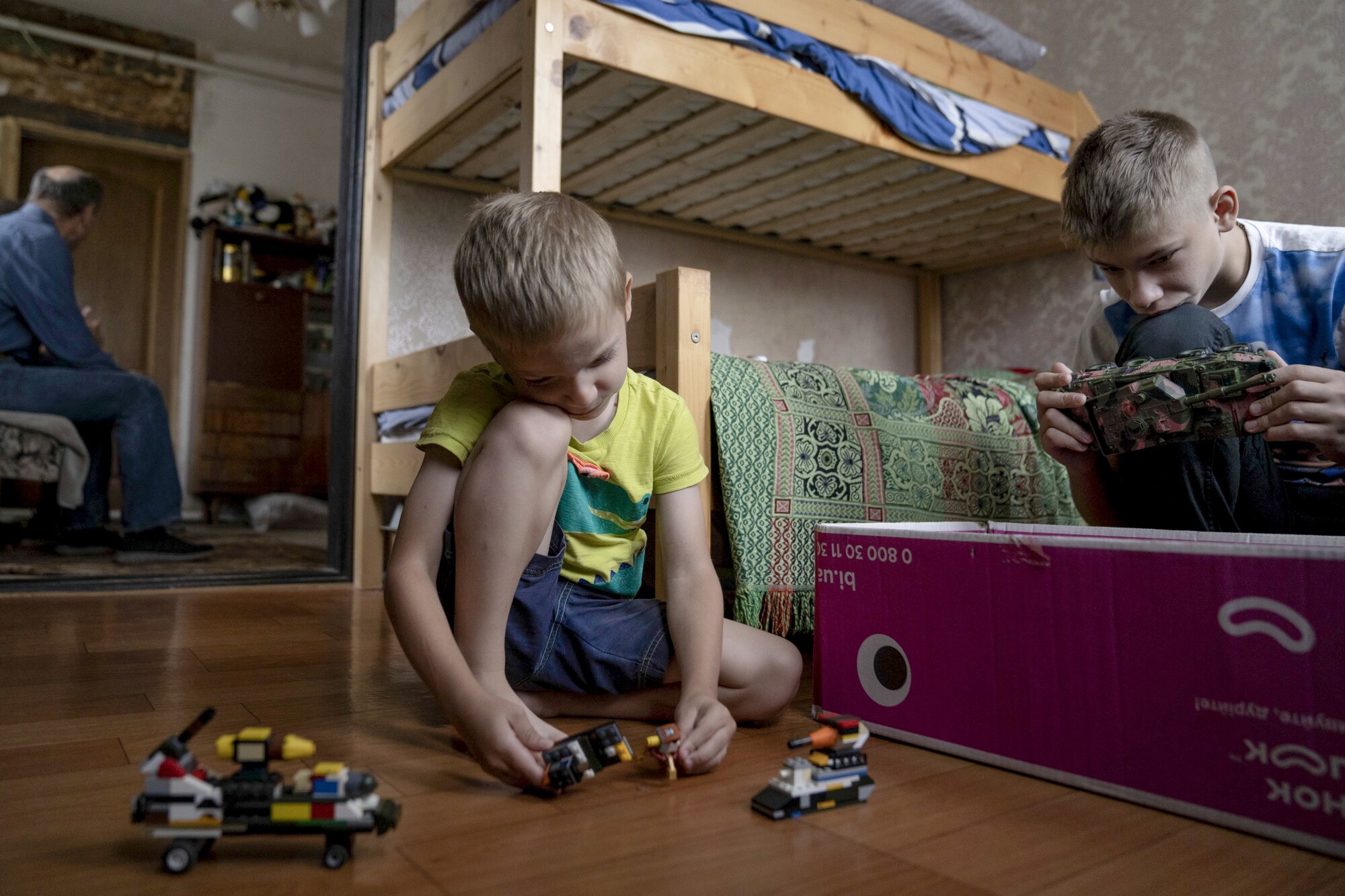

Two boys play with toys in a room.

Tymophiy and Seraphim play in their room.
(Kyrylo Svietashov / For The Times)

Lena and Serihy are adamant the boys should not be separated and want to keep both of them. But the situation is complicated by family acrimony, missing documents and the unknown fate of Tymophiy’s father, who has not been heard from in years.

Tymophiy picks up his diary only sporadically now, he said. He sometimes writes in what he describes as a private code and makes other entries in invisible ink. He willingly shows off the volumes but also declares angrily that the journals have brought him too much attention. Once a constant and a comfort, the diary-keeping has turned as strange as the upside-down world around him.

“Sometimes I just want to burn them!” he said.

In the village, some aspects of normal life are beginning to resume. Flowers poke up through rubble. There is talk of school starting at some point. The market near where Yulia and Serozha died is open again.

Some of the family cats disappeared during the fighting, but others made their way home or were born weeks later. Tymophiy scooped up a limp-looking grey kitten, nuzzling it. That helps him sleep, he said.

Lena, a decade older than her dead sister, tears up when she reminisces about Tymophiy’s mother, although she does so only if she is out of his sight and hearing. Yulia’s turbulent relationship with Tymophiy’s father nearly broke her, in the elder sister’s telling. He abandoned her when the boy was still a baby.

But as a single mother still in her 20s, Yulia rallied and finished her education in Kyiv, Lena said. She got together nearly a decade ago with Seraphim’s father and moved back to the village, and the pair rejoiced six years ago over the birth of a baby, Seraphim.

Lena was godmother to both boys. Years ago, she would take Tymophiy to school on the back of her bicycle or, when he was small enough, snuggle him right into the front basket, where the breeze on his face made him laugh.

In her sister’s place, she said, she would do her best to mother them.

“We were family, even before this war,” she said. “Now we will try to be a new kind of family.”

https://www.latimes.com/world-nation/story/2022-08-05/dreams-do-not-come-true-in-ukrainian-boys-wartime-diary-lament-and-loss

Friday, August 5, 2022

Handwritten diaries may feel old fashioned, but they offer insights that digital diaries just can’t match

From theconversation.com

By Paula Vene Smith 

The first time I taught a college course called “The London Diary” for young Americans studying abroad back in 2002, each student ended up with a tangible book of memories, a handwritten record of their semester in London. But when I taught the course 15 years later, the first question my students asked was whether they could keep their journals online. The question brought home to me how the image of a diary has shifted from words scribbled in a blank book to images and digital text on a screen.

Why not go digital?

Even while journaling apps like Penzu and Diaro become more widely available, estimates and surveys suggest that a sizable number of the world’s diary keepers still keep handwritten diaries.

Fans of digital diaries grant them an edge in convenience, portability, searchability and password protection. Jonathan, one of my 2018 students, described in an essay for class how digital diarists can upload entries to multiple platforms, keeping some portions offline or restricted to a select audience while other parts go completely public. It’s harder to control distribution, encrypt entries or build an index with a journal kept on paper.

I already expected my students to use electronic devices to read course materials, to communicate with me and with their families back home, to write essays for class, and to navigate London. Why not let them keep digital diaries, too?

Diary as artifact

Poet and literary scholar Anna Jackson was researching the private papers of novelist Katherine Mansfield for her book “Diary Poetics” when she made an unexpected discovery. Jackson came across a “piece of the world” that was also an element of Mansfield’s journal – a kowhai flower between two pages in a notebook:

“After all this time, there it still was, still yellow, still between the same two pages Mansfield had placed it between all those years ago. A piece of the world she wrote about was right there as a piece of the world still, not a piece of writing.”

Jackson’s experience shows the power of holding in your hand the diary as a physical object. What scholars call the manuscript’s “materiality” links writer to reader in an unexpectedly intimate way.

For historians and diary scholars, manuscripts are artifacts. A book’s binding, paper quality and ink can signal an anonymous diarist’s socioeconomic status. Changes in penmanship may show how the writer felt – drowsy, extra careful or agitated – while writing certain passages.

Some clues, like the bit of evidence provided by inserting a memento, relay intentional messages. Others, like crossed-out words, may reveal information the writer did not plan to share.

Physical evidence can also hint at what happened after a text was written. Damaged or missing pages may indicate a strong reaction to the contents. A few years ago, conservators at the National Maritime Museum in Greenwich, England, discovered a concealed entry in the diary of a 17th-century British sailor. In his diary, he originally confessed to committing a rape, but later wrote a different account of the event, pasting the new page so carefully over the original that it went unnoticed for more than 300 years.

Digital yet material

Every original mark in a diary reflects an impulse of the moment. As diary instructor Tristine Rainer says in “The New Diary,” “At any time you can change your point of view, your style, your book, the pen you write with, the direction you write on the pages, the language in which you write, the subjects you include. … It’s your book, yours alone.”

With so many convenient features, digital diaries remain a popular choice. This option, we might be surprised to learn, even has its own form of materiality.

In “How to Read a Diary,” literature scholar Desirée Henderson notes that digital diaries, too, are objects, shaped by tools the diarist selects – in this case, software and hardware – to create the diary. The writer’s design choices, such as site structure, networking parameters, embedding of graphics, image and audio files and hyperlinks, offer grist for interpretation not unlike reading the nonverbal signs of a traditional diary.

Writing into the future

As I thought about offering my students the online option, I began to imagine them many years from now, coming upon that London diary from their college days. I remembered my first group of students drawing sketches on their pages, attaching a Travelcard, café napkin, or theatre ticket. I remembered Anna Jackson with the kowhai flower. I couldn’t shake my conviction that future diary readers will be less enthralled by a digital product – even enhanced with multimedia – than by the quirky, untidy books hand-lettered by their predecessors.

In the end, I assigned my students – at least those who were physically able – to create their London diaries by hand. They could still use their phones to capture images or take preliminary notes, but in the end they would produce a material keepsake.

Several students decided to write in their notebooks while also keeping a digital diary. The dual process felt natural to them. To his blog Jonathan posted, “Like many children of the 21st century, I love the idea of keeping everything journaled online. This way I can make notes on my phone as I walk, have them automatically update on my computer, where I can expand with more time. If I wake up in the middle of the night with an idea, I don’t need to wake up a roommate with a lamp. However, the course also requires an analogue diary.”

Every diary, “analogue” or digital, can be read as an artifact layered with meaning – one that conveys clues to its writer’s life and times in both nonverbal signals and words. 

https://theconversation.com/handwritten-diaries-may-feel-old-fashioned-but-they-offer-insights-that-digital-diaries-just-cant-match-187508

Monday, July 18, 2022

Cycling challenge set the wheels in motion for author’s new book

From belfasttelegraph.co.uk

Writer completed 1,000-mile coastal ride in just 21 days 

A Northern Ireland author has released a book he decided to pen over lockdown about an epic cycling challenge he undertook 20 years ago.


Cecil Lowry, who is originally from Downpatrick but has been living in Stockport for many years, has released The Diary of an Irish Pedaller with the help of Belfast-based publisher Shanway Press.


It details his 1,000-mile cycle around the coast of Ireland, which took 21 days.


Cecil travelled through 17 counties on two wheels at the age of 54 in June 2002. He cycled around the Aran Islands, the lakes of Killarney and even passed the Giant’s Causeway.

He said that after cycling for enjoyment as a child, he took up the sport again after retiring as a PE teacher in his fifties.


Now, at the age of 74, Cecil still enjoys cycling every day and wanted to share his epic challenge with others.

“Cycling is good because it clears my head. I really enjoy it,” he said.

“I decided to take myself off on this challenge, initially to raise money for Marie Curie after my parents had passed away. I ended up raising £3,400 at the time.”


While on holiday in Spain prior to the cycle, Cecil took a book with him to read, Around Ireland With A Fridge by Tony Hawks, which inspired him to undertake the challenge to raise as much money as he could for a charity close to his heart.


“I ended up keeping a diary during my travels of where I went to and what happened, including drinking pints on the north coast and hitching a lift on a mussel fishing boat across Carlingford Lough, as well as getting a buckle in my back wheel coming through the mountains of Mourne.

“I thought, ‘Why not turn my adventures into a book?’


When he set out to map his route, Cecil realised it would be more than 3,000 miles to cycle the entire coastline, so to keep it manageable, he worked out a route of 1,000 miles.


“My wife left me off at the boat at Holyhead with nothing but my bike and two panniers and I set off for Dublin,” he said.

“I reckoned I could cycle 50 to 60 miles a day, but even though I had a rough plan worked out, I didn’t book anywhere to stay because I wasn’t sure what was going to be too much, so I just rolled up at B&Bs and hotels when I decided I had done enough for the day.


“On a typical day I would set off at around 9.30am and finish at 4.30pm.”


                                                      Cecil in Ballycastle


Cecil carried all his own gear for the entire cycle and received no support throughout the trip, other than a phone in case of emergencies. “Some of the most memorable milestones was when I hitched a lift across Carlingford Lough with a mussel fishing boat, and when I stayed at Strandhill on the West Coast I enjoyed a seaweed bath to wind down the day,” he said.

“When I cycled through the Mournes and was on my way to Newcastle I hit my first hurdle and got a buckle in my back wheel on my way into the town. I stopped at a bike shop and they fixed it right away.


“I met some really lovely people and it’s a time of my life I’ll treasure forever, so it is nice that my stories are being turned into a book to inspire others.”


His latest book is a little bit more light-hearted than his previous works, which focused primarily on Japanese prisoners of war during the Second World War, like his father.

Released last year, Frank Pantridge MC: Japanese Prisoner of War And Inventor of the Portable Defibrillator was a huge success in UK bookstores.

It was officially launched in Northern Ireland by Dame Mary Peters along with a statue of Frank Pantridge, which was unveiled outside Lisburn Conference Centre.


The Diary of an Irish Pedaller (£10, Shanway Press) and can be purchased at shanway.com


https://www.belfasttelegraph.co.uk/sunday-life/news/cycling-challenge-set-the-wheels-in-motion-for-authors-new-book-41845133.html


Wednesday, July 13, 2022

A Voice from the Past – Hattie’s diary entry from Hong Kong

From pressherald.com

The Brick Store Museum holds over 30,000 pieces of archival material written by historic Kennebunkers. A Voice from the Past shares from the museum’s collection. This week’s column is from a local woman named Hattie, who travelled with her husband, a ship captain, around the world in 1884. In this diary, she is writing from Hong Kong. Her diary is currently on view in the museum’s exhibition “Sea of Stories.”

Tuesday, January 1st 1884

It is now more than two years since my last attempt at keeping a diary. The year of ’82 (Aug. 10th) brought us another baby boy, and the year ’83 (Sept. 25th) took from us our darling Bennie, our first born, given, or rather lent to us Oct. 5th, 1880 in Hong Kong, and taken from us in the same place, on our third voyage to that port; within two days of his third birthday, it is useless to attempt to describe in words the bitterness of our grief – God alone knows it. He alone can help us.

My room was finished today, recess painted and carpet put down one room after another is being garnished and put in order — the three after cabin staterooms are done, also the bathroom and after vestibule. We are bound to New York with cargo of fire crackers, cassia, matting, etc. from Hong Kong and if our darling boy were only with us, this homeward passage would be a very happy one.

Wednesday Jan. 2nd, ’84 – Fine all day, until towards evening when heavy banks of clouds rising up brought a strong wind – calm, with heavy swell, all the afternoon. Captain has worked very hard today in the cabin and on deck; he does all the varnishing in the cabin, and oversees the work generally. Tom paints and steward and cabin boy do the scrubbing. We are not making very rapid progress toward our destined port having had head winds and calms for several days past. We are nearing the cape of Good Hope very slowly – hope the wind will not last much longer in this direction, as am anxious to get home – though why, I can hardly tell, as I can never be happy or contented there or elsewhere without my darling boy. When God took him, he took all earthly happiness from me at the same time. I shall never see another happy day as long as I live and I feel sometimes that I do not want to live any longer – still I know that I am not ready to die. 

Well, if I cannot be happy myself, I can endeavour to make others happy, and must and will try, to live a good life – one that shall be acceptable in the sight of God – so that when this earthly life is done, I may be reunited to my angel boy in that world where sorrow and partings are unknown and where God shall wipe away all tears.” Little Ralph is growing very fast, and is a dear little boy, but he can never take little Bennie’s place in my heart.

https://www.pressherald.com/2022/07/13/a-voice-from-the-past-hatties-diary-entry-from-hong-kong/ 

Monday, July 4, 2022

The secret Pacific war diaries of Walter J. Hinkle

From faribaultcountyregister.com

Jim Pollard’s new book reveals POW Hinkle’s concealed Pacific War diaries


Imprisonment, a world at war, parted lovers and a mysterious wooden leg…

This is the story of Lieutenant Walter J. Hinkle, which was nearly lost to the ravages of time.

When Blue Earth resident Jim Pollard obtained Hinkle’s diary in 2017, he recognized he had stumbled upon a treasure. Now, that treasure is revealed to the public in The Secret POW Diary of Walter J. Hinkle, a book researched and edited by Pollard.

The diaries, which are presented, unedited, in Pollard’s book, detail Hinkle’s experience as a prisoner of war at the Daveo Penal Colony in Japan.

Hinkle was stationed in the Philippines in the spring of 1941. His leg was severely injured that December, leaving him an invalid when the Philippines fell to Japan in May of 1942.

Bedridden and imprisoned by the Japanese army, Hinkle pieced together a diary on scraps of paper and cigarette wrappers.

According to Pollard, it is very lucky that he did so.

“It’s extremely rare to have a Pacific War diary,” Pollard says. “There were fewer soldiers fighting in the Pacific, and keeping a diary was very low on your list.” 

Unusual circumstances enabled Hinkle to keep his 136,000-word diary safely hidden from the scrutiny of the prison guards.

When Hinkle’s injured leg was amputated, it was replaced with a wooden leg containing a false compartment – perfect for concealing a contraband document.

Walter J. Hinkle, above, left, shows his diaries, and their secret compartment in his wooden leg, to Pfc. Russ Simon


The carefully-kept diary details one of the longest periods of Japanese military captivity experienced by any American during the Second World War.

Hinkle updated his diary faithfully, sometimes bartering food for paper. Pollard believes Hinkle hoped to craft an accurate portrayal of his experiences for the benefit of the outside world.

Unfortunately, Hinkle was often unable to document specific details for fear of implicating the people around him. Instead, he reported important bits of news as ‘camp rumors.’

Hinkle’s experiences themselves were also limited.

“The problem with Hinkle’s diary is that he spends the entire war in a (prisoner of war) hospital bed,” Pollard notes. “Part of camp life was missing from the story.”

Pollard wanted to flesh out Hinkle’s experiences with additional perspectives in his book. So, he supplemented Hinkle’s diary entries with the diaries of other individuals with whom Hinkle crossed paths.

“He (Hinkle) is the hubbub of the wheel around which the story turns,” Pollard explains. “The other five stories have completed the wheel.” 

Pollard wove five supplemental perspectives throughout the book. They include the diaries of a Japanese soldier, a Filipino local, a Bataan Death March survivor and a Davao Penal Colony escapee. Pollard identified them as the best stories to compliment Hinkle’s after two years of painstaking research.

The endeavor required a combination of dedication and serendipity, as do many aspects of Pollard’s hobby.

“In a way, discovering things is a form of adventure,” he considers. “(When doing research) you have to be sort of dogged and obsessive. It’s a trail, and it leads you where it leads you.” 

Pollard’s book, for example, is a product of chance and relentless patience. It is luck, after all, that led Pollard to Hinkle’s diary in the first place.

The diary traveled between four owners before landing in Pollard’s possession.

Eileen Hinkle initially owned the diary after her husband’s death. However, when Eileen died, she willed the Hinkle estate, and the diary along with it, to the family lawyer, Camilla Broderick. Broderick sold the diary to her hairdresser, who had an interest in antiques, and the hairdresser listed Hinkle’s diary for sale on eBay.

Eventually, the artifact was purchased by Rob Morgan, a friend of Pollard’s and a big-time collector of diaries.

It just so happened that Pollard was on the lookout for a new research project when Morgan acquired the diary. Morgan suggested the unusual document might be just what Pollard was searching for.

“That began a five-year odyssey that concluded, this week, with Schiffer Publishing’s release of my book, The Secret POW Diary of Walter J. Hinkle,” Pollard says.

The book’s publication was nearly as complicated as its research.

Pollard considered offers from three different publishers before settling with Schiffer Publishing, who agreed to publish the book using Pollard’s own design.

Pollard wanted an atypical layout for the book: two columns to a page, with a smattering of supplemental diary entries throughout and a variety of photographs.

“I wanted that because of the types of photographs I had,” Pollard says, adding, “I wanted the book to be small: diary-size.” 

Pollard also insisted that Hinkle’s diaries be published unedited.

“The way I like to read history is through a first-hand account,” Pollard explains. “I insisted the book be printed as-is. My voice is not in there.”

As such, Hinkle’s original diary entries are now available on Amazon, Schiffer Publishing’s website, and at Barnes & Noble. The book will also be available through booksellers in Germany and England.

You might say Pollard’s long journey to authorship ended just as satisfactorily as Walter J. Hinkle’s journey to freedom.

During his imprisonment, Hinkle found solace in memories of the Minnesota Boundary Waters, where he had once traveled with his dad on a fishing trip.

“At his worst moment, that place was magical,” Pollard says.

Hinkle returned to the Boundary Waters after he was liberated in 1945, an experience which was captured in a photograph appearing on the last page of Pollard’s book.

In the photograph, honeymooners Hinkle and Eileen grin from a small, white fishing boat, the Boundary Waters and distant woods at their backs.

“The story is essentially a love story,” Pollard says. “They met before the war on a cruise ship. They kept in touch, married after the war and had their honeymoon in the place he dreamed of.”

Pollard compares the story’s poetic symmetry to that of a Hollywood screenplay.

And yet, Hinkle’s story was very nearly lost to history, as are the words of so many people when nobody takes the time to read them.

“What’s curious about diaries is if you see them at auctions, they sell for almost nothing,” Pollard says. “Diaries are more ephemeral. They just sit in the drawer. You have to be the type of person who can enjoy seeing the experience vicariously through the words of other people.” 

https://www.faribaultcountyregister.com/news/local-news/2022/07/03/the-secret-diaries-of-walter-j-hinkle/