Friday, December 29, 2023

What COVID diaries have in common with Samuel Pepys’ 17th-century plague diaries

From theconversation.com

By Mary Rehman

People keep diaries for all sorts of reasons – to record events, work through difficult situations, or manage stress and trauma. The ongoing COVID inquiry shows diaries also have important political and historic significance. The UK’s former chief scientific adviser Patrick Vallance’s diaries have been a key source of evidence, exposing the chaos within government at the time.

In my PhD research, I’ve been exploring the COVID diaries of ordinary people, as well as diaries kept during the Great Plague of London in 1665-66. Though centuries apart, these diaries are full of insight into how people react to crises, and have surprising similarities.

From the first lockdown in March 2020, media outlets, archive centres and researchers encouraged people to record their pandemic experiences. Even BBC children’s entertainer Mr Tumble urged young viewers to start a diary.

This has resulted in a large number of COVID diaries being made available in archive collections around the UK, plus many more online in the form of blogs or social media. I’ve been looking specifically at 13 COVID diaries donated to the Borthwick Institute for Archives and the East Riding Archives, both in Yorkshire. Most were originally private documents, offering a more spontaneous, honest and intimate portrayal of pandemic experiences than their online counterparts.

Diaries written during the Great Plague are not so numerous. Of the few available, the most valuable is that of naval administrator Samuel Pepys (1633-1703), whose exceptionally detailed and candid journals form by far the most comprehensive first-hand account of plague-stricken London.

I have been reading Pepys’s diaries alongside the modern COVID diaries, and have been struck by the common themes in how people navigated their pandemic experiences.

Recording statistics

Throughout the COVID pandemic, statistics of cases and deaths were everywhere, and were key to how we judged the impact of the virus. As diarist JF wrote on June 5 2020:

It was time to watch the Corona Virus update and I was shocked to find that over 40,000 people have now died from the disease in this country and it’s not over yet!

Relatively accurate information was also widely circulated in 17th-century London via the “bills of mortality” – weekly lists of deaths according to cause and location. Pepys wrote on September 7 1665:

Sent for the Weekely Bill and find 8252 dead in all, and of them, 6978 of the plague - which is a most dreadful Number - and shows reason to fear that the plague hath got that hold that it will yet continue among us.

All of the modern and historical diaries I have looked at include these statistics – some sparingly, others with meticulous regularity.

The blame game

As cases rose, restrictions were enforced and the effects of plague and COVID loomed large in the lives of our diarists, narratives shifted to confusion and blame. Pepys was largely sympathetic to the government’s handling of the plague and, in February 1666, criticised those who flouted the rules and endangered others:

In the heighth of it, how bold people there were to go in sport to one another’s burials. And in spite to well people, would breathe in the faces … of well people going by.

COVID diarists reacted to those who didn’t follow guidelines in a very similar way, as DR wrote in March 2020:

Not everyone is playing it very well, though, with panic-buying, one last night at the pub and a mass exodus to the coast. Stupid and selfish in equal measure.

The response and actions of the UK government, and individual members of parliament, also afforded much attention. An anonymous diarist wrote in May 2020:

People are being allowed out more but the illness is still out there & there’s no treatment or vaccine yet … There are fewer deaths because of social distancing. If they let everyone get on with the ‘new normal’ surely more people will get sick?

Staying positive

A more optimistic theme to emerge in the diaries was the ability to find positivity amid the chaos. Pepys and modern diarists were thankful for the blessings of health, family and security. They praised those who went the extra mile to mitigate the impact of the pandemic on those around them, despite the risk to their own health. An entry from New Year’s Eve in 1665 reads:

My whole family hath been well all this while, and all my friends I know of, saving my aunt Bell, who is dead, and some children of my cozen Sarah’s, of the plague … yet, to our great joy, the town fills apace, and shops begin to open again. Pray God continue the plague’s decrease!

DW’s diary from April 2020 expressed appreciation for time out in nature, as well as sympathy for others living in more difficult situations:

It was lovely walking through the wood. The air was filled with birdsong. It made me realise how lucky I am to live in a village where I can walk from my front door into fields and woods along defined paths. It must be awful to live ten floors up in a high rise block with two children, and not be allowed out except for once per day.

                       Keeping a diary can be good for wellbeing, as well as recording history. Vergani Fotografia/Shutterstock


Comparing COVID with historical events such as plague, the Spanish flu epidemic and the second world war was a core element of the pandemic narrative, and for good reason. History connects.

It is easy to look around us and see the vast differences between the world we live in now, and that which Pepys traversed almost 400 years ago.

But by exploring the innermost thoughts of people with an element of shared experience, we see that fundamental aspects of the human condition endure. When faced with uncertainty and upheaval, our instincts are to record, find answers, and reclaim joy.

https://theconversation.com/what-covid-diaries-have-in-common-with-samuel-pepys-17th-century-plague-diaries-219274 

Saturday, December 23, 2023

Paperwork: I did it – a journal thanks to a fan and a fountain pen

From shawlocal.com/illinois-valley

By Lonny Cain

“I am thinking about starting a journal.”

So I said in late November last year when I wrote about keeping a journal. But I also noted this column has evolved since I began writing it in November 2007.

“After 15 years, I’m pretty comfortable with these chats we have each week,” I concluded. “I have left a trail of thoughts and memories that do reflect a personal journey. A journal.”

So I was undecided as 2023 approached, but there was a lot of great feedback from many in favour of journaling.

A wonderful email came from a reader who told me her father kept a daily diary for more than 60 years, starting when he was a teen.

“Every day he would write,” she said. … “He would switch from writing to printing, and I could see when his handwriting would change with his aging years.

“I learned thoughts he had that I never knew about. I learned how he always kept himself busy and how his extended family would come to him for advice and for help in projects they had. I learned how he worked so hard in the outside when it was cold and snowy.....

“I have much appreciation that I was able to learn more about my father and his thoughts on life,” she concluded, adding, “It was due to him keeping a diary that in later years I have been keeping a diary, although I call it a journal.”

She uses her journal to write about family and what she enjoys in life, details she wants her children to know. She added a note that turned out to be a trigger for me.

“Oh, I almost forgot,” she said, “I love to use a fountain pen when I do journal, love the sound of the nib as it touches the pages, and it does often touch many pages at a sitting.”

Before I say more, I must tell you about the package that arrived in my mail shortly after my journal column. Inside was a 2023 Sierra Club “engagement calendar” with glossy pages that flipped easily over wire spiral binding.

Inside was this handwritten note: “Lonny: Absolutely, you should keep a journal; you love to write. I’ve been keeping one since 1995 and the only downside is they’re in cursive and no one will be able to read them.

“Consider the Sierra Club 2023, 52 weeks and not digital. Happy writing in 2023 and beyond.” It was signed “A Fan.”

I was tempted but unsure I’d keep the daily pace. Then I thought about that email and remembered the unused fountain pen shoved and forgotten in my desk drawer. This would be the perfect excuse to use it. Writing in that calendar book could be fun.

And it was. … and still is. My first entry was Dec. 31, 2022, New Year’s Eve. I have not missed a day since. Thank you to my fan.

I used the journal only to log my writing progress and related activities. This added pressure on me to make sure I had something to write each day.

When the new year starts I hope to expand. I have several journaling “books” around with undated, blank pages. More room to write. More room to share thoughts each day.

Perhaps I will answer the journal question I was considering a year ago: What would you tell your kids and grandkids about this day? This would help make every day count.

And most definitely, I will be doing this with a fountain pen.

• Lonny Cain, retired managing editor of The Times in Ottawa, also was a reporter for The Herald-News in Joliet in the 1970s. His Paperwork email is lonnyjcain@gmail.com. Or mail The Times, 110 W. Jefferson St., Ottawa, IL 61350.

https://www.shawlocal.com/illinois-valley/2023/12/23/paperwork-i-did-it-a-journal-thanks-to-a-fan-and-a-fountain-pen/


Tuesday, December 12, 2023

Here’s how to achieve your new year’s goals

From stvincenttimes.com

By Eddy Smith

The arrival of a new year often ignites a renewed sense of purpose and ambition in many of us. As the calendar flips to 2024, the familiar chorus of “new year, new me” resonates strongly. While there’s absolutely nothing wrong with setting new year’s resolutions, it’s crucial to approach them with a mindset that embraces progress over perfection. Avoiding stagnation is key, but so is recognizing that transformation is a journey, not a destination. This dynamic period offers an opportunity to reflect on past achievements and challenges, setting the stage for a year of growth and self-improvement. However, the pitfall of lofty and undefined goals can lead to early burnout or a sense of failure, which is why a more structured approach is essential for sustainable change.


For those who find themselves overwhelmed by the magnitude of their resolutions or struggle with maintaining momentum, the key lies in organization and clarity. Breaking down your objectives into smaller, manageable parts can significantly reduce the feeling of being overwhelmed. Start by categorizing your goals into different time frames: immediate, short-term, and long-term. This stratification helps in prioritizing tasks and focusing on what’s immediately achievable. Daily, weekly, and monthly goals offer a more practical approach, allowing for regular progress checks and adjustments as needed. The act of writing down these goals shouldn’t be underestimated. It transforms abstract aspirations into tangible targets, providing a visual reminder of what you’re working towards. This simple action creates a stronger bond with your goals, moving them from fleeting thoughts to concrete plans.


Moreover, maintaining a diary, ledger, or any record-keeping tool can significantly bolster your efforts. Regularly reviewing and updating your goals not only helps in tracking progress but also keeps you accountable. This ongoing process of reflection and adjustment is crucial in navigating the challenges and unpredictability of life. It’s important to remember that it’s okay to modify your goals as circumstances change; flexibility is a strength, not a weakness. Celebrate the small victories along the way and don’t be too hard on yourself for the setbacks. The journey towards achieving your new year resolutions is as important as the destination, and every step forward, no matter how small, is a step in the right direction. Keep in mind that personal growth is a continuous process, and every effort you make contributes to a better version of yourself.


In the pursuit of our goals, particularly those set at the dawn of a new year, it’s vital to address the often-overlooked aspect of financial management. Living within one’s means is a fundamental principle that can significantly impact one’s ability to achieve their objectives. Financial strain, indeed, acts as a barrier, hindering progress and causing undue stress. To combat this, a practical approach is to save a portion of your income – ideally, 10 to 15 percent. This isn’t just about preparing for the unforeseen or building a safety net; it’s about cultivating a habit of financial discipline. Saving consistently helps in reducing the anxiety of unexpected expenses and provides a sense of security that is crucial for maintaining focus on your goals. Furthermore, this practice teaches the value of patience and delayed gratification, qualities essential for long-term success. Instead of waiting on the sidelines for a financial miracle, taking proactive steps towards prudent saving and spending can create a more stable and controlled environment for personal growth.

Another transformative principle to consider is the ‘1% principle.’ This concept revolves around the idea of making small, incremental improvements daily, with the aim of being 1% better than the day before. This approach can be applied to virtually any aspect of life, be it health, skills, knowledge, or habits. For instance, if fitness is a goal, incorporating a few extra minutes of exercise each day can lead to substantial progress over time. If intellectual growth is desired, learning a new word daily or dedicating time to read can incrementally expand one’s vocabulary and knowledge. Even in the realm of personal habits, cutting back slightly on indulgences like sugary treats can lead to significant health improvements. The beauty of the 1% principle lies in its simplicity and adaptability. It encourages consistent effort without the pressure of drastic changes, making it a sustainable path to self-improvement. Keeping a record of these small daily achievements not only provides a sense of accomplishment but also serves as a motivational tool, constantly reminding you of the progress made and inspiring you to continue pushing forward.

Delving deeper into the journey of personal growth and habit formation, it’s crucial to understand the science behind it. Habits, both good and bad, are essentially patterns etched into our brains through repetition. When attempting to replace an old habit with a new one, it’s not just about stopping one behaviour and starting another; it’s about rewiring your brain to form new synaptic pathways. This process requires consistent effort and repetition. Studies suggest that it takes about 21 days to a month of daily practice for a new behaviour to start becoming automatic. This time frame is critical as it allows the brain to gradually adapt to the new pattern, making the task progressively easier to perform. The initial phase is often the hardest, as it involves breaking free from the comfort zone of established behaviours. However, understanding this neurological aspect can provide a sense of control and predictability to the process, making the challenge of changing habits seem less daunting.


It’s also important to draw inspiration from the experiences of others who have successfully overcome similar challenges. Change, especially breaking away from deep-rooted habits, is a universally challenging experience, but it’s far from impossible. A powerful example of breaking barriers is the story of the four-minute mile. For a long time, it was believed to be an unachievable feat, a physical limit beyond the capabilities of a human being. However, this perception was shattered when Roger Bannister ran a mile in under four minutes. This achievement not only broke a physical barrier but also a psychological one, proving that limits are often self-imposed. Since then, thousands have accomplished what was once considered impossible. This story serves as a metaphor for personal challenges; what may seem insurmountable at first can be conquered with persistence and belief. Remembering this can be a source of motivation and reassurance when facing your own hurdles. It’s a reminder that the only true limits are the ones we set for ourselves, and with dedication and the right approach, even the most challenging of goals can be achieved.


This opinion piece ultimately underscores the vital importance of committing to your personal development consistently. The essence of this journey is in ‘showing up’ every day, not just in the physical sense, but with a mindset geared towards continuous improvement. Embrace the new year with a resolution to prioritize your growth and education, breaking away from the self-limiting beliefs of “I can’t.” This shift in mindset is foundational for facing and conquering the diverse challenges that life inevitably presents. It’s about more than just setting goals; it’s about nurturing a lifestyle that fosters personal growth. This includes ensuring you get enough sleep and stay hydrated – simple yet powerful acts that significantly impact your physical and mental well-being. Equally, it’s crucial to manage your mental health proactively. This means being mindful of the content you consume and the company you keep, choosing influences that uplift and propel you forward rather than those that stagnate your growth.

Moreover, regardless of your religious beliefs, making time for spirituality or personal reflection is essential. This practice can manifest in various forms, from prayer and meditation to quiet contemplation or engaging in activities that connect you to something greater than yourself. It’s about finding a sense of peace and purpose amidst the chaos of everyday life. Community involvement is another aspect that shouldn’t be overlooked. Being part of a community provides a sense of belonging and can be a source of support, inspiration, and motivation. It’s a reflection of the adage, “you are the company you keep,” suggesting that our communities often mirror our values and priorities. As you navigate through the year, remember that personal betterment is not a solitary journey. It involves a holistic approach that includes physical health, mental well-being, spiritual peace, and social connection. By prioritizing these aspects, you create a balanced and fulfilling life, capable of weathering the storms and celebrating the triumphs that each new year brings.

https://www.stvincenttimes.com/heres-how-to-achieve-your-new-years-goals/ 

Tuesday, November 28, 2023

The power of dream journaling: 5 ways writing down dreams can transform your mental health

From hindustantimes.com

Writing down your dreams in a diary can help one analyse them and recognise the patterns over time. Know the mental health benefits of recording dreams

Dream journaling is a powerful tool for self-discovery and growth, especially in the modern era of stress and uncertainty. Recording your dreams in a journal can open a window into the subconscious, offering a glimpse into troubling thoughts, past traumas, and present dilemmas. Recalling the dreams of last night can uncover hidden and deep-seated emotions that may have come to forefront through the process of dreaming. Most of us do not remember our dreams which means that we may be losing out on precious insights from our subconscious that could transform our life. Dream journaling is said to improve self-awareness and mindfulness which could also enrich our mental health. 

Writing down your dreams in a diary can help one analyse them and recognise the patterns over time. This could aid in dealing with personal struggles and discover areas of growth. Besides, staying connected with your dreams can also work wonders for your cognitive functions through increased mental clarity and focus. Dream journaling is also an effective way to release pent up emotions, stress and fears. This can help cut down stress and in long run play a positive role in your overall health.

How to do dream journaling

To dream journal, one needs to simply write down all the details of last night's dreams that they can recall, first thing after waking up. Experts say your dream recall is the best if you right them down immediately after opening your eyes or else there's a great possibility of forgetting them.

"Dream journaling is a practice where individuals record their dreams in a journal or digital platform on a daily basis. The primary purpose of dream journaling is to document the content and details of one's dreams, providing a tangible record that can be reflected upon later. This practice is often associated with personal growth, self-discovery, and exploring the subconscious mind. The process of dream journaling typically involves jotting down as many details as possible immediately upon waking from a dream. This includes the narrative, emotions, characters, settings, and any other significant elements that were experienced during the dream. The goal is to capture the ephemeral nature of dreams before they fade from memory," says Dr Jyoti Kapoor, Founder-Director and Senior Psychiatrist, Manasthali.

"Dream journaling is a therapeutic practice that involves recording and reflecting upon the content of one’s dreams. This process is often undertaken by individuals seeking to explore the subconscious mind and gain insights into their thoughts, emotions, and experiences. Keeping a dream journal typically entails documenting the details of dreams, including vivid imagery, emotions, and any recurring themes. The act of writing down dreams serves as a form of self-reflection, allowing individuals to examine their innermost thoughts and feelings in a symbolic and abstract context," says Dr. Gorav Gupta, Co-founder of Emoneeds.

Purpose of dream journaling

Dream journaling is believed to have several mental health benefits. Notably, it can enhance self-awareness by bringing attention to subconscious thoughts and emotions that may be influencing waking life.

"Analysing dream patterns over time may reveal recurring themes or unresolved issues, providing valuable clues to personal challenges or areas for growth. Additionally, engaging in regular dream journaling can improve dream recall and cognitive functions, as the practice requires mental clarity and focus. Moreover, dream journaling is considered a therapeutic outlet for emotional expression. Dreams often tap into deep-seated emotions, and expressing these feelings on paper can be cathartic. This process may aid in stress reduction, anxiety management, and the processing of unresolved traumas," says Dr Gupta.

"In the fast-paced world we live in, where stress and anxiety often take centre stage, finding effective ways to support our mental health is crucial. Amid the various strategies available, one often-overlooked yet powerful tool is dream journaling. Keeping a record of your dreams can be a transformative practice that not only enhances your understanding of your subconscious mind but also contributes significantly to your overall mental well-being," says Rashmi Bagri, Senior Psychologist, Helpline Team.

To dream journal, one needs to simply write down all the details of last night's dreams that they can recall, first thing after waking up(Freepik)


Benefits of dream journaling for your mental health

Dr Kapoor explains how writing down your dreams can help enhance your mental health.

Dream journaling can help in the following ways:

  • Regularly documenting and reflecting on your dreams promotes self-awareness by revealing underlying emotions, fears, and desires. This heightened self-awareness can facilitate a better understanding of your subconscious mind and, in turn, your waking thoughts and behaviours.
  • Dreams often serve as a channel for processing emotions and unresolved issues. By recording and analysing your dreams, you may gain insight into emotional patterns and challenges, allowing you to address and work through them consciously.
  • Writing down dreams may help alleviate stress by allowing you to externalize and explore feelings that may be difficult to confront in waking life.
  • Dreams often present scenarios that may be metaphorical representations of real-life challenges. By dissecting and understanding the symbolism in your dreams, you may gain fresh perspectives on issues, potentially aiding problem-solving and decision-making in your waking life.
  • The act of recording dreams encourages mindfulness, as it requires you to be present and attentive to your inner experiences. This mindfulness can extend to waking life, fostering a greater sense of presence and awareness in day-to-day activities.

Rashmi Bagri shares how dream journaling works and ways it can transform your life:

1. Insight into the subconscious

Dreams are the language of the subconscious mind. By maintaining a dream journal, you create a tangible record of the thoughts, emotions, and images that play out in your dreams. Analysing these entries over time can provide valuable insights into your deepest fears, desires, and unresolved issues. This self-awareness can be a key step in understanding and addressing aspects of your mental health.

2. Stress reduction

Dream journaling can act as a therapeutic outlet, allowing you to unload the emotional baggage that accumulates during the day. The act of writing about your dreams provides a safe space for processing and releasing pent-up emotions. This release can be cathartic, reducing stress levels and promoting a sense of emotional balance.

3. Identification of patterns

As you consistently document your dreams, you may begin to notice recurring themes, characters, or scenarios. These patterns can offer valuable clues about your mental state and underlying concerns. Recognizing these repetitions enables you to address and work through specific issues, fostering personal growth and emotional resilience.

4. Enhancing creativity

Dreams often tap into the creative reservoir of the mind. By exploring and recording your dreams, you may find inspiration for creative endeavours. Engaging with your dreams in a creative way, such as through writing or art, can be a fulfilling and enjoyable means of self-expression, providing a positive impact on your mental health.

5. Improved sleep quality

A consistent practice of dream journaling can contribute to better sleep quality. By acknowledging and processing the content of your dreams, you may find that your mind becomes more at ease, leading to a more restful night's sleep. Quality sleep is closely linked to mental health, and dream journaling can play a role in achieving that balance.

"In the pursuit of mental wellness, it's essential to explore diverse avenues that resonate with individual needs. Dream journaling offers a unique and personalized approach, inviting you to delve into the rich tapestry of your subconscious mind. As you embark on this journey of self-discovery, you may find that the simple act of recording your dreams has far-reaching benefits, contributing to a more profound understanding of yourself and a healthier, more balanced mental state. So, grab a notebook, pen your dreams, and unlock the potential for enhanced mental well-being. Your mind might just hold the key to a healthier, happier you," concludes Bagri.

https://www.hindustantimes.com/lifestyle/health/the-power-of-dream-journaling-5-ways-writing-down-dreams-can-transform-your-mental-health-101700888088536.html

Thursday, November 23, 2023

Sir Patrick Vallance reveals ‘brain dump’ private diaries as he appears before UK Covid-19 inquiry

From lbc.co.uk

Diary entries written during the pandemic were a way to ‘maintain inner calm’ and ‘decompress at the end of the day’, Sir Patrick Vallance has told the Covid Inquiry

It comes after it emerged earlier in the inquiry that Sir Patrick, the government's former chief scientific adviser, had privately been writing a journal throughout the pandemic response.

In his opening witness statement on Monday, Sir Patrick told the inquiry that his diary entries were a way to “maintain some form of inner calm, protect my mental health and keep my family out of the pressures I faced”.

Sir Patrick has prepared a 200-page witness statement for Monday’s hearing.

Questioned by Andrew O’Connor KC, the former scientific adviser said he had “no intention” of ever publishing the entries.

“These were a way of decompressing at the end of the day,” he told the inquiry. “Often quite late in the evening”.

                                 Sir Patrick Vallance has said a journal he kept during the pandemic was a way to 'decompress'. Picture: Covid Inquiry


The notes were provided to the inquiry after a disclosure request - Sir Patrick provided the entries in full despite them containing “sensitive, personal” information.

“Some of it I look back and think 'well that seems like a sensible series of reflections over that period,” he continued. But some, however, he said contradict each other.

“Others I look back and I can see I might have written something one day and then two days later written something that said, 'actually I don't agree with myself on that', which may have been how somebody had behaved or somebody made an observation.

"So they were very much instant thoughts."

Some 25 extracts have been read out to the inquiry so far.

Among them, Sir Patrick accuses officials of “cherry picking’ scientific advice and ministers of using scientists as “human shields”.

He also criticises Boris Johnson’s decision-making, branding him “all over the place” and criticising his “ridiculous flip-flopping”.

"The right wing press are culpable and we have a weak, indecisive PM," he wrote in October 2020.

Mr O’Connor asked Sir Patrick if he thinks his former role should be held by someone with a medical background, given the inevitability of another pandemic.

Sir Patrick said the role is not “set up primarily for pandemic preparedness, it is set up to provide science advise across Government”.

“The great crisis that all Governments face for the next many decades is the climate challenge, so it would be equally well-argued that you could have somebody who has that expertise,” he added.

https://www.lbc.co.uk/news/sir-patrick-vallance-chief-scientific-adviser-covid-inquiry-diary-entries/ 

Sunday, November 19, 2023

Kafka’s diaries: a chronicle of suffering

From thearticle.com

By Jeffrey Meyers

Franz Kafka belongs with the great diarists: Samuel Pepys, James Boswell, Goethe, Virginia Woolf, Anne Frank and Sylvia Plath.  His Diaries (Schocken, $45/£38), newly and expertly translated by Ross Benjamin, provide the deepest insights into his tormented character and complex fiction.  Benjamin notes that the surviving diaries consist of “twelve quarto notebooks and two bundles of loose paper filled with dense handwriting, crossings-out, corrections, and insertions squeezed in wherever possible.”  Kafka wrote, “an advantage of keeping a diary consists in the fact that one becomes aware with reassuring clarity of the transformations one incessantly undergoes.”  Yet his diary both confirms his existence and undermines his confidence: “I’m moved by reading the diary.  Is the reason for it that now in the present I no longer have the slightest certainty?”

Virgil had asked friends to destroy his unfinished poetry, Auden had asked friends to destroy his private letters, and their wishes, like Kafka’s, were wisely ignored.  But Kafka’s reputation is not based on what he actually wrote.  Max Brod, his closest friend, was more famous than Kafka in their lifetime, but is now largely forgotten except for his role in rescuing, editing, distorting, rewriting and publishing Kafka’s work.

For example, Brod not only deleted Kafka’s statement that Franz Werfel was a far more significant writer than Brod, but also struck out any hint of homoeroticism: “His apparently sizeable member makes a large bulge in his pants” and “2 beautiful Swedish boys with long legs, which are so formed and taut that one could really only run one’s tongue along them.”  Benjamin’s edition corrects Brod’s distortions and restores the original text.  Though Benjamin does not translate German titles, quotations and poems, nor provide a useful glossary of the main characters, his explanatory notes are useful and he’s tracked down the most obscure references.

Kafka’s main subjects are his oppressive father, poor health, sexual frustration, agonising relations with his fiancée Felice Bauer, comic scenes, embryonic stories, inability to write, extreme misery, fears of torture and execution, and longing for death.  He lived in the cultured city of Prague and was bilingual in German and Czech.  He was well educated and did important work as an expert lawyer in an insurance company.  Handsome and amusing, popular with men and attractive to women, he led a comfortable life in his parents’ middle-class home, and was adored by his mother and sisters.  But he also suffered intensely from noise at home and in the street; from constipation, headaches, insomnia and depression; from his father, office work and duties in the unhealthy family asbestos factory that kept him from writing; from impossibly high literary standards that he could not meet—and from his own tortured personality.

He does not mention (as one might expect) Spinoza, Schopenhauer, Nietzsche, Mann or Rilke.  He has enticingly brief references to the perfectionist Flaubert and to the emotional extremists he most admired. Here is Kierkegaard: “As I suspected, despite essential differences his case is very similar to mine at least he is on the same side of the world.  He confirms me like a friend.” And Dostoyevsky: “so reminiscent of my unhappiness. . . . His designation of mental illness is nothing but a means of characterisation.  The Karamazov father is by no means a fool but rather a very clever, albeit wicked man who is almost Ivan’s equal.”

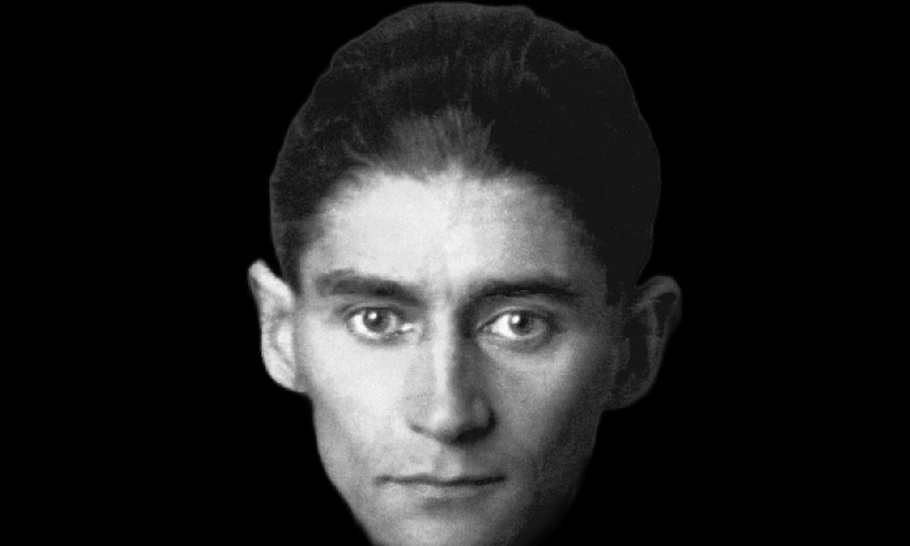
                                                        Image using the last known photograph of Franz Kafka, Most likely taken in 1923

Kafka includes almost nothing on music and art, but he attends many lectures and is very keen on Yiddish theatre.  Always self-absorbed, he’s strangely indifferent to the outbreak in August 1914 of the Great War that would destroy the Austro-Hungarian Empire: “Germany has declared war on Russia.—Swimming school in the afternoon. . . . To those who are fighting, I passionately wish all evil.”  In December he laconically adds: “The defeats in Serbia, the senseless leadership.”

Kafka often writes about not writing instead of writing what he wanted to write.  One entry reads: “Wrote nothing.”  He had to suffer in order to create, but couldn’t always suffer enough.  His stories describe bursts of irrational behaviour that were forbidden in his strict hierarchical society.  His minutely detailed observations are modelled on the logical deductions of Sherlock Holmes.  Kafka’s style is exact, precise, incisive; his clarity is pristine, his meaning obscure.

He gets annoyed when his father boasts about his own childhood suffering: “For years, due to insufficient winter clothing, he had open sores on his legs, he often went hungry, when he was only ten years old he had to push a cart through the villages even in winter. . . . The fact that I haven’t suffered all this permits not the slightest conclusion that I have been happier than he, that those sores on his legs entitle him to be arrogant.” His father wounded him out of love and intensified Kafka’s guilt.  In his forties, he still feared his father and skipped dinners to avoid confronting him.

The Diaries include his entire story “The Judgment”, in which a father’s accusations drive his son to commit suicide by throwing himself off a bridge.  Other entries suggest “the only solution is a leap out the window” or a soft-landing: “jump down from the high window, but onto the rain-soaked ground, where the impact won’t be deadly.”  Kafka describes the difficult parturition of this story as “a veritable birth covered with filth and slime”.  When he read the story to friends, “my hand moved around uncontrollably and genuinely before my face.  I had tears in my eyes.”

Even before he was diagnosed with tuberculosis in 1917, the hypochondriac Kafka despaired about his body and associated it with shame and misfortune, with ugliness, dishonour and sadness: “There’s no doubt that a main obstacle to my progress is my physical condition.  With such a body nothing can be achieved.  I will have to get used to its perpetual failure.”  He experienced psychological as well as physical pain and displayed his sores like a leper: “my eyelashes trembled in my face, in the left corner of my forehead I felt a tension as from a painless gunshot. . . . The tension that often lies over the left half of my skull feels like an inner leprosy.”  Always sensitive to disease, while travelling in Italy in September 1911 he noticed the cholera epidemic that killed the hero of Thomas Mann’s Death in Venice that year.

The severe coughing fits that made Kafka double up with pain and his first tubercular haemorrhage in July 1919 forced him to confront reality and retreat to a sanatorium.  But he distrusted the incompetent and infuriating doctors, who were “so ignorant of healing that they stand like schoolboys before the sickbeds”.  There was no cure for his disease until the 1940s, and the serums, vaccinations and operations were worthless and even dangerous.  He grimly concluded, “I cannot count the doctor as a humanly personal helper.”

So he desperately and rather pathetically turned to naturopathy, which included nudity, air baths and vegetarianism.  His mother whimpered like a cat when he didn’t eat enough and he raged against her intolerable nagging.  A picky eater among the greedy German-Slavic Wurst-Fresser, he was disgusted by raw meat, as if it were cut out of his own flesh, yet perversely craved the very thing he loathed and wanted to devour it like an animal: “If I see a sausage labeled as an old hard Hauswurst, I bite into it in my imagination with all my teeth and swallow quickly, regularly and heedlessly like a machine.”  A slab of Wurst made him ecstatic and he dreamed of “the biting into and simultaneous licking of the unpeeled salami stump.”

Most of Kafka’s sexual descriptions are squalid.  But one saucy wench flattered him as if he were a cute girl: “Oh, if only I could see you naked one day then you must be especially pretty and kissable.”  He was impressed by the potency of a man who told him “how he must slowly stuff his large member into the woman.  His trick in earlier days was to exhaust the women until they couldn’t go on.  Then they were without a soul, animals”—completely passive and subject to his will.  Kafka’s curious friend questioned a woman in the same way the priest had questioned Molly Bloom to get vicarious pleasure in Ulysses: “How was it?  I want to know down to the last detail.  Did he only kiss you?  How often?  Where?  Didn’t he lie on you?  Did he touch you?  Did he want to take off your clothes?”

In the bordello he notes intimate and crude details: “Hair runs thickly from her navel to her private (or not so private) parts.”  He’s fascinated by the  brusque behaviour of a repulsive but serviceable whore: “The only woman suitable for him is the dirty, oldish complete stranger with wrinkled thighs, who extracts his semen in an instant, puts the money in her pocket and hurries into the next room.”  In a passage from America, a graphic moment of aggressive foreplay disgusts the protagonist, Karl: “she shook him, listened to his heart, offered her breast for him to listen to hers, but couldn’t get Karl to do so, pressed her naked belly against his body, searched with her hand, so disgustingly between his legs, then thrust her belly against him several times, he felt as if she were part of him and perhaps for that reason a terrible helplessness had seized him.”  Venereal disease always threatened to punish the fornicator: “Fear of infection, he kissed her down below, even now he sees himself decaying.”

Kafka’s love for Felice Bauer, a successful Berlin businesswoman whom he met in Prague, was also a symptom of his disease.  The promessi sposi were engaged and disengaged in 1914, and repeated this wretched pattern in 1917.  The first impression of his heart’s desire was quite negative: she actually seemed repulsive.  She looked like a maidservant, had a bony empty face, an almost broken nose and stiff charmless hair.  She had the gall to correct his Austrian German and rudely called his sisters “shallow.”  He never experienced with her, as he had with other women, the sweetness of a beloved, “only boundless admiration, subservience, sympathy, despair and self-contempt”—all lethally combined with what he considered her fear of and disgust for him.

The unsuitable suitor Felice was a withdrawn, taciturn, dissatisfied person, horrified by the idea of happiness, who foresaw only lasting and hopeless misery.  He was unable to force her to accept his abysmal opinion of himself, felt guilty about his inability to marry her and the unhappy years she’d suffered on his account.  He confessed, “I have done the wrong for which she is being tortured and moreover wield the torture instrument.”

Striving to be logical rather than emotional, he compiled a list of arguments against marriage.  He had to spend most of his time alone; he could not live with anyone; he feared a wifely connection would swallow him up; the sight of nightshirts on his parents’ bed suggested sickening sex; he hated everything (including Felice) that didn’t relate to literature; marriage would prevent him from giving up his office job and devoting himself entirely to writing.

Even if she loved him—and did she?—he didn’t deserve her devotion.  He confessed, “I love her, as far as I am capable of it, but this love lies buried to the point of suffocation under fears and self-reproaches.”  In a self-condemnation that denied the Joy of Sex, he famously declared, “Coitus as punishment of the happiness of being together.”  One escape route was suicide, though he wouldn’t blame her even if “the apparent immediate cause of it should be F.’s behavior.”  Finally, and most cruelly, he compared Felice to his fatal bacilli: “the lung wound is the symbol of the inflammation which is called Felice.”

Unlike most lovers, Felice inhibited rather than inspired Kafka’s writing.  Despite her distractions, he tried to recapture his dreamlike inner life and strived for the clarity that made ordinary events seem mysterious.  Writing for Kafka was both a liberation and a punishment that made him feel as if a wild beast were waiting to devour him: “I will jump into my novella even if it should cut up my face. . . . [There’s] the tremendous world I have in my head.  But how [can I] free myself and free it without being torn to pieces?”  When he finally managed to complete a work he immediately saw its imperfections, its stunted and irremediable defects.  He read “In a Penal Colony” aloud and was “not completely dissatisfied, but for the blatant ineffaceable flaws.”

Yet surrealistic comedy often burst through and relieved his pervasive gloom.  He delighted in real weird names: Tschisik, Utitiz, Shhite.  He wanted to ascend a flight of stairs with somersaults.  An old wooden ruler had the same edge as a bumpy country road.  A moment of intimacy was interrupted by fear of vermin: “May Bettina rest her head on your arm?  If Bettina has no lice.”  Diners who carelessly ate a finely prepared roast cat began to meow after the meal.  During a deadly reading of inferior stories, “people kept leaving one by one as if another reading were being given next door.”

The writer provoked a stampede by threatening to read yet another story and announcing a five-minute intermission.  He then “read a fairy tale that would have entitled anyone to run from the farthest point of the hall straight through and over all the listeners.”  Kafka’s excited family announced the birth of a grandson “as if the baby had not only been born but had already led an honourable life and had its funeral.”  But mirth could not move a soul in agony.

Kafka includes long excerpts from his unfinished novel America and records many themes that evolve in his fiction.  Like the character in the story “A Hunger Artist”, a man “is constantly starved, only the moment belongs to him, the perpetually continued moment of torment.”  Like the underground man in “A Burrow,” he burrowed away in his shelter, “dug a hollow in the sand in which he felt quite comfortable. . . . But all the preparations he was making to secure the hut against the animals and keep himself safe for the winter had to be abandoned.”  Like the parable “Before the Law,” “It had been impossible for him to enter the house, for he had heard a voice saying to him, ‘Wait until I lead you.’ ”  He foreshadows “The Metamorphosis” with this: “I myself have a strong capacity for transformation, which no one  notices” and “can only creep onward no better than an insect.”

Passages foreshadowing The Trial emphasize Kafka’s feeling of complete helplessness as if he were imprisoned behind locked doors.  He fears “we are outside the law, no one knows it and yet everyone treats us accordingly.”  Though weak, he must defend himself against the prevailing injustice.  A harsh verdict is handed down, “but one should still keep in mind that the first judgment always stands on shaky ground and that one should not let it perhaps muddle all future judgments.”  Nevertheless, the strange but severe penalty is carried out: “the man condemned to death is stabbed there in his room by the executioner without the presence of other people.”

Kafka experienced both a demonic need to create with an inability to write, and expertly analyses his sterility without finding a solution to his dilemma.  Goethe’s great achievement, instead of liberating him, “permeates me and keeps me from doing any writing.”  Anxious and restrained, he lacks sufficient time, is always under pressure, rarely starts anything and finishes nothing.  When he manages to write, his sentences are dry, broken off and unusable.  Everything is fragmentary and worthless, and he feels “condemned to this inferiority by the circumstances of his life.”  He crosses out most of his work and puts it aside for a more propitious time that never comes.  As “a screeching ink-spraying [not-ink-flowing] stroke goes through the whole thing,” the tubercular compares his “wicked, pedantic, mechanical [stories] to an only barely breathing fish on a sandbank”—destined for a slow and painful death.

For Kafka, a specialist in self-torment, life was a perpetual Yom Kippur, a Day of Atonement.  Open his heart and you would see ’graved inside there Misery.  The perpetual alien is a Jew among gentiles, a German among Czechs, a tubercular among the healthy, an outsider even in his own family.  He whimpers like a sick cat, wants to be dissatisfied, can’t resist the tiniest worries and “nervous states of the worst sorts dominate him without cease.”  All his undertakings end in misfortune, and he’s trapped as his wretched life “flashes before his open eyes with steel colours, with taut steel bars and airy darkness between them!”  Echoing Christ’s last words on the Cross, he laments “the pain over my forsakenness that came into me so piercingly and forcefully.”

As his via dolorosa continues, Kafka finds it impossible to sleep, remain awake or endure life.  He suffers weakness, longs for self-annihilation and feels the “tip of the flame of hell penetrating the floor” and ready to thrust him among the eternally damned.  He feels a strange dissociation between his external self and his real creative being, “the terrible uncertainty of my inner existence.”  His most famous aphorism doubts his essential identity and recalls Rimbaud’s “Je est un autre” (I is someone else): “What do I have in common with Jews?  I have scarcely anything in common with myself and should stand completely silent in a corner, content that I can breathe.”

Suffused with a permanent agony that verges on the comic, Kafka assumes vicarious power and punishes his guilt as both torturer and victim: “A large old knight’s sword with a cross-shaped hilt was stuck in my back to its handle” and “a spike crookedly jutted out of my shattered forehead.”  The coup de grace, as in Nineteen Eighty-Four, is self-created: “rats that tear at me and that I multiply with my gaze.”  The torments continue as he’s pulled through the “window of a house by a rope around the neck and yanked up, bleeding and tattered, through all the ceilings.”  Gagged, bound and tortured, he’s finally “stabbed deeply with something sharp, surprisingly here and there, wherever their whim prompted.”  The masochistic Kafka enjoys the self-inflicted punishment for his indelible guilt: “the pleasure again in imagining a knife twisted in my heart.”

The only escapes from these endless torments are insanity, suicide or death.  He could never hope to do what he believed he was required to do and, feeling quite worthless, was prepared to die at any moment: “Dying would mean nothing but sacrificing a nothingness to nothingness.”  He’d nearly obliterated himself while still alive, and told Max Brod that “on my deathbed, provided the pains are not too great, I will be very content.”  As Kafka lay dying, he told his last doctor, “Kill me, or else you are a murderer!”

https://www.thearticle.com/kafkas-diaries-a-chronicle-of-suffering