Thursday, July 25, 2024

Transit Diary: A week in the life of a Washington DC high school student

From ggwash.org

By Beckett Neustad

Beckett Neustad, pictured with his bicycle.

Transit Diaries is a series in which residents of Greater Washington track how they get around the region for a week, shedding light on what’s working well and not so well with our transportation systems. Read past Transit Diaries. 

Hello, my name is Beckett Neustad and I was an intern for Greater Greater Washington in the first half of 2024, and am a student at School Without Walls High School, located in Foggy Bottom. I live in the Eckington neighbourhood of Washington, DC, and typically commute via bicycle. I obviously spend most of my weekdays at school, but when I am not at school, I enjoy learning history, playing guitar and reading books. I also often spend my time doing homework, which is unsurprisingly a little less fun.

Day 1: Monday, April 29

I pretty much bike to school whenever I can. I am lucky to have a fairly direct route to my school with enough bike lanes to at least give the illusion of safety. Other than driving to school, which takes 30 to 45 minutes, my next best option is taking the Metro which usually takes roughly half an hour. Today I had to go to the GGWash Navy Yard offices at 1:30 pm for my internship, so I strongly considered taking the Metro from Foggy Bottom (where my school is) to Navy Yard. Ultimately, I decided to get out of my comfort zone and bike there.

I can’t say that the trip was easy. Navigating Southwest DC by bike wasn’t fun. Parts of I and M Streets were particularly bad. There was a lot of road work and the streets that weren’t being worked on were poorly paved. It didn’t help that I hadn’t memorized a route before setting out. The route I took turned out to be fine, but having to navigate in my head made things more stressful. In the end riding there ended up being a lot easier than the way back. I didn’t anticipate how difficult getting around the Capitol would be, leading me to take a roundabout route that added about 10 minutes to my journey.

Total distance travelled: Biking, 9.9 miles

Highlights: Taking the bike lane on Raoul Wallenberg Place was very smooth and made that part of the commute very easy. I just wish the bike lane could continue on Maine Avenue so you could connect up with the trail at the Wharf. The trip to Navy Yard only took about 25 minutes, which was impressively fast considering the bad planning and bad infrastructure.

Hitch: As I mentioned before, the bike infrastructure in Southwest was not ideal and I found myself taking the sidewalks a lot.
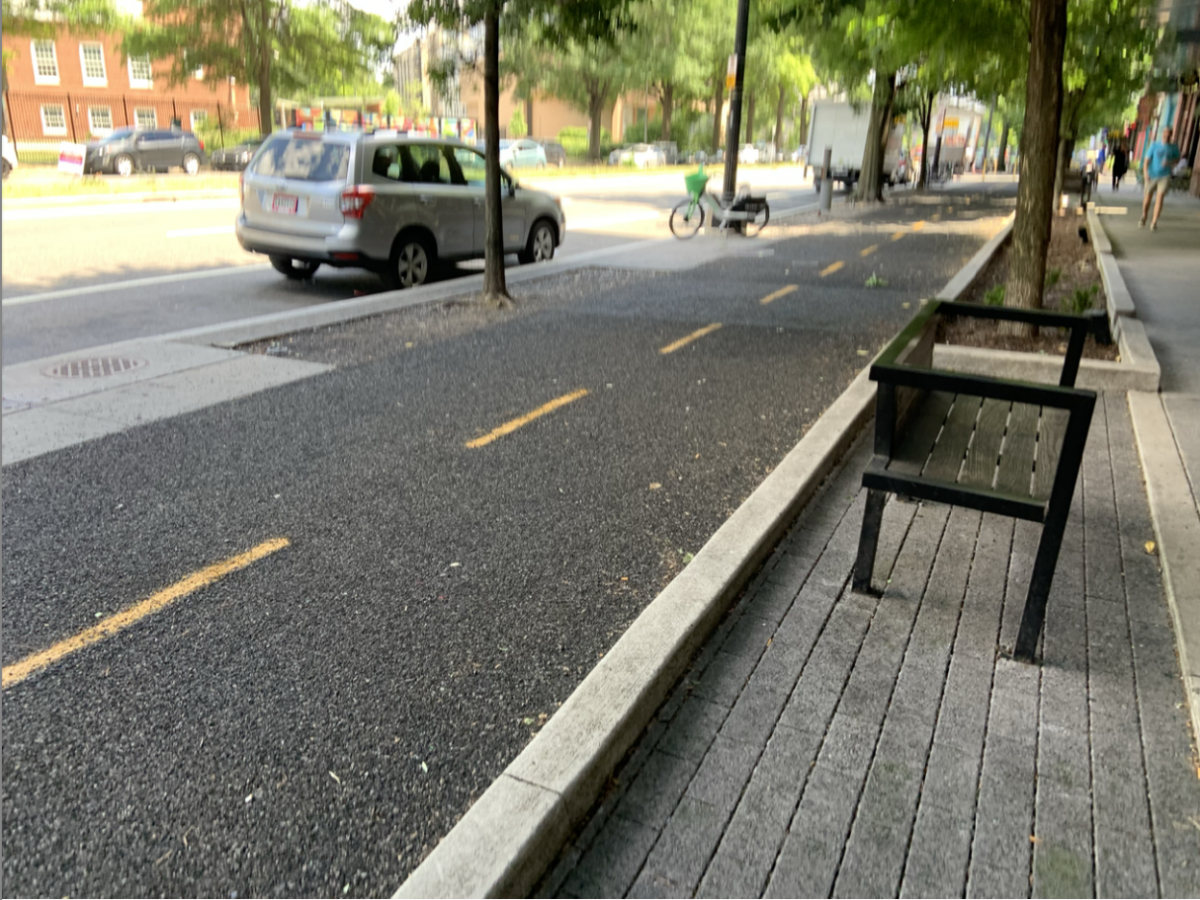
Bike path along the Wharf. Image by the author.

Day 2: Tuesday, April 30

Today was GGWash’s Sweet Sixteen celebration and this made my commutes more interesting. I rode my normal route to school and back without any big hitches. For those who weren’t there, the Sweet Sixteen celebration was down at the Wharf. This necessitated my second trip through Southwest. Luckily, I learned from my previous mistakes and took a much better route around the Capitol, going around the eastern side instead of the western side. I also took an interesting route back from the Wharf, going northward on 12th Street, riding through the National Mall and taking the Metropolitan Branch Trail back.

Total distance travelled: Biking, 14.3 miles

Highlights: Taking the Mall back was very smooth. The sidewalks are wide so you don’t feel like you are at risk of hitting pedestrians. I just want to say that the MBT is absolutely amazing! It always has lots of activity and shows how projects that are geared toward walking and cycling can succeed.
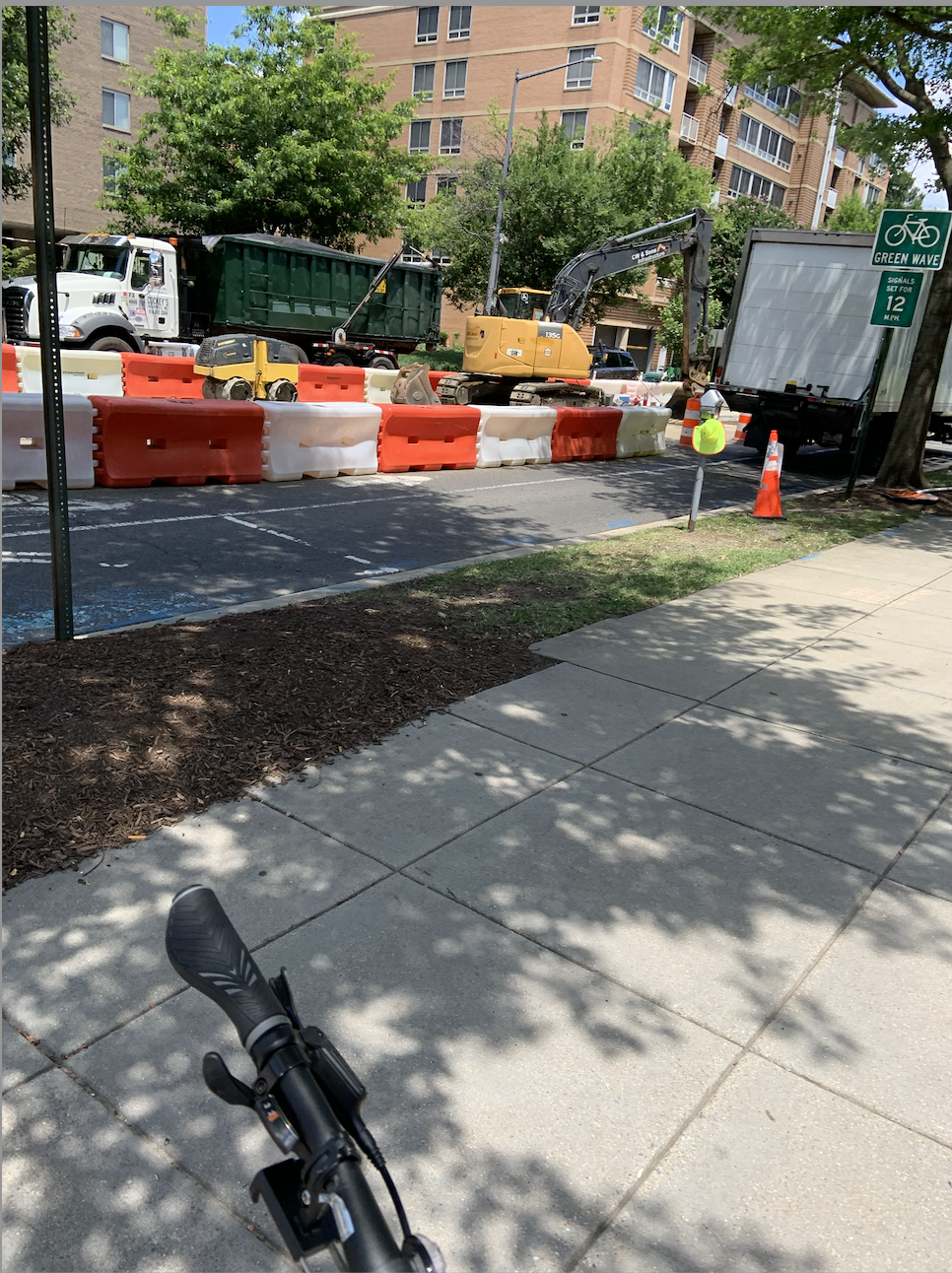
Construction and a blocked bike lane means I take the sidewalk. Image by the author.

Day 3: Wednesday, May 1

After my two days of heavy commuting by bike, I was ready for a break. I did my normal biking commute to and from school. This is a good time to talk about what my commute is like. I like to think I have picked the best route to my school and back, both time- and safety-wise. On the way there, I take R Street until I get to Rhode Island Avenue, which I take to Logan Circle. I then turn onto Vermont Avenue, take it to Thomas Circle, and then turn onto M Street. I take M Street for a while before turning onto 20th Street and finally turning onto G Street, where my school is. On the way back I start by taking the reverse of my route to school, but I deviate from it by turning onto L Street and taking the bike lane there until I turn left onto 13th Street. I take 13th Street up to Rhode Island Avenue, which I take until I turn onto Q Street. I take Q Street all the way to First Street NW and continue on First to R, which takes me home.

Total distance travelled: Biking, 6.4 miles

Highlights: My commute is very fast by bike, solidly beating my time when driving or taking the Metro, despite the poor infrastructure through many parts of the ride.

Hitches: Biking along Rhode Island Avenue can be very scary. There are no bike lanes on the way to school and I have to ride in the third lane, sometimes having to dodge past illegally parked cars. The bike lane on L Street can also be very scary at times. The places where the bike lane shifts to the right to accommodate a left turning lane freaks me out since I have to look back each time to make sure cars aren’t changing lanes.

Day 4: Thursday, May 2

Boy, did I have a busy day in terms of transit! I did my normal commute without any problems in the morning, but my afternoon commute was disastrous! For context, I have wanted to get a new bike for a few months. My current bike is a mountain bike, which is great for mountain biking, but not for city riding. My mountain bike has also had a lot of issues with the gear shifter, which is what plagued my ride back from school. When I was crossing K Street and Connecticut Avenue and tried to shift gears, my chain came loose and got stuck in my gear shifter. This caused me to lose all my momentum and I almost flew off my bike. Luckily I was able to stabilize myself and make it through the intersection with only a few bruises. But my bike was broken. I managed to get the chain back on the bike and got home, but now I need a new bike as soon as possible.

On an unrelated note, today was also my mother’s birthday. We had scheduled a birthday dinner in NoMa, which we planned to walk to. It is a very short walk, but it involves going around Dave Thomas Circle, which is an absolute nightmare. It is being renovated, in a hopefully successful effort to improve traffic flow. Recently there have been people directing traffic during certain hours of the day, which has made things a lot safer. However they weren’t there when we crossed, forcing us to dodge traffic and walk in-between cars stuck in traffic. Other than that the walk was smooth and we took the MBT back, which was, suffice it to say, a lot safer.

Total distance travelled: 9.5 miles. Walking, 3.1 miles. Biking, 6.4 miles

Highlights: Not many highlights today but I can say that the MBT is still amazing. The next time it is suggested that we widen a freeway or road, we should widen this instead. It could certainly use extra capacity!

Hitches: My bike breaking was an obvious hitch, but at least that wasn’t due to poor urban planning. I am sure a lot of people reading this will know this already, but Dave Thomas Circle is one of the scariest places to be a pedestrian. I am hoping that the work will make things feel safer, but I have my doubts. In the meantime, it is terrifying to have to dodge cars in the middle of crosswalks and decipher unclear walk signals.

Day 5: Friday, May 3

I checked my bike last night and determined it would not be safe to ride to school in the morning, meaning that I would either have to drive or take the Metro. Readers of GGWash may be disappointed to know that I opted for the former. While the actual Metro ride is very fast, it involves 15 minutes of walking on either end, greatly extending the journey. This makes driving the second-fastest option after biking. Driving does have another upside: it gives me hours toward getting my provisional driver’s license.

For those who don’t know, there are two steps to getting a driver’s license in DC. First, you get a learner’s permit by passing a multiple choice test; then you need 40 hours of driving and to pass a driving test to get a provisional license. Finally, to get your full license you have to get another 60 hours of driving in. I am currently almost done with my hours and am planning to take my driving test soon, so driving to school does have a silver lining. In addition, because my father has to be in the car with me I don’t have to park.

Total distance travelled: 7.9 miles. Walking, 1.5 miles. Driving, 6.4 miles

Highlight: I took a walk around the GW campus during my lunch break today and the campus is quite pedestrian friendly.

Hitches: Rhode Island Avenue isn’t just a disaster to commute on by bike, it is also a disaster to commute on via car. Drivers are very aggressive and often try to pass you using the parking lane, only to have to honk their way back into traffic after getting stuck behind a parked car. This isn’t so much a hitch as bad urban planning, but there are several places on Rhode Island Avenue where there are crosswalks with no stop signs or lights where cars are instructed to stop for pedestrians. While this may be a good idea in theory, in practice it means that cars can zip past pedestrians who have to run across the six-lane avenue when there is a lull in traffic.

The Metropolitan Branch Trail (MBT).  Image by Joe Flood used with permission.

Day 6: Saturday, May 4

My only transit excursion today was going to get a haircut in Takoma Park. The Metro ride took about 25 minutes including walking on both ends. The ride went without any hitches and I made it in time for my haircut. My mother and sister met me there, and afterwards, I drove them back home, getting some more hours behind the wheel.

Total distance travelled: 11.7 miles. Walking, 1.7 miles. Driving, 4.8 miles. Metro, 5.2 miles

Highlights & hitches: The Metro trip was very smooth and fast. The walk to and from the Metro added a little to the duration, but otherwise I was very satisfied with it. Takoma Park is fairly walkable, there are some questionable intersections and the roads feel unnecessarily wide, but it has a car-free area and the sidewalks are passable.

Day 7: Sunday, May 5

This is by far my least interesting day. I spent most of the day on homework and preparing for exams. My one excursion was to my sister’s chorus recital near the American University law school. I drove there and back with my parents.

In terms of my transit decision making there was really no question that driving was by far the easiest choice. The second best option would have been to take the Red Line to AU, but this would have entailed a long walk from the Tenleytown Metro to my sister’s choir recital. A bike trip would have been difficult anyway and was impossible with my entire family going.

Total distance travelled: Driving, 13 miles

Highlights & hitches: The bike infrastructure in Ward 3 is very underdeveloped, making any bike trip difficult. It sure would be nice to have bike lanes on Connecticut Avenue.

While this may not be a highlight or hitch I think it is interesting that when traveling to places in upper northwest from where I live driving is clearly the easiest and fastest choice. Part of this has to do with the lack of Metro stops across upper northwest. The Red Line can take you to the most prominent areas of upper Northwest but there’s no way to get to areas far away from the Red Line without taking a long walk. A line going roughly horizontally across Northwest could help end this problem, though this would be far off in the future owing to WMATA’s current funding woes. Another part of this is the ease of access with a car. It is not hard to find parking and Massachusetts Avenue takes you most of the way there.

Final tally: 30 trips

ModeNumber of trips% of the total number of trips (rounded to nearest whole number)

Walking

827%
Biking1654%
Metro13%
Driving516%
Total300

Reflections

This was an interesting and informative experience. I had never really thought about my daily commutes like this. I found writing this diary very helpful for giving myself a document I can look back at to consider how I make choices on how I get around. This week was not necessarily representative of a normal week in my life, what with my bike breaking and having a lot of commuting to Navy Yard in the first two days. I was a little horrified by the fact that I drove the last three days, but this provided a good wake-up call for me and it was affected by circumstances beyond my control.

Keeping this diary also made me concentrate more on the things I would like to see changed. While I often think of these things when I am commuting, it was helpful to write these hitches down and think about possible solutions. My hope is that others will have encountered these problems and brainstormed their own solutions. Writing this has also made me appreciate the many ways in which our region is unique. We benefit from a great Metro system, and for all its flaws, my bike commute wouldn’t be possible in many other American cities. In the end, this reiterated for me the fact that the Washington, DC, region is great but it can be greater.

Beckett Neustad was a spring 2024 intern at Greater Greater Washington. A lifelong resident of the District, he first became interested in urban planning from his experience biking to school. He is also passionate about D.C. history and public policy. For fun, he likes to look at historic maps of D.C. to see how the city has changed over the years and ponder how we can improve it in the future.

https://ggwash.org/view/96372/transit-diary-a-week-in-the-life-of-a-dc-high-school-student

Monday, July 22, 2024

Samuel Pepys: diarist, administrator … budding fashionista

From theguardian.com

New analysis of 17th-century diarist’s French fashion engravings shows he was not only a shrewd political operator but had a keen eye for new trends

He may be best known for his juicy diary, administrative prowess and wandering eye – but new research has highlighted a different side of Samuel Pepys: that of a budding fashionista.

A historian from Cambridge University has conducted a fresh analysis of the diarist’s collection of French fashion engravings, arguing they not only show Pepys was keeping up with the scholarly and gentlemanly trend of collecting prints, but reflect a long-term interest in the latest styles of dress, and the link between clothes and social status.

“It demonstrates that Pepys had – to put it in very colloquial terms– a finger in a lot of pies,” said Marlo Avidon, whose study has been published in the journal The Seventeenth Century. “[He] was very concerned with appearing a certain way and cultivating this gentlemanly reputation – both in an intellectual capacity but simultaneously as a member of fashionable society.”

A detail from Jean Dieu de Saint-Jean, Habit Noir, c1670, etching. Photograph: Reproduced by permission of the Pepys Library, Magdalene College Cambridge


But Avidon added while these concerns have previously been considered separately, the prints show they are not mutually exclusive.

Born in London in 1633, Pepys was the son of a tailor and a washerwoman, who became an MP, secretary to the Admiralty, and president of the Royal Society.

But he is perhaps most famous for the diary he kept for almost a decade during the 1660s. As well as offering a first-hand account of a number of momentous events such as the plague and Great Fire of London – during which he buried his wine and parmesan cheese in the garden for safekeeping – it provides fascinating insights into more mundane aspects of daily life.

After Pepys’s death, his diary and other papers were bequeathed to his alma mater, Magdalene College, Cambridge. Among them were ballads referencing clothing, and two volumes that contained his collection of French fashion illustrations. Printed between 1670 and 1696 these depicted the latest styles, as modelled by the French elite.

While not the first time the prints have been examined, Avidon said her work considers them alongside Pepys’s diary to demonstrate that throughout his life he had a very keen interest in clothing – his own, and that of the people around him.

“Even when he stopped writing the diary in 1669, what these prints help us see is that that interest in clothing didn’t necessarily go away, it just manifested in another form,” she said.

The diary reveals Pepys could be controlling and overbearing regarding the attire of his wife, Elisabeth, while reflections on his own wardrobe are also carefully noted.

Avidon cites one entry of 1663, in which Pepys records a colleague approving of some of his new clothes – including a velvet cloak. As a result Pepys writes he is “resolved to go a little handsomer than I have hitherto”.

But not all of his clothes struck the right chord. In 1669 Pepys shelved his new summer suit “because it was too fine with the gold lace at the hands, that I was afeared to be seen in it”. When he did wear it out and about, a colleague criticised the cuffs as being too fancy for Pepys’s position. Pepys subsequently resolved to have the trim removed.

Yet, perhaps tellingly, he later bought a print depicting an elite Frenchman bedecked in similar lace cuffs, with ruffles and ribbons.

Avidon said Pepys’s diary also reveals his eye for new trends, be it the introduction of periwigs or the emergence of the vest – a precursor to the three-piece suit.

The prints not only tie into these interests, Avidon suggested, but provide a lens through which to consider wider social behaviour and cultural attitudes towards French fashion in the late 17th century – including economic concerns regarding textile imports, and moral worries arising from the association of French fashion with vanity and excess.

Yet while Pepys criticised Frenchified English fops in his diary – describing one as “an absolute Monsieur” – he also seems to have admired the styles.

The prints may even provide a link to Pepys’s later life, with Avidon suggesting the “unsteady, untrained hand” that coloured them could have been that of Mary Skinner, who became Pepys’s housekeeper and mistress after Elisabeth died.

                                           Inside the Pepys Library at Magdalene College, Cambridge. Photograph: Douglas Atfield


Robert Blyth, senior curator of maritime history at the Royal Museums Greenwich, said Pepys had a fascination about the world around him and a desire to be at the forefront of knowledge.

“It doesn’t surprise me that this applies to fashion prints as well,” Blyth said, describing Pepys as “a man of the now”.

Blyth noted Pepys would not only have seen the latest trends on the streets, but had access to the court of King Charles II where he would have seen high-end fashions.

“During the diary, he is a young man. He’s a man about town,” Blyth said. “So he’s continuing this interest in fashion into his middle age.”

https://www.theguardian.com/books/article/2024/jul/22/samuel-pepys-diarist-administrator-budding-fashionista 

Wednesday, July 17, 2024

In a young boy’s diary, a record of how Jews lived to the fullest, even in the face of death

From forward.com

YIVO’s new online exhibition tells the story of cultural life in the Vilna ghetto 

Like many teenagers, Yitshkok Rudashevski had a lot on his plate.

“It is so hard to make time for school and the club and then to get entangled in cooking and cleaning,” Rudashevski wrote in his diary, which chronicled the class assignments, lectures and exhibitions that filled his days. 

“I often think: this is supposed to be the ghetto, yet I have such a full life of cultural activities.”

From 1941 to 1943, Rudashevski lived in the Vilna ghetto, keeping a record of Nazi atrocities; the machinations of the Jewish council, “a caste that helps the oppressors do their work;” and his own efforts to interview families about life under the cramped, inhumane conditions of the ghetto.

“The wonderful ghetto-folklore, etched in blood, which abounds in the streets, must be collected and preserved as a treasure for the future,” he wrote.

Rudashevski became part of this history. 

Yitskhok Rudashevski in 1939 with an image of his diary. Photo-illustration by Canva/Ghetto Fighters’ House Museum, Israel/Photo Archive/The YIVO Institute for Jewish Research

After Nazis murdered him at the killing pits in Ponar in 1943, his cousin, the sole survivor of his family, recovered his diary from their hiding place and gave it to Rudashevski’s mentor, the poet Abraham Sutzkever. Sutzkever, a member of the famous Paper Brigade that risked their lives to preserve thousands of documents in the ghetto. Sutzkever gave the diary to the YIVO Institute for Jewish research after the war and published it in 1953 in his literary journal Di goldene keyt.

On July 17, YIVO will launch its second online exhibition, drawn from Rudashevski’s diary. The exhibit hopes to teach high school students about the ghetto’s vibrant cultural life and how it marked a form of defiance against the Nazis.

“He had a real vision about how intellectual and creative life was a form of resistance against the oppressive circumstances in which they found themselves,” said Alexandra Zapruder, an expert on Holocaust-era diaries and co-curator of the exhibit. “Within the boundaries that were prescribed, these young people were going to live as fully as they possibly could.”

‘We will not go to Ponar’

Rudashevski had a rare eloquence, but his diary, written in Yiddish, hasn’t always been the most accessible. 

Sutskever redacted much of Rudashevski’s Marxist politics on publication, and a 1973 English translation, now out of print, took liberties with his prose. For the exhibition, which includes videos, links to archival objects and short graphic novels inspired by the diary, YIVO commissioned a new translation by Solon Beinfeld.

Jonathan Brent, YIVO’s CEO, picked Rudashevski’s diary for its mention of ephemera like posters for plays and lectures and poems set to music, many of which survive in YIVO’s archive. Together these artifacts tell a story that can deepen people’s understanding of how Jews like Rudashevski endured.  

“It was the formation of Jewish identity that comes out of this cultural continuum that gives him an understanding of his self worth, that enables him to fight against the humiliation, the despair, and, as he frequently notes, the hopelessness of the situation,” said Brent.

The Rudashevski exhibit provides historical context and multimedia maps to explain the complicated politics of Vilna, which was under Polish control from the author’s birth to the outbreak of the war, when it changed hands between Lithuania, the Soviet Union and the Nazis. Also included in the exhibition is a breakout section concerning moral choices that ask visitors to consider, among other questions, if it is “better to face the truth and try to prepare for what might happen or to try and keep hope as long as possible?”

Visitors are prompted to consider moral choices drawn from Rudashevski’s own reflections. Courtesy of YIVO Institute for Jewish Research

Rudashevski was intensely critical of what he saw as Jewish collaboration, excoriating Jews who “dip their hands in the dirtiest and bloodiest work” by serving as facilitators to the Nazi occupiers. Karolina Ziulkoski, chief curator of YIVO’s Bruce and Francesca Cernia Slovin Online Museum, noted that Rudashevski’s diary stood out from the wartime diaries like it for its understanding of social ecosystem of the ghetto.

“He’s always looking at what is happening around him,” Ziulkoski said. “He has this view and criticism about everything that he sees going on.“

But while Rudashevski lamented how a butcher would give the finest cuts of meat to members of the judenrat, or how starving people were beaten for stealing bread, he nonetheless kept a spark of resistance alive.  

Ponar, he knew was “saturated with Jewish blood,” he wrote defiantly that he would not go there. When he heard news that Jews who broke from railway cars were shot as they made their escaping, he observed how his class, instead of despairing, sang a song.

“We will be the ones who will come out of the ghetto and throw off the poverty that for generations has oppressed the Jewish people,” Rudashevski insisted.

Rudashevski would go to Ponar, where he was killed at age 15, his diary going silent shortly after he retreated to an attic hiding space. Zapruder believes his life can serve as an example to young people to navigate a world that can at times seem overwhelming or hopeless.

“Seeing how somebody else in what turned out to be a doomed set of circumstances, nevertheless exerted tremendous will and energy to try to live as fully as he could, and then left behind this incredible record, I think, in and of itself, is inspiring and kind of insightful,” Zapruder said.

A voice other than Anne Frank

In Lithuania, excerpts of Rudashevski’s diary have been included in textbooks since 2017, a supplement to the traditionally read diary of Anne Frank.

Former Lithuanian minister of culture Mindaugas Kvietkauskas translated the diary, which in 2020 and 2021 was donated to hundreds of Lithuanian schools, part of a government initiative begun in 2011 to recognize the Holocaust, the country’s role in it and the tremendous loss of its Jewish citizens. 

“The spot of oblivion that until recently existed in Lithuania over the past several years gave way to an emotionally powerful memory site of the Holocaust – the memory of the talented child who wrote a Vilna ghetto diary and was killed in Ponar at the age of fifteen” Kvietkauskas, a co-curator of the YIVO exhibit, wrote in an email.

For Zapruder, Rudashevski’s diary can serve to remind young people that Anne Frank’s experience was just one of millions, and indicates a shift in Holocaust education away from privileging facts and figures (from which we get startling surveys about general awareness of the Shoah) toward a more personal understanding. 

The questions asked in surveys, she said, shouldn’t be limited to how many Jews were murdered or can you name three concentration camps, but whether students understand the impact of war and genocide on an individual life. 

“That’s what this is about,” Zapruder said. “You can’t encounter this story and walk away unchanged.”

https://forward.com/culture/633201/yitshkok-rudashevsky-vilna-ghetto-holocaust-yivo-online-exhibition/

Tuesday, July 2, 2024

Diaries offer insight into Anglo-Irish life

From southernstar.ie

THE diaries of the daughter of a Skibbereen landlord, Lionel Becher Fleming, have formed the basis of a fascinating new book, which will be launched in Castletownshend this week.

The Memoirs and Diaries of Judith Isobel Chavasse: An Account of Life in West Cork and Waterford (1867-1935) was written by Dr Rachel Finnegan, who acquired the diaries two years ago, after they had lain uncovered for more than four decades. Judith Isobel Chavasse, née Fleming, was born in Ballydevlin in Goleen in 1867 and lived in New Court House in Skibbereen, as well her marital home at Seafield House in Castletownshend, until her death in 1935.

Rachel told The Southern Star she was gripped from the moment she opened Judith’s first diary entry. In 1890, at the age of 23, which began with: ‘Father died a few minutes before the New Year.’

The book chronicles Judith’s childhood and early adult years through her memoirs, written towards the end of her life, and describes her courtship and married life through an almost complete set of diaries from 1890 to 1933. The final two years of her life, when she stopped keeping her diary, are told through the diaries of her husband, Major Henry (Hal) Chavasse (1863-1943), who survived her for another eight years.

Judith Chavasse with her family at Seafield House, Castletownshend, in January 1916. Courtesy: Chavasse Papers.

Judith’s days were deeply intertwined with her extensive circle – the Fleming, Reeves, Townshend, Coghill, Becher, Haythornthwaite, Fitzgerald, Somerville-Large, and Somerville families, including novelist Edith Somerville – and filled with her efforts in parish and war work.

The biography delves into Judith’s personal trials, her struggles with domestic life and ill-health, and her devotion to the grand houses that framed her life story, including her mother’s childhood home – Tramore House in Douglas in Cork – and Whitfield Court in Kilmeaden, Co Waterford, where she lived for the first 15 years of her life and raised four sons (a fifth died in infancy). The story of Judith’s privileged life is set against the backdrop of the turbulent times of the Boer War, the First World War, and the Troubles.

The book will be launched by artist and local historian Margaret O’Dwyer on Wednesday July 3rd from 6.30pm to 8pm, at the Warren Gallery in Mary Ann’s Bar in Castletownshend.

Copies are available from local bookshops or direct from the author and publisher at pocockepress.com.

https://www.southernstar.ie/history/diaries-offer-insight-into-anglo-irish-life-4297720