Thursday, August 26, 2021

Dear Diary: how keeping a journal can bring you daily peace

From theguardian.com
By Anthony Quinn

Writing a diary is a great way to offload – and, if memory fails, it’s a wonderful window on the past

I still get funny looks from people when I mention that I keep a diary. Maybe the practice strikes them as shifty or weirdly old-fashioned. It’s true that I never feel more furtive than when my wife finds me writing it at our kitchen table – it’s like being spotted entering a confessional box in church. What exactly have I got to tell this black book about a life that we share all day, every day? What secrets can I possibly be keeping?

The answer: nothing of any great note, and yet so much of my life is in it. I started writing a journal (as I used to call it) when I went on holiday. Twenty years ago I decided to go full-time and since then I’ve kept it more or less every day. Why? I suppose it began as an experiment – and became an obligation. You can’t hold back time, but you can try to save the past from being completely erased. It often feels trivial to record things as they happen (a stray remark, hearing a song, fleeting moments of doom or delight), but later they may prove useful, or instructive, or amusing. It also maintains the illusion of diligence – that you’re not just pissing away the days. A diary is good exercise for the writing muscle, the way a pianist practises scales or a footballer does keepy-uppies. During lockdown, like everyone else, I got into routines that felt numbing in their repetition and diary-wise left me short of material. I took recourse to discussing the books and box sets I was involved with – not exactly Pepysian, but it got me through.

Which prompts the question: who are you writing for? Ultimately, it’s yourself. Diary-writing is the most private form of literary creation because you are both the author and (for the present at least) the sole reader. There are great advantages to this. The first is the benefit to your mental health. The diary is a safety-valve in an age of invasive scrutiny. I should admit that I have never been on social media and don’t own a mobile phone. (Yeah, I know). Much better to confide your unworthy or unrepeatable thoughts to that book on your desk than pin them up for everyone to read online. There is no fear of being trolled or cancelled when you only write for yourself and you won’t have to live out your regret in public. Is there anything quite so pathetic in social-media manners as the line “They later deleted the tweet”?

Me and my thoughts: ‘There’s a lot about music in mine, and loads of gossip, much of it indefensible. There is also a fair bit about football.’ Anthiony Quinn in his garden with some of his old diaries. 
Me and my thoughts: ‘There’s a lot about music in mine, and loads of gossip, much of it indefensible. There is also a fair bit about football.’ Anthony Quinn in his garden with some of his old diaries. Photograph: Antonio Olmos/The Observer

Even the greats have used their diary as a psychological prop. James Boswell, often prey to insecurity and low spirits, would address himself in his journal in the second-person, as if he were his own mentor. Studying law as a young man in Utrecht in September 1763, he writes: “Try and be shaved and dressed by nine… Read much privately and continue firm to plan… Resolve now no more billiards. Be not hasty to take music master, and consult Count Nassau about concert. Be frugal, calm and happy, and get wine soon.” I love that last bit.

The second is more to do with existential curiosity: the long perspective of diary-writing furnishes a picture not just of what you did but of who you were. To read diaries of old is to chart the progression of the self – “the varieties of ourselves”, as Penelope Lively puts it – as it changes through time. Sometimes I happen on a diary entry from years ago and think, in genuine surprise: did I write that? If it weren’t in my handwriting I would be inclined to doubt it. We evolve, we slough off old selves and acquire new ones, and yet some essential core in us persists, a cast of mind. Memory will play us false about our past, will blur the nuances or miscarry the meaning; a diary, while not infallible, can at least claim: “I was there at the time.”

A third important advantage of the diary is as an aide-memoire to your work. History does the broad sweep of years and decades. Biography does the intricate detail of character and incident. Diaries do both of these jobs, somewhat inadvertently, and may be mined for material thereafter. Certain seismic events are noted in mine, though aside from the odd pandemic and election result there’s not much “hand of history” stuff going on there – that’s not why I write it. I have some sympathy for Louis XVI returning from hunting on the day the Bastille fell and writing in his diary, “Rien”.

There’s a lot about music in mine, and loads of gossip, much of it indefensible. There is also, as I discovered on re-reading in lockdown, a fair bit about football, in particular about Liverpool FC, the club I support. This proved hugely helpful when I came to write a short book about our manager Jürgen Klopp, who arrived at the club nearly six years ago and carried us to glory. Here is what I wrote on 8 October 2015:

Have been checking the BBC Sport website all week for news and when it finally arrives I yelp with excitement: Jürgen Klopp has agreed to be manager of Liverpool. Yay! Really like the cut of his jib, he’s dry and merry and apparently an inspiration to all who play for him. Jürgen, may you reign long and happily at Anfield! Welcome to Das Boot room.

As you will note, this hardly constitutes fine writing, but here it doesn’t matter. What these entries about Klopp had was immediacy and spontaneity, which would lend a different flavour to the book I was writing. Klopp would not be a biography, rather a memoir about being a fan, a meditation on Liverpool, and a slightly embarrassing love letter to a man I’d never met. Had I remembered the dream the following night in which I was actually playing for Klopp? No, but my diary had. (Apparently I was wearing a cashmere jumper for a training session and Klopp felt the edge of my sleeve and said, “Nice”).

Today he gave his first press conference as LFC manager and was masterly: funny, mischievous, smart, charismatic. “I am the Normal One,” he said, and the press guffawed. Oh please let him be the club’s saviour. God knows we’ve waited long enough for one.

I suppose the classic “Dear Diary” moment would be meeting the man himself. I don’t imagine that happening, and that’s fine – he’s got better things to do, like returning the club to winning ways.

The question hovering over every diarist is the one concerning posterity. Are you writing with publication in mind? A tricky one. I’m not sure any writer would dismiss outright the idea of their diary being published one day – only it should be one day when you’re no longer around. There’s a whiff of bad faith about a living writer who publishes their diaries: it sacrifices the vital combination of intimacy and freedom that distinguishes the best. You can’t be quite honest.

There are exceptions. The theatre critic James Agate (1877-1947) wrote a wonderful sequence of diaries called Ego that were published in London from 1932 until his death. They are wit-struck, gossipy, erudite, indiscreet (though not that much; inevitably there’s no mention of his hectic gay life). Agate had high hopes for them: “I would like 100 years hence to be put on the same shelf with Pepys and Evelyn… Ego is a gold brick made from no straw. It may live or it may not. It would be nice if it did.” It did not. The diaries have been out of print for years, and Agate’s name outside theatrical circles is all but forgotten.

Serious contemplation of the future’s indifference to us is like gazing at the sun: you can’t do it for long. Most writers know they are in a race to obscurity. The blessing of a diary is to give you peace of mind, and a place to order your thoughts. I have never loved Virginia Woolf as a novelist, but as a diarist she strikes me as one of the greatest who ever lived.

Here she is on 17 November 1934: “A note: despair at the badness of the book: can’t think how I could ever write such stuff – and with such excitement: that’s yesterday; today I think it good again. A note, by way of advising other Virginias with other books that this is the way of the thing: up down, up down – and Lord knows the truth”. The skittish punctuation married to the intense feeling speak to us down the decades – a completely individual voice expressing the universal. A diary consoles, charms, invigorates; and it keeps remembering while everything else disappears.

Klopp: My Liverpool Romance by Anthony Quinn is published in paperback by Faber at £8.99. Order it for £7.64 at guardianbookshop.com

https://www.theguardian.com/lifeandstyle/2021/aug/21/dear-diary-how-keeping-a-journal-can-bring-you-daily-peace


Saturday, August 21, 2021

Diary of a British soldier in Afghanistan: ‘We’re on joint patrol with the Taliban, it’s surreal’

From telegraph.co.uk

In exclusive article for The Telegraph, servicemen describe life in Kabul as they come face to face with militants who killed their comrades

British paratroopers in Afghanistan have found themselves effectively on “joint patrol” with the Taliban who killed their friends, soldiers have said. 

The Telegraph has been speaking over the past week to servicemen from 16 Air Assault Brigade’s 2 Para who are on the frontline in Kabul as part of Operation Pitting, the UK’s effort to rescue British nationals and eligible Afghans.

As city by city fell to the Taliban, the soldiers were dropped in under the cover of darkness to save as many as they could. 

This is the story of their week.  

British soldiers arrive in Kabul

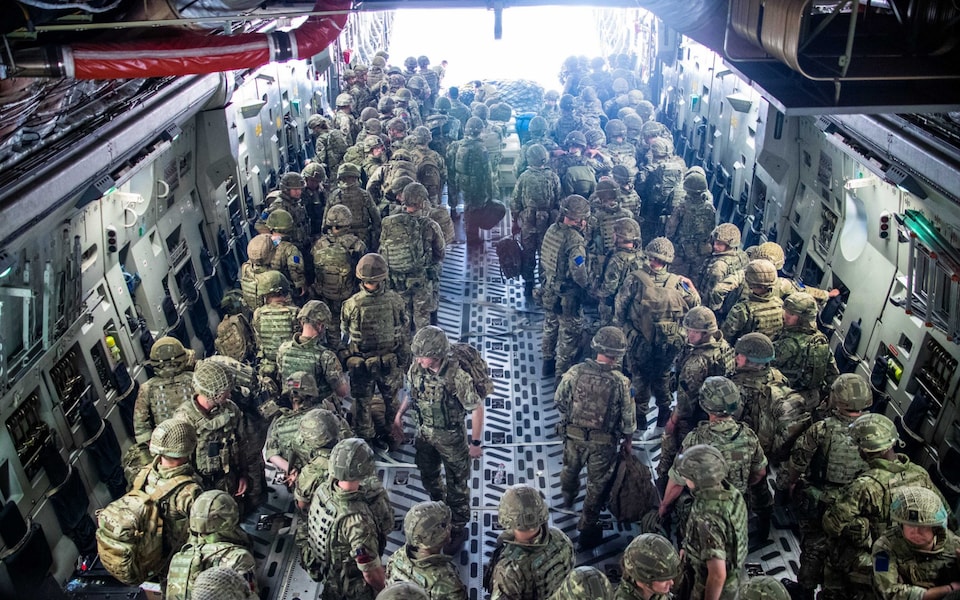
British forces from 16 Air Assault Brigade arrive in Kabul. Their week is
documented below by Soldier A                 Credit: Ben Shread

Friday, August 13:  Soldier A did not expect to be packing his bags to deploy for a rescue mission to Kabul. He was due to be enjoying summer leave, switching off from the military and having a break. Instead, after Ben Wallace, the Defence Secretary, ordered a Non-combatant Evacuation Operation to be executed on Thursday, he was back on a C-17 Globemaster to Afghanistan, a place he had fought in many times before and thought he could leave behind.

Saturday, August 14: “It’s crazy out here,” Soldier A texted from Afghanistan. Within 2 hours of touching down at Hamid Karzai International Airport in Kabul, he had taken to the streets to rescue people.  “Everyone from 2 Para landed and went straight into it, we had no choice,” he said. “It was really chaotic as Kabul was falling.” The streets were busy, the night was hot, and at times personnel were forced to dismount their military vehicles to move displaced people out of their way so that they could find those they had been sent to rescue. The passengers, a combination of expats, dual nationals and people working with NGOs and contractors, had been instructed by the Foreign Office to report to a secure location, where they were picked up by the soldiers. “We scooped up most of the British nationals on the first day, but I believe there are a few still out there,” he said. Among them were blind, pregnant and disabled people. 

Sunday, August 15: In the early hours of the morning, the evacuees were brought to the airfield. Ensuring the safe passage of the civilians to the airport was a “phenomenal” effort, which required coordination between the Royal Air Force and other agencies, including the US military, Afghan police and the Foreign, Commonwealth and Development Office. Once inside, the evacuees were fed and given the chance to rest. However, the soldier said “conditions were basic, reflecting the emergency nature of the extraction”. Those who had been rescued were “relieved to be getting out”. “A friendly British face goes a long way,” Soldier A said. By nightfall, the capital had fallen to the Taliban. 

Monday, August 16: At around 11.30am, 2 Para had completed their first evacuation of around 200 British nationals from Afghanistan. Packed into a military aircraft, the evacuees travelled to the UK via another location in the Middle East. “The guys and girls here have been exceptional,” Soldier A said. “Likewise, some of the Afghans have been unbelievably brave.”

With the first evacuees safely in the air, the soldiers went on to occupy the Baron Hotel complex around 600 metres from the perimeter of the airport, working around the clock. “I’m sleeping less than an hour at a time,” Soldier A said. “I’ve completely lost track of days.”

Tuesday, August 17: Crowds of people swelled around the airport entrance. “It’s chaos,” Soldier A explained. “People are fighting for their lives to get in and British soldiers are at the front of it.” The Taliban appeared to be making it extremely difficult for those seeking evacuation. “People are shaking with fear when they get to us because of the ordeal of getting past the Taliban to reach us,” he added.

 The emotional strain of what they are seeing - men and women sobbing, pleading for their lives - takes its toll on the soldiers. “We do a job that volunteers us for some of the most extreme environments on earth,” Soldier A said. “We understand that when we sign on the dotted line, and we do what we have to do. But it doesn’t mean we always enjoy it.”

Wednesday, August 18: It is not lost on the soldiers just how unprecedented it is to be operating in a collegiate way with the Taliban. Many on the ground fought them over the 20-year war and lost colleagues along the way. However, today, they are not being obstructive.  “I’m pretty much on a joint patrol with them,” Soldier A said. “It means we stand about five feet away from them. It’s surreal.”  In order to get through it he said, “I’m separating the two now”, but conceded that the entire situation was “pretty unfathomable”.

“I am a little concerned, perhaps less about the Taliban’s behaviour changing, more about people becoming desperate,” he said. 

Thursday, August 19: Flights have started to leave regularly and Soldier A is confident that the UK has developed “a really good system to transition chaos” in order to enable orderly departures. They have also picked up people from a number of other nations. If things keep going at pace he believes British troops will be out by August 31. “We are still on for the end of the month because the real question is will the Taliban accept a delay, they want us out,” he said. Asked if he believed they will evacuate everyone they were sent to recover by that deadline, he added: “We are certainly trying.”

Friday, August 20: Since Sunday, Britain has evacuated more than 2,400 people, 599 of them UK nationals. However, frustration has been brewing on the ground as to why the mission was left so “last minute”. 

“Why we didn’t do it a month ago when the rest of the UK mission withdrew is beyond me,” Solider A said.  “The country was stable then. Yes, it was the plan to send us in, but it doesn’t make sense – take a load of people and their kit out of a place, to send different people and kit to the same place a month later.”

The soldiers are the ones who have the difficult job of turning desperate people away at the gates of the airport.  “Without all the right documentation they just become good people we can’t take,” Soldier A said, although he insisted that despite the emotional hardship the male and female soldiers alike would carry on with their mission in the vein they had started. “They really are doing an awesome job,” he said.

https://www.telegraph.co.uk/world-news/2021/08/20/crazy-herediary-british-soldier-afghanistan/?li_source=LI&li_medium=liftigniter-rhr

Sunday, August 15, 2021

NHS nurses' diary tell patient's 15-day intensive care Covid-19 story

From islingtongazette.co.uk

London: An Islington man spent five weeks fighting Covid-19 at the Whittington, just yards from his home. Now he wants to share the diary nurses wrote for him, and pay tribute to their amazing care.

Nick Martens, 70, was admitted to the Whittington Hospital with Covid-19 in early June. He spent five and a half weeks there, including 15 days in intensive care. 

During his time in intensive care, the nursing team looking after him did something they do for all of their patients – they wrote a diary for him, keeping track of his care and his condition. 

Nurses wrote to Nick Martens while he was unconscious during his fight with Covid-19

'Hi Nic, It's me Carlo, your nurse for today...' Nurses wrote to Nick Martens while he was unconscious during his fight with Covid-19 - Credit: Nick Martens

Nick wants to share the diary, which he was given at the end of his stay in intensive care, to pay tribute to the medics who kept him alive – especially as at times it was not always a sure thing.  

Nick told the Gazette: "I had not seen anything like it to be honest. I remember nothing of those 15 days - there's just this diary which the nurses left by my bedside.

"The [hospital] is absolutely amazing. The doctors were amazing. The nurses were amazing. I could just wax lyrical about the care I received all day."

A Whittington Health spokesperson said: "We are pleased to hear that Mr Martens continues to recover following his time with us and we’re proud to have been there for him when he needed us.

"His case serves as a reminder to everyone of how serious Covid-19 can be which is why it is so important that everyone gets the protection of two doses of Covid-19 vaccine as soon as possible.”

The patient diary written by Nick's nurses during his time in intensive care is presented below - it has been edited for brevity, but the words remain the nurses' own.

June 10 - day shift

Hello Nicholas

My name is Maybelle, your nurse for today. This is your second day here with us in the critical care unit. You remain to have a breathing tube connected to the breathing machine. 

We are doing the best we can to help you keep fighting. I will pray for your recovery.

Maybelle

June 10 - night shift

Hi Nicholas

My name is Wincey. I am looking after you tonight.

I was helping her Wednesday night. And tonight I get the chance to look after you. Your oxygenation somehow improved after putting you on the ventilator. 

Unfortunately it was not a very good night for you. You remain very unwell at present. I hope today will be a better day for you Nicholas. I will pray for your recovery just continue to hang in there. We are all doing our best to help you get through with this.

God bless.

Wincey

June 13 - night shift

Hi Nicholas. I wonder if they call you Nick or it's just Nicholas.

It's me again Wincey, your nurse for tonight. 

I must say for the past night shifts I have looked after you. This is the most stable night you have had. I hope this will carry on but we must just take it day by day. In reality, you will have good and some not so good days but that's OK  - as long as you are still here and fighting.

I wonder what the sound of your voice is like

Keeping you in my prayers

Wincey

Nick Martens spent five weeks in the Whittington Hospital suffering from Covid-19

Nick Martens spent five weeks in the Whittington Hospital suffering from Covid-19 - Credit: Nick Martens/PA

June 16 - day shift

Hi Nick

My name is Sophie and I'm the nurse looking after you today.

You remain on the ventilator with the breathing tube in your mouth - however today we have managed to wean down your oxygen and the amount of support the ventilator is giving you which is really good.

We have also reduced the amount of sedation we are giving you and although you remain very sleepy you have just been able to squeeze my hands when I asked you to, and you have been able to nod and shake your head to me when I've been speaking to you which, although it may seem like a small thing, is an amazing achievement considering how unwell you have been.

Sophie

June 18 - night shift

Hi Nicholas

I'm looking after you tonight. You are still on a ventilator and improving slowly, day by day. You are on a sedation and may not remember me, but the most important thing is you and it is a pleasure to take care of you. Your ventilator settings needs adjustment during the night. Our doctors are still seeing you as well. So good luck, hope you will have a speedy recovery. God bless.

Carlo A

June 19 - day shift

Hi Nicholas

I'm Sheila and looking after you for the first time today. It's a Saturday and not the best weather in London as it's been rainy/drizzling outside. 

You appear to be comfortable and after the wash I put on some music for you. I hope you did not mind me choosing a variety of music. I played The Supremes, and some blues and 70s hits just to mix it up a little for you. I do hope the music helps relax you. You remain quite ill and do need quite a lot of support. We will continue to work together to help you through this so be patient.

I wish you all the best recovery.

Regards

Sheila

Intensive care patients at the Whittington receive a Patient Diary - composed by their carers

Intensive care patients at the Whittington receive a Patient Diary - composed by their carers - Credit: Nick Martens

June 21 - day shift

Hi Nicholas

It is a pleasure looking after you today. We are hoping to remove your breathing tube as soon as you are ready. I really hope you recover rapidly and when you read this diary, you will realise how sick you were.

I wish you all the best and am hoping that you remain strong in this fight.

Sheik

June 22 - day shift

Hello Nick

It's Sophie the nurse looking after you again today.

You should be very proud of yourself. We have been able to take out the breathing tube and take you off the ventilator.

Wishing you a continued speedy recovery.

Sophie

June 22 - night shift

Hi Nicholas! I'm MJ your night nurse.

I am just ecstatic to see you doing so well after the great difficulty you've been through. You've been and still are quite disorientated after two weeks of induced sleep. Well I would probably be too! You told me as we conversed that you went on a very long sailing trip on a boat. I said that you are not the only one who shared that experience.

I am afraid I will be leaving you for now Nicholas. I hope you'll have a lovely and productive day. May you have a speedy recovery. I wish you all the best.God bless!!

Your Nurse

MJ

June 24 - day shift

Hi Nick

It's Dennis your nurse today.

You made a big progress and you're making good conversations with the doctors regarding your treatment plans. You also had a phone call to Tristan to surprise him about your transfer from ITU to Nightingale Ward.

I wish you well and be better every day.

Your nurse

Dennis

The diary ends on June 24 - when Nick was transferred out of intensive care. Not all of the entries in his diary could be included here. They were written by Whittington nurses Dennis, Susile, Carlo A, MJ, Sophie, Sheik, Maria, Sheila, Meron, Wincey and Maybelle.

https://www.islingtongazette.co.uk/news/health/nhs-patients-covid19-diary-whittington-hospital-8221788

Friday, August 6, 2021

Journaling to excellence

From castanet.net
By Caren S. Neile

What do grunge rocker Courtney Love, the late South African President Nelson Mandela, and explorer Marco Polo have in common? You may be surprised to learn that they are among the millions of people around the world and throughout history who have kept journals.

According to the University of Rochester Medical Centre in New York, journaling is simply writing down your thoughts and feelings to understand them more clearly. While a diary is intended to look back on where you’ve been, a journal helps you analyse the past with a purpose: to look forward to where you’re going.

If it seems unusual that a medical centre promotes journaling, consider this: Journaling has been proven to help people improve physical health—immune system, sleep, and even wound care—in large part because it affects mental and emotional health. Those benefits may include enhanced mindfulness, better memory, more self-confidence, higher emotional intelligence, and, of course, stronger communication skills.

The mental and emotional benefits in particular make journaling a highly effective contribution to the savvy communicator’s or leader’s toolbox. In fact, “Understanding Emotional Intelligence (EI),” a Level 3 project in the Motivational Strategies path of Pathways, requires that you keep a journal about your emotions and how they impact you and others, and then speak to your club about what you’ve written. EI is the ability to understand and manage your feelings and to self-motivate, as well as to understand the feelings of others and respond appropriately.

In addition, claims Toronto, Ontario, Canada, freelance writer Hayley Phelan, writing is “fundamentally an organizational system.” So keeping a journal helps organize and process a particular event in our mind, she explains. That’s one reason why our working memory improves when we journal. Our brains are freed from the work it takes to process the experience.

Photo: Contributed

Look for Patterns

Recording and reviewing your feelings and responses on a regular basis can also help you recognize patterns in your behaviour and interactions. That kind of self-awareness can in turn make you a better leader and better communicator, which is one of the reasons it can have a direct effect on Toastmasters activities. There are others, as well.

“Journaling helps me to come up with speech ideas,” explains long-time member Basha McCrumb, DTM, Past District 38 Director. “It also helps me to see my growth if I go back and reread where I was when I started on various paths or leadership roles and compare that to where I am currently.”

The benefits of journaling may include enhanced mindfulness, better memory, more self-confidence, higher emotional intelligence, and, of course, stronger communication skills.

For example, she recently looked back at journal entries corresponding to the beginning of her leadership journey in Toastmasters, when she became President of a newly chartered club.

“I saw how naïve and hesitant I was! Then I scrolled on to [entries marking] the beginning of other leadership roles and was amazed at the growth I have seen in myself since then,” recalls McCrumb, a resident of Delaware who belongs to five clubs. “I still have questions and concerns with each new role, of course, but they are changing as I grow.”

Guided Journals

Many people simply use whatever they have on hand for their journals, but Emmet Naughton, of the Berkeley Square Speakers Toastmasters Club in London and the online club Firebirds Collective, went much further. In order to excel as speakers and leaders and help others do the same, he and his partner, Valeria Crespo, created The Speaker’s Journal, a guided journal chockfull of motivational ideas (“Passion. Purpose. When was the last time you spoke with either of these?”); quotes (From Steve Jobs: “Innovation distinguishes between a leader and a follower”); and useful content (“Key benefits of humour in public speaking: Humour can put a tense room of listeners at ease. Being funny for a moment will also put you at ease”) that complement the Toastmasters experience.

“I needed a central point from which to build. I needed room to expand my ideas and to explore the important conversations in my life [both personal and professional] on paper,” explains Naughton. “The journal is also there to empower the user with smart, simple, and repeatable routines that range from preparation to reflection.

“From my own experience and those of others, I can tell you that it’s worked.”

Tips for Your Journaling Journey

Just do it: Five minutes. One sentence. No censoring. Maybe you want to start writing after your next meeting or speech—or before.

Keep it simple: If you decide to go the pen and paper route, pick up a notebook or ready-made journal that calls out to you, either in style, size, or number of pages.

To be digital, or not to be digital: Although McCrumb, the long-time member from Delaware, prefers to use a written journal, she suffers from a common condition: terrible handwriting.

“Currently I am journaling in a Word document,” she says. “However, I print it out and put it in a physical journal, as I also include mementos or other items as well. Those may be pictures or a napkin from an airplane, or confetti from a play, etc.”

Typing on a phone or computer can yield the same outcome as paper, especially if it’s easier for you. You could even use a voice recorder. Until journaling becomes a habit, you might want to use some type of reminder until you automatically remember to pull up the file.

Make it a habit: “I find consistency is a very powerful tool in journaling,” says Catalina Rozo, of Berkeley Square Speakers and Early Bird Speakers in London. “It makes it easier to commit to daily goals, and it helps me set an intention before starting the day. Then when I end the day, I check my goals and see how I did.”

Top secret: Your journal is a guide to your personal journey. You don’t need to share its contents with anyone, including club members, unless you choose to. That said, sharing bits and pieces might open up good conversations and connections with other leaders. (And as we’ve seen, a journal can be a gold mine for speech material.)

Look back: From time to time, turn back the pages of your journal to review the thoughts and behaviours you find there. Are there any you want to capitalize on, or others you want to overcome?

“I write down my emotions and thoughts before and after events and then look back at those perceptions from time to time to see how things have evolved,” says Andrew P. Bennett, DTM, another member in the Berkeley Square Speakers and Firebirds Collective.

Finally, as if you needed any more motivation to give journaling a try, remember; The kind of skills that journaling promotes has benefits far beyond the club meeting.

“Journaling and targeted reflective practices like it actually hold the keys to making you a better person,” says Andrew Ben-Salem of Berkeley Square Speakers. “They help you become not only someone who is more aware of how you communicate with others, but also someone who is constantly learning about the way you are showing up, and making improvements so that you can connect better with others in general.”

All this, of course, is on top of the physical and emotional benefits. Now that’s what I’d call a tool for success. Wouldn’t you?

https://www.castanet.net/edition/news-story-342036-1120-.htm

Wednesday, August 4, 2021

Dear diary: Basu shares notes from policymaking’s front lines

From news.cornell.edu

As the chief economic adviser in India’s Ministry of Finance in 2010, Kaushik Basu was confident the government’s decision to end price controls on gasoline and diesel was the right one.

But after the policy change’s announcement and a slate of media interviews, Basu, then on the job for about half a year, wrote in his diary that later that night he suddenly felt shaken.

“In one fell swoop we took a decision that would affect millions of lives,” he wrote. “For the 12 or 15 of us involved, it was several days of deliberation but, finally, just one decision. Yet it can be momentous for the nation. How strange life is.”

Basu, the Carl Marks Professor of International Studies and professor of economics in the College of Arts and Sciences, relates that and many more experiences from his seven years in public life – first in the Indian government, then as chief economist and senior vice president at the World Bank – in a new book, “Policymaker’s Journal: From New Delhi to Washington D.C.,” published in July.

A collection of journal entries jotted at the end of days or weeks, revised slightly for clarity, the book does not attempt to detail the economics and policies in which Basu was immersed, some of which he wrote about previously in “An Economist in the Real World: The Art of Policymaking in India.”

Rather, Basu writes, he sought to share his musings about life on the front lines of economic policymaking and the morality of public life, some of which he hopes may be “mulled over and hopefully used to shape a better world.”

Readers travel the globe with Basu – from the United States and China to Samoa and Tajikistan – and learn about his encounters with world leaders, power brokers and economic thinkers, as well as ordinary citizens grappling with economic hardship.

Basu had no prior government experience when Prime Minister Manmohan Singh tapped him as India’s chief economic adviser in 2009, a position he held for nearly three years. Recognizing that unusual transition would be worth recording and bringing an outsider’s objectivity to the experience, Basu began keeping a diary from his first day in his North Block government offices in New Delhi on Dec. 8, 2009.

At first, he felt overwhelmed by the “shock and awe” of moving from the cloistered world of academe to the rough-and-tumble world of politics and policy, Basu writes. He immediately confronted economic challenges related to the aftermath of the global financial crisis and rampant inflation, engaging in late-night decisions that participants knew could prompt protests or roil the stock market the next day.

He describes fascination at seeing how the government works from within, along with some frustrations learning to operate within a political system resistant to change and in which people often don’t say what they mean.

“It is the lack of imagination and the grip of stale ideas on political leaders and career bureaucrats that have a tendency to stall good policy,” he wrote Feb. 19, 2010. “I also now feel convinced that economics as a discipline is not just a stunning intellectual achievement but it is, in practice, a very useful discipline.”

Starting a four-year term at the World Bank in 2012, Basu oversaw a team of about 300 economists supporting the bank’s mission to help governments reduce poverty through financial and technical assistance. His work there, he said, was not as closely involved in policymaking but “breathtaking” in scope, from missions to remote nations to decisions about how to calculate and report global poverty data. He sought to instil an appreciation, he said, that economic development is interdisciplinary and “depends on much more than economics.”

Reflecting on those years from his home in Ithaca in December 2020, as the world struggled with a pandemic and polarized politics, Basu wrote that today’s policy challenges are similar but have a new urgency.

Addressing climate change and creating a more equitable world, he suggests, will require more radical – or what now appears radical – and progressive policies, including greater redistribution of wealth. Passion to achieve solutions, he argues, must be matched by intellectual commitment.

“It is for this reason that the two worlds I inhabit – those of activism and policymaking, and research and analysis – are deeply intertwined,” he writes. “Human beings need the intellect as well as the moral compass. We must invest in both to combat the immediate challenges that we are faced with now, and our long-term challenges of poverty, inequality and discrimination.”

https://news.cornell.edu/stories/2021/08/dear-diary-basu-shares-notes-policymakings-front-lines

Thursday, July 22, 2021

Where Is Anne Frank? Animated film brings Holocaust diary to life

From jewishnews.timesofisrael.com

Oscar-nominated director Ari Folman's latest work attempts to reclaim the legacy of teenage diarist for a new generation

A disoriented teenage girl lies on Anne Frank’s bed as people swarm the family house. But these people are not Nazis; they’re modern-day tourists. And the girl on the bed isn’t Anne, but Kitty – the imaginary friend to whom she addressed her now world-famous diary.

Magically resurrected from the page and transported into modern-day Europe, Kitty is appalled by how society has fetishised her best friend, hawking cheap merchandise and endless inaccurate reinterpretations of her words. Eventually she takes it upon herself to reclaim Anne’s legacy by any means.

This is the bold reimagining of Anne Frank’s story found in the new animated film Where is Anne Frank, which premiered last week at the Cannes Film Festival. 

The film was made by acclaimed Israeli director Ari Folman, best known for his 2008 Oscar-nominated animated documentary hybrid Waltz With Bashir about the lasting memories of Israel’s first Lebanon War.

Now Folman has tackled what many consider the sacred text of the Holocaust — rewriting Anne Frank in order to interpret her true lasting legacy.

Made in partnership with the Anne Frank Fonds, the Swiss non-profit founded by Anne’s father, Otto, that holds the copyright to her diary, the film is aimed at younger audiences.

But it also enters surprising political territory, as Kitty comes to understand Europe’s modern-day immigration crisis and begins to consciously relate the continent’s millions of asylum seekers to Anne’s story.

“The main goal of the film is to help young audiences today connect with Anne Frank’s story in the way previous generations connected with the diary,” said Yves Kugelmann, a member of the Fonds board and a key producer of the film.

“That’s mostly how I look at the film. If this objective is achieved, then it’s a success.”

A fiery redhead with rosy cheekbones, Kitty is not just a silent observer – she speaks her mind, loudly, about the creeping commercialisation of her best friend as a brand.

“Anne did not write this diary so that you can worship her,” she tells Dutch police in a climactic scene, following an incident in which she heckles a stage production of the diary. “Or name bridges and schools and theatres and train stations after her.”

Kitty also begins dating a boy who pickpockets tourists at the Anne Frank House and later becomes a pro-immigration activist.

As he did with Waltz With Bashir, Folman blends spectacular fantasy sequences with a factually grounded narrative. 

Kitty’s journey through 2021 Amsterdam and a meticulously detailed Anne Frank House is paired with allusions to Greek mythology and the Roman Empire, both of which fascinated Anne. 

In flashbacks, the Nazis are portrayed as robot-like ghouls wearing death masks, patrolling the streets of Amsterdam with neither hate nor pity for the people they hunt and victimise – a reference to how Anne herself never met a Nazi prior to her capture and wrote about how she had trouble visualising them.

Folman told The Hollywood Reporter that his own mother, a Holocaust survivor from Lodz, Poland, was eager for him to take the project.

“I actually didn’t want to do it at all,” Folman said. “I thought there were too many adaptations and she was too iconic. But I read the diary again, the first time since I was a teenager, and I went to visit my mother (both my parents were Holocaust survivors).

She said: ‘Look, we never interfered in your choices, but if you don’t take this project, I will die over the weekend; you can come and collect my body on Sunday. But if you do it, I will stay around until the premiere.’”

While doing research for the project: His parents arrived in Auschwitz the same week as Anne’s parents, Otto and Edith.

Although Kitty continually decries the endless modern-day reinterpretations of Anne’s story that exist to burnish her status as a symbol rather than a person, it could be argued that the film is another such effort, keen on drawing simplistic parallels between the Holocaust and the modern refugee crisis.

The film differs from the text in other ways. Although Anne’s diary contains a good deal of humour, the film has at least one character in distress in every scene, be it in modern-day Amsterdam or during the Holocaust. 

Where Is Anne Frank also alleges, without proof, that Auguste van Pels, who also hid with the Franks, concealed an expensive vase in the house, conceivably to avoid having to sell it for food. But then Folman’s vision for the film was never about merely relaying the facts of the story.

“I was looking for a new dimension, a new way to tell the story,” he said. “And I tried to figure out how to bring it to the youngest audience I could. And when you start a movie with a miracle, like with this creation of Kitty, you build the fairytale.”

Folman also collaborated with the Anne Frank Fonds on a graphic novel adaptation of Anne’s diary, illustrated by David Polonsky and published in 2017. 

The film and the book will be part of a new educational package the Fonds will share with hundreds of schools worldwide to which it provides Holocaust-education programmes and materials.  

In keeping with the charter of the non-profit and Otto Frank’s wishes that none of the Fonds projects be commercial, any proceeds from the film will go to supporting the organisation’s work, which includes many educational programmes and projects with UNICEF, the United Nations agency for children’s welfare, Kugelmann said. 

In Kitty, the project hopes it has found its newest ambassador to a younger generation – straight from the 80-year-old pages of Anne’s diary.

https://jewishnews.timesofisrael.com/where-is-anne-frank-animated-film-brings-holocaust-diary-to-life/

Friday, July 16, 2021

The appeal of diaries and autobiographies

From thefinancialexpress.com.bd/views
By Shihab Sarkar

The style of conveying the Gregorian New Year's greetings has continued to change radically in the 20th century. Certain popular trends became prominent in the years in the decade of the 1970s. The changed vogue had replaced bouquets of fresh flowers in the morning kept on one's door. Books also no longer remained an appropriate New Year's gift. In place of these 'obsolete' items, the objects which made spectacular entry into public life were lavishly printed 12-page photograph or painting-based calendars --- and the equally expensive diaries. Both the gifts came from single companies. The calendars were regarded as a highly useful item. But when it came to the diaries, a debate could well have warranted to be sparked between those backing the usefulness of the deluxe diaries, their first few pages filled with assorted data and information, and those opposing. The latter would place their arguments saying when the educated people have veritably stopped reading, presenting them with diaries was sheer wastage of a company's money.

Surprisingly, and to the distress of consummately educated persons, the observations proved true. The diaries, finally, would end up being university and college students' class-note taking exercise books. Youth has always been considered the ideal time for keeping diaries. Although a major segment of the entries into the pages of diaries dealt with romantic broodings, lots of others used to keep diaries on serious happenings in a country. Personal or family events would also comprise a significant portion of the day-to-day chronicles. Dozens of celebrities in different areas of activities at some time of their careers enjoyed added reputation for their diaries. Some of these serially recorded accounts of their lives came to light posthumously. The most notable of them published in the sub-continent is, indisputably, 'The Osomapto Atmojiboni' (The Unfinished Memoirs) by Sheikh Mujibur Rahman, the founding father of Bangladesh. Bangabandhu Sheikh Mujib wrote another autobiography titled 'Karagarer Rojnamcha' (Prison Diaries). It chronicles his life in different jails in the then East Pakistan as a political prisoner. As a born leader, Sheikh Mujib's couldn't remain a purely solitary life. Surrounded by other political leaders of his time, Bangabandhu was able to turn his prison wards into the platforms of different political struggles. The dominant of them was his unflinching mission for attaining self-rule for the then Pakistan's eastern wing, which later emerged as independent Bangladesh under his heroic leadership.

Politicians, statesmen, philosophers and social thinkers have kept diaries in different ages. In the modern age, viz. the 20th century, the world was gifted with several diaries in book forms and autobiographical works. They include the 'Long Walk to Freedom' by Nelson Mandela, 'Dreams from My Father', by Barak Obama, 'Wings of Fire' by A P J Abdul Kalam, former Indian President and scientist, and many others. These were preceded notably by 'Toward Freedom' authored by Jawaharlal Nehru, one of the leaders of the sub-continent's independence from British rule, 'An American Life' by former US President Ronald Reagan. Despite being a portrayal of the socio-political and intellectual state of India in the early 20th century, 'Autobiography of an Unknown Indian' by the Kolkala-based Bengalee intellectual Nirod C. Chowdhury, also deserves a distinctive place among these documentation works.

Hundreds of educated ordinary people nurture the habit of keeping a diary. These people mostly limit themselves to the circles of family, relatives and friends. Before going to bed, they would record in writing what had happened to them during the day. This practice pays off if the persons concerned are in need of knowing which particular person visited his home on a particular date. They can find the names of certain medicines written on a particular page of the diary. An interesting feature of keeping a diary is many people's entry for a particular day comprises just one sentence --- 'Nothing remarkable occurred today.' The opposite also occurs. Think of the days of the 1969 mass upsurge or other turbulent and historic days of the country like the 7th March in 1971, the great day of Bangabandhu Sheikh Mujib's watershed speech at the then Race Course Ground. Other equally important national days that deserve to be recorded in diaries include the 25th March,1971; the start of genocide by the occupation army in East Bengal; the 9-month reign of terror in this land, then already called Bangladesh; the formation of the government-in-exile at Baidyanathtola, later named Mujib Nagar; the operations of the Freedom Fighters; the victory of the Allied Forces, comprising the Freedom Fighters and the Indian Army, on 16th December, 1971; the formal surrender of the defeated Pakistan Army at Race Course on 16th December and countless wartime events.

Jahanara Imam, then a teacher at the Teachers Training College in Dhaka, had started keeping a diary after the day his two sons joined the Liberation War. One of them embraced martyrdom on the front. The mother shed tears in silence; but she remained undaunted by continuing her diary keeping, recording the major events centring round the Liberation War in East Bengal. Jahanara Imam's diary came out as a complete book in independent Bangladesh. It has sold hundreds of copies over the last forty-five years. The printed diary has been recognised as one of the most authentic collections of the chronicles of the happenings in Bangladesh, Dhaka in particular.

In the late1940s Tajuddin Ahmad, a young activist of Awami League, began writing a diary. In it he would record in detail the socio-political developments that took place in the state of Pakistan, newly created on the so-called two-nation theory. From the very start of the Bangla Language Movement in Dhaka in 1948, which took a decisive form on 21st February in 1952, Tajuddin got himself engaged in the movement demanding Bangla be a state language of Pakistan. The emerging leader used to note down almost all the events related to the Language Movement which left far-reaching impacts on the consolidation of Bengali nationalism and the 6-point demand, both spearheaded by Sheikh Mujibur Rahman. For his active role in all the nationalistic movements, Tajuddin Ahmad was picked by the party leaders as the Prime Minister of the Provisional Bangladesh Government at Mujib Nagar on April 17, 1971. Bangabandhu Sheikh Mujibur Rahman was declared as the President of the country in his absence.  He was arrested by the Pakistan army on 25th March after his formal declaration of independence and taken to West Pakistan.

After the independence of Bangladesh, the diary of Tajuddin Ahmad emerged as an authentic source for researches and lengthy discourses dealing with the political and socio-cultural movements in East Bengal leading to the start of the independence struggle. Diaries written in countries under the siege of enemy forces, like during the World War-II, were later emerged as highly authentic records of physical and mental ordeals endured by their authors. Although written by the adolescent Dutch girl Anne Frank while in hiding to escape Nazi persecution of her family, her 2-year diary became an extraordinary record of wartime trauma.

A similar piece of WW-II related writing is considered an autobiographical classic. Called 'The Pianist', it presents the nightmare-haunted life of a Polish-Jewish pianist and composer in Warsaw in occupied Poland during WW-II. While dealing with diaries, they inevitably bring to mind a number of autobiographies. Due to their not being written chronologically, these works are not commonly viewed as diaries. In a sense, they are set against a normally wide backdrop. Their protagonists vary, amazingly, in their identity. Thus the autobiographical works of Adolf Hitler's 'Mein Kampf', Agatha Christie's 'Secret Notebooks', Ernest Hemingway's 'A Moveable Feast' and Jean Paul Sartre's 'Words' on the one hand, and 'Baburnama', the autobiography of the founder of the Mughal Empire --- Zahir ud-Din Babur, 'The Greatest: My Own Story' by Mohammad Ali, 'Moonwalk' by stellar singer Michael Johnson or 'The Autobiography of Malcom X' keep the true readers equally spellbound. It's saddening to note that keeping a diary is fast becoming an out-of-vogue trend. In fact, the educated people, even those with a flair for writing, feel tired when asked to write something of their own choice. But still there could be rays of hope flickering somewhere. Optimists firmly believe that individuals living in far-flung corners of the pandemic-plagued world must be jotting down their traumatic times in one or another form of autobiographical notes.

https://thefinancialexpress.com.bd/views/the-appeal-of-diaries-and-autobiographies-1626363415