Sunday, December 26, 2021

Write it down: Keeping a journal can be a productive way to cope with uncertain times

From cbc.ca

Putting your thoughts, feelings and experiences down on paper could improve your health and memory

The past two years have had ups and downs for licensed practical nurse Stephanie Rimando, who works at a hospital in Metro Vancouver and at a long-term care facility.

But dealing with the stress of the COVID-19 pandemic has been eased by a long-term habit she started as a teenager: writing in a journal.

Rimando, 29, started keeping a diary when she was 17 to cope with her mother being abroad.

"I just wrote all my thoughts, my emotions, all my experiences and it made me feel like someone is listening to me, so that was the start of my journalling," she said.

She's kept up with the practice, writing regularly at night before she goes to bed. She says it helps her sleep, helps her understand herself better, and helps her face the current uncertain times.

"I just write all my anxious thoughts in my diary and it really helped me process those thoughts and it really helped me prepare for the next day for my shift," she said.

Stephanie Rimando, a nurse in Metro Vancouver, writes each night in her journal before going to bed. (Stephanie Rimando)

Rimando and others like her say keeping a journal is an inexpensive habit with plenty of rewards, which scientific study seems to support.

There have been numerous studies over the past decades that have looked at how expressive writing can help people deal with traumatic experiences, cope with anxiety and depression, and also perform better on tests.

American author Julia Cameron has for decades written about the power of being creative and expressive. A book she wrote 30 years ago, called The Artist's Way, discussed the concept of "morning pages," a daily ritual of writing three pages of stream-of-consciousness ramblings.

"Writing daily pages gives us a witness to our lives and brings us optimism and generosity and encouragement and fulfilment and just a lot of positive things," she said from her home in Santa Fe, New Mexico.

Julia Cameron wrote about the concept of making daily, stream-of-consciousness journals entries in her 1992 book The Artist's Way. (Robert Stivers)

She said that The Artist's Way has made it back to the top of some bestseller lists recently as she believes the pandemic has pushed many people to find ways to cope with the uncertain times.

"I think that the book's reputation is that it is supportive, so I think people in COVID, when they're casting about for, 'Gee what can I do to feel better about myself to feel less trapped,' they turn to the book," she said.

Social media as public diary

Cameron acknowledges technology has changed since 1992, when the book was first published, and that many people now like to share their thoughts and feelings over social media. But she encourages people to do private writing that no one will ever see.

"I think morning pages are so private and so personal and so naughty because people are putting down what they actually think and what they actually feel," she said. "I find the idea of going public with your pages to be counter-productive."

Back in B.C. another long-time journal-keeper, Laurie Anderson, who also began keeping a journal in high school and is still at it 40 years later, says there is also a practical side to having a box full of books that you wrote.

"It's absolutely fabulous to have a record of what was important to me at 17, 25, 33, 48," she wrote in an email.

Rimando and Cameron both encourage people to try doing private, expressive writing as a way to start the new year, whether daily or once in a while, trying to form it as a new habit.

"Try trusting that you will receive benefits," said Cameron. "Pages train you to expand."

https://www.cbc.ca/news/canada/british-columbia/journal-keeping-during-tough-times-1.6287076 

Tuesday, December 14, 2021

5 Benefits Of Kids Keeping A Journal

From moms.com

From navigating emotions to reading and writing skills, there are many benefits to kids keeping a journal

Kids have a lot of big emotions that they need to sort through in order to successfully navigate through childhood. Not only does the processing of these feelings help them to understand some emotions that they may have never experienced before but doing this can also help with seeing the point of view of others in their lives. And while working through emotions is necessary to remain mentally healthy, some kids do not have the desire to verbalize how they feel with others. As such, these kids would benefit from keeping a journal to write down everything they think and feel, sharing optional bits as they deem necessary along the way.

Journaling is an open-ended way that helps kids to work through emotions on paper that perhaps feel too jumbled to work through in the mind alone. By doing this, according to Scholastic, kids are able to process their thoughts while sorting through negative feelings. This helps kids to understand why they feel the way they do and perhaps see other perspectives as well. And because they know that nothing will be shared from the journal unless they choose to do so, there is a safety in being able to say whatever they want on paper that kids may not feel comfortable with saying otherwise.

Here are some benefits of kids keeping a journal.

5 Kids Can Process Their Emotions Through Journaling

pexels-polina-kovaleva-5717467
via Pexels/Polina Kovaleva

Kids are bombarded with emotions daily. Some of those emotions are bigger than others to sort through, especially if not sure where to begin sorting. That is why a journal is beneficial because kids can write down how they feel without feeling judged or teased in the process.

According to the University of Rochester Medical Center, journaling is a very effective way to maintain a mentally healthy lifestyle. This is important because even though on the surface it appears that kids are carefree, they still have stressors that they face, along with problems and fears that they need to work through to remain emotionally healthy.

The emotions that kids feel are not always something that they want to share with their friends or family initially because they need a moment to sit with them. Sometimes, they do not share them at all. And according to the publication, not all emotions need to be shared. But if they can be written down and sorted through, that is all part of the process of living a healthy lifestyle that if continued through childhood will reap benefits as kids age.

4 Helps Kids To Find A Voice When Reluctant To Speak

pexels-content-pixie-9177837
via Pexels/Content Pixie

While kids may be able to work through their emotions in their heads, sometimes it is necessary to get those feelings out and acknowledge them before sorting through them is truly done. And for those who are not able to effectively verbalize how they feel to others, writing in a journal allows them to do so.

According to the National AfterSchool Association when kids write down what they think and feel, they are able to get emotions, both positive and negative, out of their bodies and sort through them more effectively. When the feelings have nowhere to go because kids do not want to speak about them, they can fester if they are negative or continue to become more confusing for those never experienced before. As such, putting the pen to the paper helps to get thoughts organized, so that if kids decide they do want to speak with someone about how they feel, they have worked through emotions enough to be able to succinctly communicate those emotions to a trusted ear willing to listen.

3 Ranting Through Writing Helps To Vent Frustrations

pexels-jessica-lynn-lewis-606541
via Pexels/Jessica Lynn Lewis

Sometimes, kids just need to get their frustrations out. This could be with a situation, with friends, or even with family. And rather than take those frustrations out on others, journaling is a great way to ease those big emotions.

According to the Center for Child Counseling, journals are a fantastic outlet for letting kids work through the frustrations that they have with others be it through a first-hand account of an incident or through storytelling in which a character experiences the same frustrations as the writer. In both instances, kids are able to not only get the frustrations down on paper in front of them to read over, but they are also able to work through those frustrations as well. And by doing this, the hope is that a resolution can be found so that instead of venting face-to-face, emotions can be talked through in a calm and effective manner.

2 Kids Can See Different Perspectives Through Journaling

pexels-dom-j-45718
via Pexels/Dom J

Sometimes it takes writing things down to understand where others were coming from during an interaction. Journaling is very beneficial in this regard.

According to CHOC, when kids are able to see things from another person's perspective, not only do they gain insight about the other person but about themselves as well. By being able to see things in a new light can change the entire way that life is seen or lived.

It may take a while for the insight to come. But for those who review their writing, many times there is an "a-ha" moment had and clarity gained that allows a situation to be seen with fresh eyes.

1 Journaling Helps With Writing Skills

pexels-anete-lusina-4792344
via Pexels/Anete Lusina

When kids pick up a pen to write in a journal, they know that they are not going to be judged on the content of their writing or how grammatically correct it is. Therefore, it does not matter how strong their writing skills are. Journaling consistently, however, has a way of improving writing skills without kids even realizing it.

According to Brain Balance, when kids are tasked with "meaningful writing" they do not feel it is a chore. They know that there are no wrong answers or judgments for what they write in their journals, so there is no longer a dread that comes with writing. When this happens, kids are open to writing more and with more writing comes more experience that can "springboard" into more "complex writing tasks," per the publication. This makes kids more comfortable with writing in general and therefore strengthens writing skills across the board, all thanks to journaling.

https://www.moms.com/kids-keeping-journal-benefits/

Saturday, December 11, 2021

A question a day keeps the memories alive

From thesundaily.my

Keeping a daily journal is a great way to keep track of events and reflect on all the changes that happened through the years

HAVE you ever found an old diary you wrote when you were 14 years old, stowed away in a dusty cupboard? The emotions written by the past you might feel so raw, open, and real, but sometimes, the incident might feel distant, like a dream that happened a long time ago. The way memory works is that the more memorable the images accompanying an event are, the more likely it will become a long-term memory.

The appeal of a journal or a diary is the way it creates and recreates an experience by allowing the author to jot down a story to be read and remembered across time and space. Like a time capsule, it is memories materialised, and coming across it again allows you to unlock a core memory long forgotten. It is to remember that yes, you existed, before, now, and then.

The premise of a question a day journal is exactly what it sounds like. You have 365 (plus an extra for a leap year) question prompts for you to answer every day for as long as you like. The idea is to see candidly what has changed, how you’ve changed, and maybe even what you missed and would like to revisit.

The topics of the questions range from ordinary everyday events like what you had for lunch, to contemplative questions like ‘what would you do for free?’. The longer you keep the daily journal habit, the longer you’ll be able to look back upon the time span.


There isn’t any format that you have to strictly adhere to because you can make it entirely yours by modifying the questions to suit whatever you’re interested in knowing about yourself. This allows you to have something to look forward to every day.

Most questions will only take a few seconds to a few minutes for you to answer depending on the type of questions.

You don’t necessarily have to start the journal on the first of January or stress out about missing a day. Just take it as something enjoyable, a little bit of present (pun intended) for your future self.

Firstly, you’ll need a notebook with at least 365 pages in it for the days in a year, but if you’re a person that gets to the point fast, you can also have fewer pages. Personally, I’ve used two notebooks, separating the year into two parts, so it isn’t too bulky to carry around.

If you’d like, you can even do it online and answer everything on your phone, but if you’re more of a pen-to-paper type of person, having a physical book can allow more creative prompts like attaching things inside or drawing things.

For anybody who has ever given up journaling or has been intimidated by a blank page, a question a day journaling makes journaling effortless and the beauty of it is that it enables the author to track their emotional growth as well as keep track of memories, including presenting an interesting walk down memory lane a few years later.

The point is to see that living is not just about goals or mere achievements.

Maybe to live is to be present at every moment, to enjoy every sip of coffee or every conversation with a friend. Maybe to live is about the little things, the ones we tend to forget about or do it on autopilot.

When we are mindful and present, I suppose that’s when we’re really living.

Here are some journaling prompts you can start with for your first month:

1. What’s something unexpected, that happened to you last year?

2. When do you feel most in tune with yourself?

3. If someone described you, what would they say?

4. What was the most exciting thing that happened today?

5. What was the best meal you had today?

6. What was the worst meal you had today?

7. Draw something about today.

8. Write a poem about something that happened today.

9. Keep the receipts of everything you bought today and stick them on this page.

10. What was the most boring thing you had to do today?

11. What did you wear today?

12. What did you have inside your bag today?

13. Who did you meet today?

14. What are you looking forward to next week?

15. When and what was the last workout you did?

16. When was the last time you got sick?

17. What’s the funniest thing you heard all day?

18. What’s your favourite song at the moment?

19. Write down a list of things you’d like to accomplish by the end of this year and check back next year.

20. What made you angry today?

21. What TV shows are you watching?

22. What’s a song that would be the perfect background music for what happened today?

23. What’s the last book you read?

24. What’s something you’ve been obsessed with lately?

25. Take a picture of yourself with your instant camera and paste it on this page.

26. What’s the last advice you were given? What did you think about it?

27. Where did you go today?

28. Who did you talk to today?

29. Who did you text today?

30. What made you sad today?

https://www.thesundaily.my/style-life/a-question-a-day-keeps-the-memories-alive-KK8639862

Sunday, November 14, 2021

UK comic artist Rachael Smith on her Prague residency and the benefits of keeping diary comics

From english.radio.cz

Author:Ruth Fraňková

Rachael Smith is a young, comic artist from the UK, who has just undertaken a three-week residency programme in Prague, organised by the Czech Literary Centre in cooperation with the International Lakes Comic Art Festival. During her stay she recorded her life in the Czech capital through short comic strips, which she immediately shared with her fans online.


I met with Racheal on the last day of her residency to discuss her work and her impressions from the Czech Republic, but I started by asking what brought her here in the first place:

“It was actually the Lakes festival that suggested me as a resident here to the Czech Literary Centre [a section of the Moravian Library], and luckily for me, they accepted me, so here I am.”

What did you work on during your stay in Prague?

“I am mainly known for my auto-bio comics, or my diary comics, so I thought while I was here, I would just make diary comics about my experiences here, about soaking up the culture and learning about how people live.

“So I have just been making comics every day about my experiences. And it was important for me that I could make the comics and upload them online so that my fans could come on the journey with me, in a sense. So that’s what I wanted to do!”

I believe this was your first visit to Prague. What was your impression of the city and what was it like working in a completely different environment? Did you find it inspiring?

“Yes, I have never been to the Czech Republic before. It is so beautiful and I have really loved it here. It’s been very different working here. There was a lot of restrictions and I don’t have all the materials I am used to having. But that was good, in a sense.

“I think having restrictions on how you can work sometimes force you to be more creative with what you are saying in your work. And, as I said, it is just breathtakingly beautiful here. So I hope I have done it justice in my drawings!”


What did you like about Prague? Did you have time to visit places?

“The apartment I am staying in is quite close to VyÅ¡ehrad, which is really beautiful and I have been there several times already. Otherwise, I just love walking around the centre. I love all the squares and I love how Prague has a lot of green spaces. I guess London has that a little bit, but it seems Prague really considers it important to have green spaces.”

I know that you also tried to learn some Czech….

“Yes, I can say hello, and thank you, and ask for a glass of red wine. But otherwise, I struggle.”

You recently published a comic collection called Quarantine Comix, written and drawn every day during the 2020 lockdown. What inspired you to start doing these comics? Was it a sort of therapy, a way to overcome your loneliness?

“During the lockdown I was trapped away from my partner and I couldn’t see him for a long time, so I went into a bit of a depression.

“My friend Heather suggested that if I am good at anything, it is making people feel less alone through my comics. So I started documenting what I did every day, which made me do things every day and it was actually very cathartic.

“I started putting the comics online and a lot of people told me that they were helping them, that they made them feel less alone. So I just carried on and they ended up being put in this lovely book.”

Do you record your life regularly, or does it only happen in unusual moments, such as the lockdown?

“I have done in the past. One of my most famous books is called Wired up Wrong, which is a black diary comics about my experiences with mental health and my issues with depression and anxiety, talking about my coping mechanism with that.

“I have another one called Stand in Your Power, which is a very similar book about going through a break-up and relationship issues. I made them sound very bleak, but they are actually very funny!

“So I am known for my diary comics and it felt very natural that that would be what I would do on my residency in Prague.”

What has drawn you to the genre of diary comics in the first place? What are the advantages and disadvantages of this genre?

“It was ten years ago, when my therapist suggested that I start drawing, because I told her it was something I loved to do. She suggested that I draw something every day that was good that happened to me, to try to be more positive about life.


“So I started doing that and I started putting them online and I called the project One Good Thing. And I just found that really helpful and cathartic to get it out there.  Also, the added benefit that I wasn’t expecting was that it actually helped other people. This has helped me think more positively about life.

“So at that point I thought: this is actually quite important, I should continue doing things like this. So then I wrote Wired up Wrong, and from there, it kind of snowballed.

“I don’t do diary comics every day, but when I do, it’s very rewarding. It’s a kind of instant gratification putting them online and having people immediately come back and say: Oh this is great.”

“So I put my comics on my Twitter and my Facebook and my Instagram and people comment on them and talk about them.”

https://english.radio.cz/uk-comic-artist-rachael-smith-her-prague-residency-and-benefits-keeping-diary-8733854

Friday, November 12, 2021

Helen Garner: I always liked my diary better than anything else I wrote

From theguardian.com

Garner has spent thousands of hours on her diary, writing every morning and night. It’s been useful for her other books – and it’s taught her she’s never alone

When I was young, I liked writing. It was the only thing I was any good at, and I wanted to do it all the time. But I knew I would never be able to write a book.

A book, back then in the 50s and 60s, meant a novel. Novels were all I knew about. I’d read hundreds of them. But I thought you couldn’t write one unless you had an “idea” that you wanted to “express”. Writers, I learnt at school and university, had plots, and characters, and things called “themes”. I didn’t have any of those or know how to get them. All I had was a million details. I couldn’t see how it would ever be possible to make a container for the cascade of interesting stuff that poured past and through me each day.

But I liked pushing a pen, so I went on taking notes of the cascade as a way of keeping my head while it rushed on by, trying to capture bits of it in good sentences with grammar and punctuation, to get it into words in a way that relieved me. That’s how I started to keep a diary; and I’ve never stopped.

Eventually I got older and figured out how to pretend I was writing in the proper way. When I published my first “novel”, smart-arses saw through my charade and blew the whistle on me. “She’s only published her diary.” “She talks dirty and passes it off as realism.” This stung, but there was no point in caring. I was using the only material I had: the world as it presented itself to me, and through me. In other words, I was using myself.


‘During these hours of peculiar solitude, in conversation with myself and no one else, I’m free.’ 

Photograph: Darren James

Pretty much everything I’ve ever published was drawn from this compulsion to watch and witness and record. Great chunks of the diary turned out to be useful in the books I taught myself to write. I learnt to “invent characters” who could do and think things that people could interpret as “themes” if they wanted to. But it was all based on my driven, daily-and-nightly habit of writing things down. In my heart I always liked my diary better than anything else I wrote.

When I sit down to write something for publication, I’ll do anything to avoid the desk. I drag the chain for half a day at a time. I eat biscuits or put on the washing or vacuum the mats or lie on them and curse my fate. To write with conscious purpose I have to corral myself, to buckle on a harness before I can even start.

But every night before I go to sleep, and every morning when I open my eyes, I pick up my diary and my fountain pen, make a note of the date and time, and start writing. I never don’t want to. I never don’t feel like it or can’t be bothered. I just do it, sitting up in bed, and when I’ve been writing for 10 minutes or maybe an hour and feel like stopping, I stop – because I’m not writing for any reader other than myself. During these hours of peculiar solitude, in conversation with myself and no one else, I’m free.

I used to think (and often have been told) that there was something self-obsessed and neurotic about keeping a diary, that it was a way of defending myself from the world. Why would anyone be interested? Why on earth should a perfect stranger care, let alone feel something, when I describe, say, a dream I had of a bear in the back seat of a car? A broken umbrella in a bin, a rat in a kitchen, a bird that sings all night in a park? Isn’t it almost pathological, sitting there scribbling away by myself?

But I get letters from people. Strangers make lists of the things they recognise, and send them back to me. Sometimes they even say, “Thank you. This could be my life. This could be me.”

What I’ve learnt, from editing the diaries into books and putting them out there, is that during those thousands of private hours, I’m never alone. If I go far enough, if I keep going past the boring, obedient part of me with its foot always riding the brake, and through the narrow, murky parts that are abject or angry or frightened, I find myself moving out into another region, a bigger, broader place where everybody else lives: a fearless, open-hearted firmament where images swarm, and there’s music, and poetry that we almost understand, fleeting moments of sky and dirt, subtle changes in the light, a feather of a hesitation, mistakes and pain and getting over pain, all kinds of shouting and dawn and small nice things to eat, and being allowed to carry a stranger’s baby round a garden, and singing in the car all the way home.

https://www.theguardian.com/books/2021/nov/10/helen-garner-i-always-liked-my-diary-better-than-anything-else-i-wrote

Wednesday, November 10, 2021

Why I . . . keep a diary

From bmj.com

Aberdeenshire GP Catriona Lawson talks to Tom Moberly about how keeping a diary has helped her to reflect and keep things in perspective, especially during the pandemic

Catriona Lawson has kept a diary on and off since she was a child. “It was the traditional childhood thing of writing down your thoughts because they seemed really important and because it gave you a chance to think things through.”

Since then, she has put her thoughts and feelings down on paper when she wants to reflect. “I can be mulling something over, and chewing it over and ruminating on it,” she says. “But if I write it down—and write down a few things that aren’t really related to it—suddenly it looks quite small.”

She says that the role of her diary has been different at different times in her life but that she tends to return to it when she has had a lot to think about. “When I do write something down, it usually has all the factual ‘this happened, that happened’ stuff but it also includes the thoughts and feelings and hopes that come out of that. And that’s where the value lies.”

Since the start of the pandemic, Lawson has found herself turning to her diary more regularly, and at the moment she writes in it every day, usually in the evening.

“It’s been more of a discipline and an opportunity to reflect while things have been busy and there’s been such a lot of change,” she says. “There have been stressful times in the past when I’ve kept a diary—partly as a way of putting things in perspective and getting them out of my head and being able to go off and do something else.”

Lawson is careful to ensure that any people mentioned in the diary, especially patients, are not identifiable. “Nobody’s going to want to read it, but if anybody was to pick it up, I would want it to be something that could be read.”

She says she would absolutely recommend to others the practice of keeping a diary, but that everyone should find what suits them in terms of how and when they write. “If it suits somebody just to write down a few details so that they can refer back and say, ‘Oh that was when I did that,’ then that’s fine. If they want to do something much more reflective, great. There are lots of different ways. Do what fits you.”

How to make the change

  • Treat yourself to nice stationery. “Have something that you’re happy to sit down with—maybe a nice notebook or maybe a file on your iPad,” Lawson says.

  • Leave the boring bits in as they can be interesting to come back to

  • Consider writing daily to get the details right—and try to include the small things

  • Don’t make it a chore “It’s something to enjoy, so think about why you want to do it,” Lawson says

  • Diary writing helps train the “writing muscle” and is good practice for anybody who wants to do more writing


Sunday, November 7, 2021

How John, Paul, George and Ringo helped a writer survive the pandemic

From latimes.com

By Charles Finch

For close to a year, beginning with the first “temporary” closures in March 2020, critic and novelist Charles Finch began keeping a diary of his life during the COVID-19 pandemic — a record that began with an assignment from The Times that month. The following excerpt from "What Just Happened," out Nov. 9, chronicles a day in that life, during which, unexpectedly, the Beatles change everything.

September 22

Some days you wake up feeling like a different person than the day before. Not very often for me — mostly it happens behind my back. But I woke up today and remembered something strange that I had vowed in stoned clarity last night, during a long walk toward the Griffith Observatory, which was to remind myself: Listened to Beatles for first time since age 10. But I hadn’t forgotten.

I have listened to the Beatles a lot since I was 10, probably more than any other band. At boarding school I used to drop my backpack on the floor of my room the second the school day was over, put "Abbey Road" on my CD player, then fall on top of my covers and go to sleep as the wintry Massachusetts day faded. I wrote a book listening exclusively to "Revolver" and “Rubber Soul.” I’ve seen Paul McCartney live twice. Once was in Grand Rapids, Michigan. I drove four hours to see him by myself, feeling stupid the whole time, and then, about eight minutes into the concert, discovered to my shock that my arms were raised and eyes were closed, and realized with a start that this must be how religious people feel. The other time was at Dodger Stadium in 2019, not long before COVID — a huge outdoor crowd, the kind that wouldn’t look the same for a long time, or maybe ever — and Ringo came on at the end. You could feel people’s hearts bursting. The last two Beatles on stage, right in front of us; everyone understood it was sacred, at least to some.

A man with a bass guitar waves at the crowd.

Paul McCartney at Dodger Stadium in 2014 — his first concert there since the Beatles broke up in 1970.
(Los Angeles Times)

Yesterday it was a cool evening at last after this blazing month, half a year into quarantine: no sign of a vaccine, still (like so many people) immunocompromised, grimly determined to stay home and stay safe. I was walking in Griffith Park. It was cloudy, the wind measuring everything, swaying the tennis nets. Discarded blue surgical masks fluttered around the street, and walking the empty hillside felt good, my body limbering and loosening.

As I walked, I thought about the last few days, which I’ve spent writing a long descriptive passage of when I first got badly sick, as a kid. It’s the first time I’ve written about it. Though the condition still affects me, I thought I had moved beyond thinking so much about those acute days. But maybe not. I thought moodily of the way I should really have put it, which was to say that ultimately there’s just one of those “two types of people” things I believe, and it’s that there are those who have been sick and those who haven’t. Neither side is special, and by “sick” I don’t mean any specific thing, I just mean there are people who have been at war with their bodies. Not pain, but a contraction of your whole existence into nothing except pain. Everyone has to answer for themselves whether they know what that feels like.

Then, while I was walking in long pissed-off strides, thinking about all the things I should have written, I realized that Spotify had tossed out a Beatles song at random. I kind of avoid them on Spotify — too tender, too real. It was “I’ll Get You,” which is really a true 50/50 Paul and John song, and as I listened, the song slipped behind my defences so easily that it took me a moment to realize what was happening, that I was hearing it, first in indistinct glimmers, then completely, with the same ears as I had when I was little.

It sounds so slight the day afterward, like most such experiences. (It’s all in William James.) But it wasn’t. When the song ended I put on a random Beatles playlist, practically in a trance. I didn’t even want to look at my phone for long enough to get distracted by a text, I didn’t want to lose the feeling, and walked for hours through the night, listening. I had put so much of myself inside those songs for safekeeping. If I was someone who could cry, which is an aspiration I have, I think I would have cried; at least, my face was warm, and I had a feeling of disbelief which is what I think crying must be like, when your inner life and the world are so different that you can only reconcile them by crying tears.

There are millions of bigger Beatles fans than I am, but I feel stubbornly certain in my heart that no one can love the Beatles more than I do. They were incredibly alive to me from the moment I heard them. Looking back, I think it was their joyfulness I found so mesmerizing. Even their saddest songs have an undercurrent of happiness. (You’re never too far from a 7th chord with the Beatles.) I think it’s because they were four working class kids whose crazy plan had actually worked. Especially in their early pictures they look dumbstruck to be so famous and gifted and rich and happy. It’s there in their first perfect song, "Please Please Me." A minute and a half in, John and Paul mess up the lyrics, then sort of cover it as they launch, with John laughing — but not to the listener, just caught up in the happiness of the playing with Paul, this other genius he found in Liverpool — and then covering the laugh with the start of the chorus.
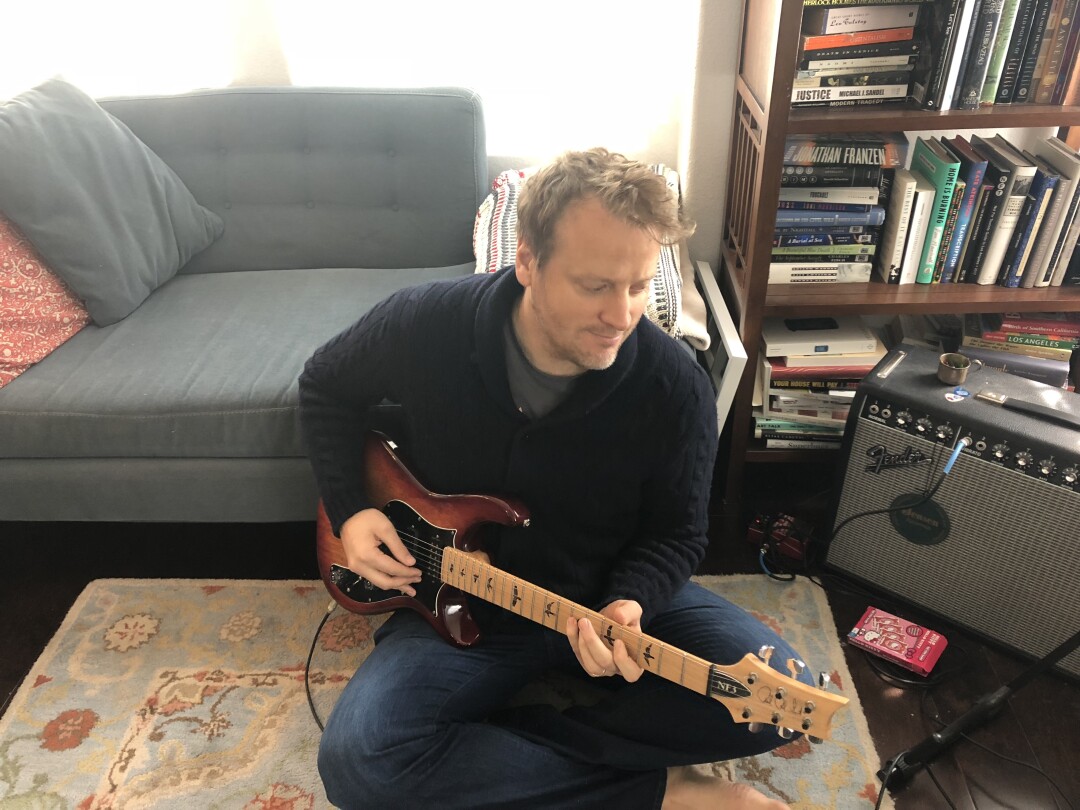
A man plays guitar while seated on a rug.

Charles Finch learns a Steely Dan solo early in the pandemic.
(Charles Finch)

That joy in life, that freedom, is what makes their music different from all other music. “Even in the most sublimated work of art there is a hidden it should be otherwise,” said Theodor Adorno. I’ve prodded the thought for soft spots, because aphorisms can be cheap, but I think it’s brilliant and sad. I also think there’s an exception: the Beatles. Even at their most grizzled, they were on a grand adventure. “When you get to the top there is nowhere to go but down," Philip Larkin once said. “But the Beatles could not get down.” None of them was even 30 when the band broke up.

Last night, I listened to all of it. In my head I tracked the other songs in which various band members laugh (“I Should Have Known Better,” “It’s Only Love,” “If I Fell,” etc.) and observed with intense satisfying scrutiny just how weird and sad and good John’s parts of "A Day in the Life" are, so much of each that it’s hard to believe it’s a part of mainstream culture, until you remember that one of Paul’s transcendent gifts is to lift the sensation of hopelessness from a song without rejecting its presence. I listened to “I’ve Got a Feeling.” “Everybody had a hard year.” I nodded, in the misting dark, as I headed home. In my defence it was very late by then. Everybody had a hard year.

Something obvious occurred to me, which is how vitally important music must have been to so many of us since the start of the lockdowns. Usually we encounter dozens of people a week; now, for months, if you’ve been keeping safe, it’s one or two a week, greeted with tight, scared, friendly nods at the grocery store or pharmacy. In this solitude, music takes on strange new emotional intensity, or at least has for me, from the tender start-of-quarantine March moments when I was listening to Fleetwood Mac (could we handle the seasons of our lives? Unclear!) to the cooling summer company of Funkadelic.

But this felt different, as if the music had reached farther into me than usual. As I arrived home completely sober, completely exhausted and listening to “Hello, Goodbye,” I said hello to these four old friends of mine, and I very cautiously said hello to myself when I was eight, a person whose characteristics and dreams I think I have largely forgotten. But that was me, as definitely as I am myself now.

“Hello, Goodbye” was their first single after their manager Brian Epstein died. It was with Epstein’s death and that song that the Beatles lost their initial illusions, and their music from then on became more interesting, and it also became inevitable that the band would end. Typically brilliant of them to give us an album from their 20th year together without having to get there, which I think they knew they wouldn’t: Sgt. Pepper.

Am I alone in having gone into different parts of myself during these last few months? I think no, it’s the other way: that none of us had to think about ourselves and how we move through the days of our lives this deeply before. All of us went inside as certain people in March; it will be interesting to see who walks out. Whatever it was, the music as I walked felt like water flowing down dry riverbeds. It occurred to me that in this year of change, it might be possible for me to change. I went to bed at a rare peace with everything — or really, truthfully, with the deep past, I suppose, which has always been so present in my adult life, never cleansed of its meaning, rushing farther away and closer every minute.

Excerpted from “What Just Happened” by Charles Finch, copyright © 2021 by Charles Finch, by permission of Alfred A. Knopf, a division of Penguin Random House LLC.

https://www.latimes.com/entertainment-arts/books/story/2021-11-04/how-john-paul-george-and-ringo-helped-a-writer-survive-the-pandemic