A diary recording the experiences of a York woman during the Napoleonic Wars has been published, nearly 30 years after it was 'accidentally' discovered.
The diary of Jane Ewbank charts her interests in science, theatre, concerts, and the natural world during the period, and was discovered accidentally in the National Library of Scotland by Dr. Jane Rendall, a former member of the Department of History at the University of York, now associated with the Centre for Eighteenth Century Studies.
Life in York
Jane, born in 1778, was the daughter of George Ewbank, a well-known druggist and banker in York, who lived and had his shop on Castlegate in the city centre. She died at the young age of 46 in 1824.
The diary, published in digital form, consists of around 34,000 words recorded between 1803 and 1805, including details of her life in York and her travels in the Lake District and North Yorkshire. It stands as a unique illustration of what life was like in York for a woman during the 1800s.
The diary, which will now be the focus of an academic conference, demonstrates that Jane had an active social life, frequently attending plays at York Theatre Royal, concerts in the Assembly Rooms and many lectures on science.
The diary recorded between 1803 and 1805, including details of Jane Ewbank's life in York.
Credit: University of York
Women writers
Dr. Rendall said, "I found the diary of Jane Ewbank in the 1990s totally by chance when I was working on women writers in eighteenth-century Scotland. When I read it, I was totally fascinated, because I realised how much light it threw on the life of a York woman from this time in history."
"Over the years, I have passed it to several students writing theses on York women's history. I had always hoped to publish the diary, so I am thrilled that it is now widely available for others to read and enjoy and for the diary to be the focus of a conference."
Conference
The conference—also open to members of the public—will bring together scholars in women's history, the history of science, literature, theatrical performance, music and historical archaeology from across the UK and the US, to contextualize and analyse the diary.
Co-organized by Dr. Rendall, on behalf of the Center for Eighteenth Century Studies, which is based at King's Manor in the centre of York, speakers include a historical archaeologist of York, historians of science, literary specialists, and historians of eighteenth-century theatre and music.
Theconference, "Science, Gender and Sociability in a Northern City c. 1775-1820," supported by the University of York, will take place from June 8-10, and is also supported by the Modern Humanities Research Association, the British Society for the History of Science, the Yorkshire Philosophical Society and the York Georgian Society.
(ETX Daily Up) – On TikTok, more and more posts show Internet users keeping a diary. Internet users are arming themselves with their best fountain pens and fluorescent lights to show how a notebook can help overcome everyday problems and capture memories. Explanations of a trend that takes us back to the past.
On Tik Tok, the hashtag “journaling ideas” has over 400 million views. The diary, which was once stored safely out of sight, has become the new ritual of Generation Z on TikTok. This trend has a name, “journaling”, understanding the fact of writing down your thoughts and feelings on paper every day, at all times. It has become for many socionauts a new mental refuge. This return to paper is surprising with the advent of digital technology and smartphones. Sleek desk, fountain pen, outline notebook. A whole aestheticwas born on the social network around journaling, revealing to as many people as possible a hitherto intimate ritual.
When scrolling through the application, we see more and more posts showing, most often, young women at their desks writing lines from their diary. Advice is also given to guide the writing. For example, the user orendaduong, which brings together 170,000 subscribers on her account, has launched a month-long challenge during which she answers an existential question every day. For many, the diary is a free therapy where you can give yourself the right to be vulnerable. In the comments of avideo Internet users share the positive effects of this ritual: “Journaling and crying got me through my first heartbreak and is currently getting me through my second.”
This return to basics is by no means trivial. As always, Tik Tok takes concepts as old as the world and tries to modernize them. This time, the diary has come back into vogue with the advent of self-care on social networks, where taking care of yourself takes precedence over everything else. The newspaper is sometimes basic in appearance, or otherwise adorned with stickers, photos, and innocuous things like tickets box.There are several ways to keep a diary. It can be a gratitude journal in which you write down all your accomplishments, your inspirations, your favorite foods. But also an expressive diary, where you write down your emotions, your traumas, and your personal problems. Even more unusual is the “dream diary”, which allows you to write down your dreams once you wake up.
In an interview for StylistNicky Clinch, maturation coach and well-being author, believes that journaling is an effective way to help people better understand their emotions: “We have thousands of thoughts running through our minds in 24 hours, and about 80% of them are negative. (…) We can use ‘journaling’ as a way to begin to see and gain a deeper awareness of what is going on in our mind.” According to medical experts from the University of Rochester, journaling can help, among other things, to manage stress, reduce anxiety, and cope with depression. He was also proventhat keeping a daily gratitude journal can improve sleep quality and mood, strengthen relationships with others, and reduce symptoms of physical pain.
When I was in junior high, I romanticized the idea of keeping a diary. A blue hardcover book that would hold the hottest playground drama, places I wanted to travel to, impromptu poems and updated lists regarding all my favourite things. Yet, however hard I tried, I struggled with consistency. I would revisit the said journal every five to six months, feeling like a vastly different girl than the one writing months ago. My stories would have plot holes that I was too lazy to fill in and all in all — between homework on fractions and Disney channel shows — I didn’t have time to waste.
Eventually, enough ripped-out pages and crossed-out thoughts led me to give up and throw the failed project into a memory box pile. Then, cut to the summer of 2020 and I had enough free time to try again. I picked out a dainty journal, a couple of trusty pens, and a chair on the porch to sit and focus on. I started new entries by placing more attention on manifestations, affirmations, and gratitude lists to ease my anxieties. Eventually, journalling stuck with me. My journals every year since then have naturally had distinct themes, this year’s increasingly being about my day-to-day happenings and using a self-therapy kind of approach to life. Ultimately, this omnipotent way of dissecting your own thoughts and feelings is helpful in identifying the root cause of most of our emotions or behaviours, tracking our journey and the particular stage of life that we are in and healing from things that we might not be able to talk about otherwise.
If journaling is of interest to you, the following are a couple of prompts that I have created and found that might help you get started!
Cancelling Out the White Noise
We are each our worst critics. Identify thoughts from your inner critic and provide a rebuttal to them. For example, why do you think you are not cut out for a certain task or opportunity that has been awarded to you? Present evidence and invalidate the initial thought.
My Body & Nature’s Equivalent
This prompt was inspired by a video by Nelly London (@_nelly_london) on Instagram who asked “what if our bodies are an integral part of nature?” She proceeds to compare stretch marks to the ocean’s waves and textured skin to the crates of the moon. Whether you have a good relationship with your body or not — hopefully the former — this exercise of finding similarities between your body and nature can boost confidence and self-compassion — especially when you are struggling with a two-month-long eczema flare-up, speaking from experience.
Note to Self
The golden R’s of journaling include both reminders and reassurances. By reminders, I don’t mean drafting —although you could — to-do lists or outlining academic deadlines but more so, writing about things that you need to reinforce in your mind. The trick is to try to pair one reminder with a subsequent reassurance.
Reminder: I have no way of knowing what people actually think about me. Reassurance: Even if their beliefs about me are negative, I don’t need to prove myself to anyone.
I am not
We are used to telling ourselves or hearing others tell us who we are. But who are we not? This exercise, often best achieved in the form of a list, distances those ideas and fears from ourselves and thus, I like to think of it as wiping away all that which clouds our identity. As a result, even in our own minds, we begin to take control over the narrative surrounding ourselves.
Example: I am not incapable. I am not any less than those around me.
Little Victories
As the name of this prompt suggests, identify the little to big victories that you have had over the course of a week or month. In doing so, you begin to fight the voice in your head that convinces you that you are not doing enough or are stagnant in life. Every accomplishment counts. Every accomplishment signifies growth.
Energy Givers vs. Energy Drainers
Long ago, I saw an image on Pinterest that distinguished between things that can boost our energy versus things that will likely drain the same force. For instance, an energy giver is fresh air and being in nature but an energy drainer can be extensive amounts of screen time. I find that I feel most defeated mentally when I’m physically fatigued. So at the end of the day, when I separate my personal energy givers from my energy drainers, I feel better equipped on how to approach my days moving forward.
Honourable Mentions:
Weekly Highs and Lows
Gratitude Lists
I will vs. I will not. (I will drink more water. I will not stay in bed for two hours after I wake up to daydream and scroll through TikTok.)
I'm no Michael Palin or Alan Bennett. But in intermittent bursts throughout my life I’ve kept regular accounts of the - more often than not - mundane drama of my day to day.
I’ve found It’s easier to be consistent with such a task when your life is generally, well, consistent and perhaps, okay, a tad predictable.
The years-long gaps in my diary keeping often reflect periods when my life was full of change and drama - no time to write, gotta live!
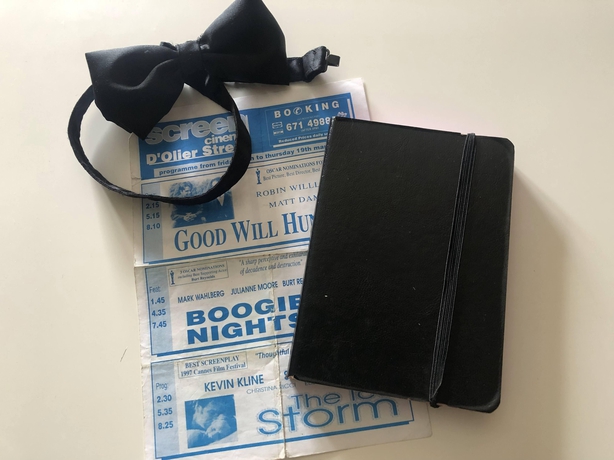
One of many attic roots during lockdown turned up a biscuit tin containing a dickie-bowtie and a small black reporter’s notebook.
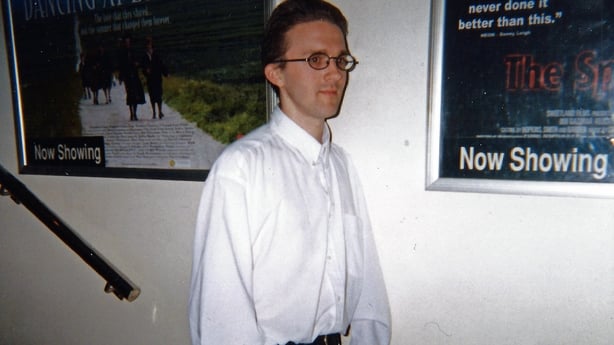
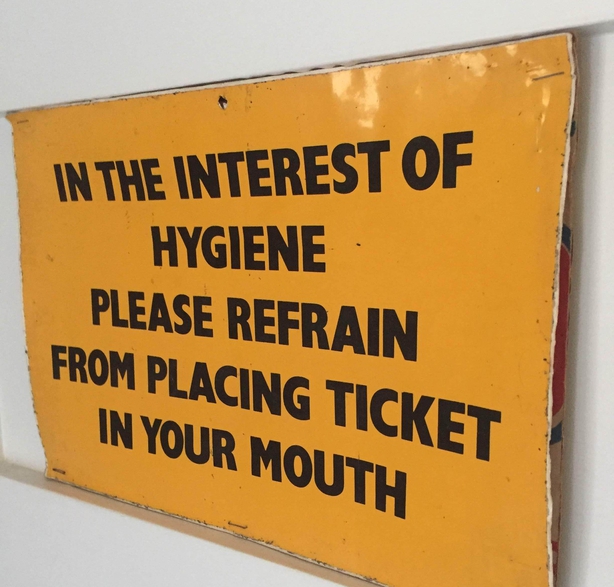
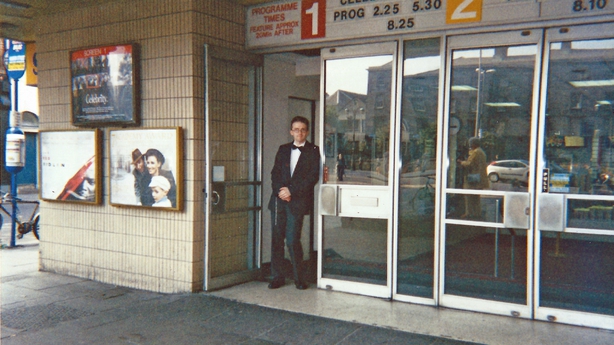
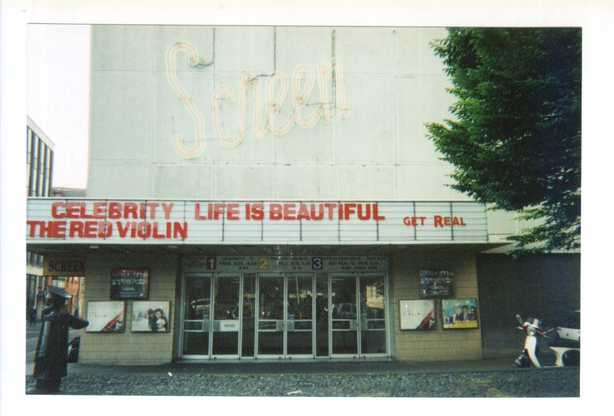
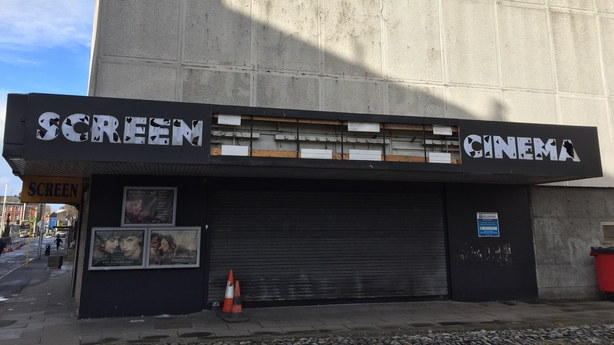
Somehow this box had survived seven flat moves across twenty-four years. Inside these pages, the year stretched from 1998 to '99. After a brief stint in The Ambassador in O'Connell Street, I was sent to the Screen Cinema (nee Metropole) to be an usher/doorman/security fella.
Dublin. The time of the (Celtic) Tiger. I was 27. Two years in South America had left me a skinny shell of a man. At the behest of the staff, the names have been changed.
Out of respect for cinema, the rest has been told exactly as it occurred.
July 1998: The author pictured in the lobby of the Screen Cinema
1998 June
Instrumental in the removal of two not the full shilling types from screen 3. Felt guilty afterwards. They weren’t causing any real trouble. And there’s a lot worse to be done than hanging around a picture house all day. You wouldn’t look twice at this couple. Apparently they’ve been loitering in this place for ten years, forcing friendships on various staff members to get in for free. Then staying for an entire day, slipping between shows. Before their expulsion today, and before I knew their reputation, yer woman asked me my name on the way in. I must’ve sensed something because I lied and said it was Jorge.
Liam (my boss, Chief Usher, 60) challenged me at the door with a fiver for tea bags, sent me up to the shops. I come back with the usual Lyons and suit-up, deep into the second half of Columbia Vs. Romania. Liam is a master of the trivial. He stands on the lobby steps like Washington crossing the Delaware, looking out across Pearse Street to Trinity College deep in thought. Not on the current instability in the Balkans or the outcome of the last G7 summit. But rather if the student sitting on the ledge outside is going to litter the place with their sandwich. "Animals!" is his crying mantra.
July Communist wheelchair access: A woman arrived in a wheelchair pushed by her male companion. He doesn’t say anything. She asks me if she can stash the chair while they see a film. Sure thing, says I. She gets out of the wheelchair. Helps her companion fold it up. They hand it to me. I store it without comment. They return from a show of Washington Square. I dug out the chair. They fold it out. He gets into it and she wheels him off. What the actual?
Never in my life have I seen so many girls of a certain age gather in groups as those which flooded the lobby all afternoon. Every man jack of them done up to the nines. They were there for the remake of Lolita. For the late show, the audience switched to a certain type of older men. I see. A film which deals with a middle-aged man’s obsession over a beautiful young girl gets audience of same.
August These glass doors are my IMAX to the world: a couple argue, broke up, the boy stormed off into the rain. The girl remained. Two teenagers soaked each other as they danced in a giant pool of rainwater. The shower faded. The boy returned. The girl remained the same. Isn’t that every movie, right there?
My favourite films of all time: A Room With a View, Les Amants Du Point Neuf, The Lavender Hill Mob, Europa, Subway, Hannah and Her Sisters, The Great Escape, Le Femme Nikita, The Vanishing, Do The Right Thing.
Part-time usherette, Nora, regaled me with tales of her Savoy cinema salad days in the 1960s. The most coveted spot, she said, was under an actual spotlight, before shows and during intervals when concession and cigarette sales would be announced. Nora is cool. Lovely smile. Happily married. No Kids. Travels the country and the world.
The Omen…A seventy-year-old woman dropped dead outside. A young couple asked me to stash a heavy black bin bag while they saw a film. It contained a wreath for the fellas’s dead brother. Notification of death benefits arrived in the post for the long term staff. I go home and find out my mother’s late twin sister’s husband has died in Holland.
A dozen Spanish students came at me with their tickets one at a time. "Top of the stairs, on the left, screen number three" I said, and each and every one repeated the line back to me, practising their English out in the wild. Liam says we’ll get a new film on Friday. Maybe Primary Colours. Must check the news to see if Clinton has confessed to anything. It’s bizarre to think the President of the United States' affair two years ago has such ramifications across the globe it will affect how late I get home over the next four weeks (the movie runs 2 hours and 23 minutes)
September A spate of new posters to put up today: Firelight, costume melodrama slash love story, with a poster image you’d see in a chemist advertising condoms. "Passion has no limits," it says. Fear and Loathing in Las Vegas, can’t wait to hear what the retired afternoon crowd say when they walk out of this one! Out of Sight, anyone who says George Clooney isn’t a movie star needs to check out this image. The Spanish Prisoner, David Mamet mind feck. Have to work the press screening of this next week and hopefully avoid spoilers in the lobby.
A short poem, by Paul Markey: The rain it rainith down. Beats of the ground. And comes through the roof in screen one.
Just saw Saving Private Ryan at the press show in The Savoy with Derek. Dear god, what a film. What cinema. There wasn’t an empty seat or dry eye in the house. The walk up the aisle towards the toilets as the credits rolled was a procession of teary-eyed sniffing grown men. Us amongst them. Liam says word from on top is we’re likely to get it in the Screen, too, as opening day bookings at the Savoy have been so heavy.
I noticed there's a sweet spot in the upper lobby where the sound from all three screens meet and mingle into this Parallax View-like sound scape. I recorded it tonight on my dad’s machine. The result doesn’t quite capture the phenomenon. But Dancing at Lughnasa does sound like Donegal is being shelled by the US Eighth Army. "Didiidle-di-idleday..." (INCOMING!)
Celeb alert! Bono and Ali for Elizabeth. But we’re sold out! Embarrassing. But this Cate Blanchett is packing them in.
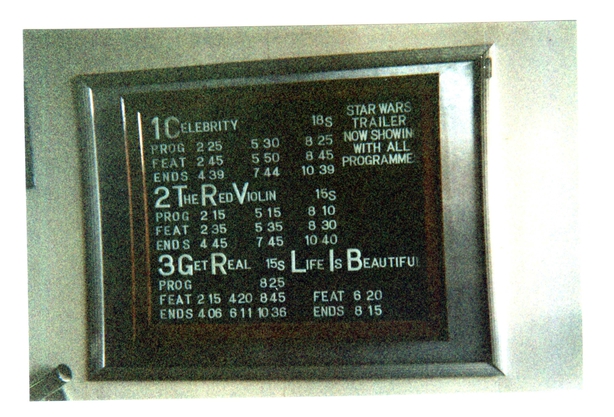
1999 February Hungover after a week in Amsterdam. Returned to chaos. Life is Beautiful? Or so they say. Who are ‘they’? Feckin’ everybody, it seems like. While I was away, the Screen Cinema’s biggest hit in years opened. Roberto Benigni’s Life Is Beautiful has struck the mother-lode. It’s playing exclusively at the Screen. And when I say exclusively… nowhere else in the entire country! Not even the IFC. Masses of great reviews and seven Oscar nominations have pulled folk from all corners of the city (the country?). I feel like Moses out there, alone trying to wrangle the mob. Except I’m not crying out Ten Commandments. Just the one: "Centre doors, top of the stairs! Screen one!"
Siobhan in the box office waved at me intermittently from behind the glass. I jumped up from the crowd and waved back like a lost seafarer. Siobhan’s been there almost a decade and has never seen the like of this. I found out Chief Liam, apparently, is in his element. The constant crowds are what it used to be like every weekend back in his Metropole heyday. He’s lovin’ every wranglin’ minute of this madness.
Celeb alert! Van Morrison and Michelle Rocca. Japers. Your classic rock star and statuesque model height disparity in the flesh.
March A month on release and it’s only getting worse. All the people who received recommendations from their friends who saw Life is Beautiful last month are starting to show up en masse. The crux of my daily flood control problem is this: hundreds are showing up to collect their pre-booked credit card tickets fifteen minutes before the programme starts, all thinking they can just collect their tickets right then and stroll straight in. I’ve never been abused by so many people with Dublin 4 accents in one night in my life.
Ah…can’t believe it. Stanley Kubrick has died. Printed out a memorial note at home and stuck it up in the lobby. He died at home in London yesterday morning, leaving three daughters, twelve films and the impending release of his thirteenth (Eyes Wide Shut), starring the world’s biggest actor, shot within an hour's drive of his gaff.
April It hasn’t stopped. Those who came on a recommendation have told more. But cracks are appearing: about an hour into Life is Beautiful, an elderly fella comes out to me: "Is this the only Italian film with subtitles you have on?" "Yeah. ‘La Vita Bella’. Nominated for seven Oscars. Sold out nearly every night since it opened," I replied. "Well, what’s good about it?", he mumbles to himself as he goes back up the stairs. An old dear sticks her head around the door. "He says it’s the right one," he says to her. "Sold out every night." They disappear back inside. I look at my watch. They haven’t gotten to the concentration camp scenes yet.
I’m a year at the Screen as of today. After two years in South America, I’ve spent the last twelve months bang smack in the middle of Dublin and I still don’t know if I’m where I should be. Small ad in the Evening Herald: "Trainee Projectionist wanted for suburban multiplex cinema."
Postscript: In retrospect, I realise my year at the Screen was the last time I worked with the public. That merciless mob, comprised of us. I was to spend the next decade out in LIffey Valley locked away in a projection booth. But for a year there, near the end of the twentieth century, I had the key to my own cinema. I was the last one left at night. I doused the lights, locked the doors, strolled off into the night in search of the last bus.
The building is gone now. But cinema lives! Along with the memories, as long as I’m still standing.
This morning I was flipping through my copy of the Bicycle Sentences Journal that illustrator Betsy Streeter sent me and I was quite taken with this final paragraph by Grant Petersen. (I’m a big fan of his blog and Just Ride.)
He touches on why I keep a diary, why I keep it on paper, and the magic of keeping a logbook. The mundane details can bring back sublime memories, and what you think is boring now may be interesting in the future: “What seems bland when you write it down… will seem epic in thirty years.”
I have a new studio routine where when I’m unsure of what to write about, I revisit my notebooks each year on today's date. (I have notebooks going back 20 years, daily logbooks going back 15, but I’ve kept a daily diary for 5 years now. That’s where a lot of gems are buried.)
Flipping through these notebooks will usually yield something worth writing about. (This morning, it was William Burroughs on language.)
Reading my diary this way, which I first learned from reading Thoreau’s diary, also shows me the cycles and patterns of my life.
(For example: Cocteau Twins and the beginning of spring are somehow intertwined in my life. What does that mean? And what does the fact that their lyrics are barely understandable mean when matched with the Burroughs? Spring is a season of rebirth… When babies are new, they babble and make noise without language… do they sound like spring to me for this reason? You can see how these thoughts, none of which I had when I woke up this morning, come forth from just reading myself.)
Another way to think about it: Keeping a diary is being a good research assistant to your future self.
This is the advice that art critic Jerry Saltz has tweeted over the years:
Be a good assistant to yourself. Prepare and gather, make notations and sketches in your head or phone. When you work, all that mapping, architecture, research & preparation will be your past self giving a gift to the future self that you are now. That is the sacred.
I’ve never had an assistant. I am my own best assistant. My assistant-self is my past self loving my future self who’ll need this previous research when I reach for something in my work. My assistant-self has gotten ideas for whole articles, essays from minutes of research online.
Artists: The beautiful thing about giving yourself a little break & not working – those are the times when new ideas flood in from the cosmos & set your “assistant self” in motion, the self that will be there for your “future-self.” Curiosity and obsession always fill the vacuum.
Artists: Be your own best assistant. Do your research. Get your tools and materials in order. These will be the ancestors, spirit guides and self-replicating imagination of your work. This will allow art to reproduce itself in you. You’ll thank yourself during & afterwards.
I have my many moments of self-loathing at my own lack of progress, but one thing I have done right, at least in the past half decade or so: I have been a good assistant to my future self.
Joan Didion said of re-reading notebooks, “I think we are well advised to keep on nodding terms with the people we used to be.” This is especially true if they have bothered to preserve themselves so we can visit them later.
Yes, a diary is a good spaceship for time travel: for meditating on the present, flinging ourselves into the future, and visiting ourselves in the past.
Charles A. Cook was born in Licking County on March 15, 1844. He was 17-years-old when he enlisted to fight in the Civil War on Jan. 20, 1862.
He served with Company C of the 76th Ohio Volunteer Infantry until his enlistment was over on Jan. 24, 1864. At that time having already been with his unit through the battles of Fort Donelson, Shiloh, Corinth, Arkansas Post, Vicksburg, Canton, Jackson, Lookout Mountain, Mission Ridge, and Ringgold Gap, he chose not to reenlist in the 76th. On June 25, 1864, Cook continued his service and enlisted with Company G of the 1st Veteran Volunteer Engineers. These men were tasked with repairing railroads, building block houses and bridges, and other general engineering duties for the army.
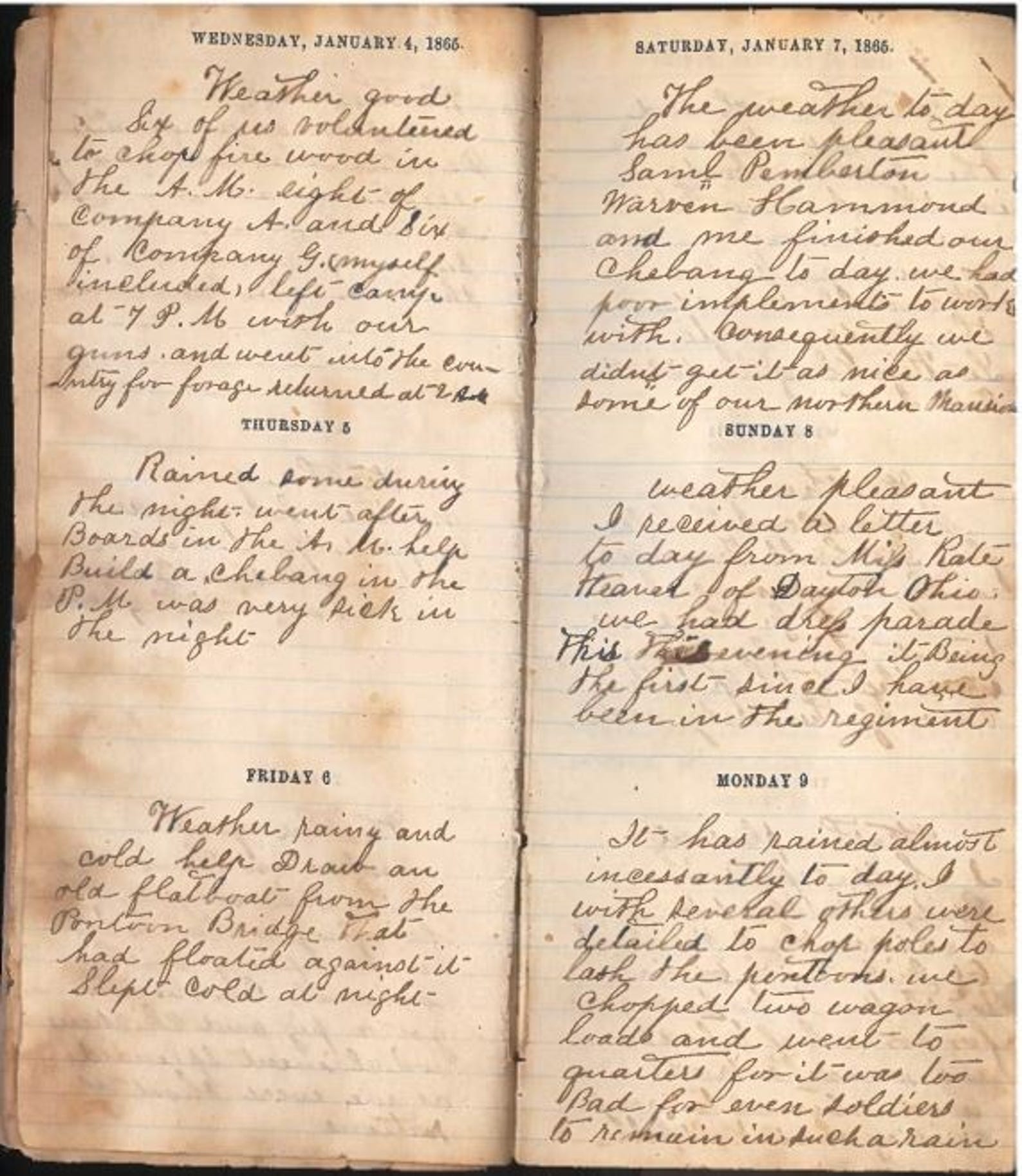
A page from the diary of Charles A. Cook, a Licking County soldier in the Civil War.
COURTESY OF DOUG STOUT
The descendants of Cook have a diary that he kept. The small black cover was stamped 1865 and was marked inside with each date. In the back, there was a ledger that one could keep track of their finances by day as well as a calendar of the year. Cook remarked on Feb. 1, 1865 that he “bought this diary.” At the time he was stationed in Chattanooga, Tennessee. However, the diary has detailed entries from January 1, which leads us to believe he was keeping another diary and then just entered the details from that one to this one. His entries are mostly 3-4 sentences and center on the weather, his job for the day, what letters he received or wrote, and his health. Some might think this has no historical value, but they would be mistaken. There is very little online when researching his unit, so any information in his diary is helpful as to their movements and what they were doing. The other part, as you will see, is reading what the common soldier was thinking as the end of the Civil War approached in the coming months.
The diary began that January with Cook arriving opposite Decatur, Alabama, it is here that they are tasked with maintaining a bridge over the Tennessee, River. He stayed here until Jan. 30 when they were sent to Chattanooga, where he purchased the diary. For the next few days, he sat and did nothing. According to his entry on Feb. 3; “Weather cool with some rain. I cleaned my gun in the A.M. nothing in the P.M. worth mentioning. Health tolerable good.” On Feb. 7, it snowed heavily and they began work on a blockhouse, but according to Cook the ground was warm so it ended up just “very muddy”. Throughout the rest of February, he hauled lumber for the blockhouse through cloudy and rainy conditions. By Feb. 27, it had rained so much that the camp was flooding. The rain stopped however, and the creek “commenced falling” the next day. On March 4, he reported, “Weather cloudy, I was on guard last night. Between 8 and 11 it rained very hard while I was on duty. The president of the United States retaken his seat today.”
Abraham Lincoln had begun his second term in office. By March 5th, they had to “evacuate their quarters’ because of the rising floodwaters. Fortunately, for Carter on March 11, they left Chattanooga for a new job on the Duck River in Tennessee. They arrived there on March 18 and he noted: “Weather windy we left Carter Creek this morning and marched about 8 miles and camped near Duck River. Was on guard last night and today. This is a much pleasanter place than Chattanooga”. On March 15 he mentioned, “I am twenty-one years old today.”
He had been a soldier now for four years but his army days weren’t over yet and an occurrence after the war would bring Charles Cook national and international fame.
Doug Stout is the Veterans Project Coordinator for the Licking County Library. You may contact him at 740-349-5571 or dstout@lickingcountylibrary.org. His book "Never Forgotten: The Stories of Licking County Veterans" is available for purchase at the library or online at bookbaby.com & Amazon.com
“Expressive writing is scientifically proven to be beneficial, sometimes even as beneficial as seeing a therapist.”
As little as three months ago, the practice of journaling was to me akin to a 2005 Panic! At The Disco album – perhaps cathartic in theory, but probably better suited to an angsty teen who wears Tumblr quote T-shirts. The concept of trauma dumping on an inanimate page seemed like a messy and needless exercise, especially for someone so emotionally talkative they worry their friends’ ears might bleed.
It’s this scepticism that I brought to the first day of January 2023, when I relented to an Oprah-level self-help epiphany and resolved to keep a journal every day for the remainder of the month. Vowing to write both my sins and my tragedies à la Brendon Urie, much of my early journal entries reflect my reluctance around the entire enterprise.
“Don’t know what I’m hoping to achieve from this, LOL,” an excerpt dated January 1 reads. In that entry, I question the mechanics of journaling itself. I struggle with technicalities like handwriting (I should have my pen licence revoked), then worry that I sound like Elmo because I switch to third person on a whim.
“How does this work?” I write in the opening lines on day one, mustering the energy of Greg Heffley from Diary of a Wimpy Kid. By the end of the excerpt, I selfishly vow that at the very least, the journal will provide material for my biography – which at that point would constitute all of three paragraphs. Forthcoming entries remain equally uninspired. On January 8, I tell myself to go for a run and then lament not completing the task the following day.
“Shower thought,” an excerpt from January 10 reads. “Why do I only break out when there’s a social event approaching?” While extracts like these pose uber-important questions for posterity, they nonetheless feel inconsequential as the first fortnight of my journaling experiment concludes.
Then, on January 16, I was made redundant at work. Overnight, entries barely stretching a page now extended until the pen ink ran dry, and a former journaling sceptic had become a bonafide convert (excuse the third-person reference).
Mary Potter Kenyon, a grief counsellor and author of the book Expressive Writing for Healing: Journal Your Way From Grief to Hope, also arrived at journaling from a place of loss. In March 2012, she lost her former spouse and wrote her first entry two days after his death. Now, Mary runs expressive writing workshops and has filled out some 20 journals since first adopting the practice over a decade ago.
“Expressive writing helped me process emotions I didn’t know what else to do with,” Mary tells me. “Keeping a journal is an inexpensive form of therapy.” I see glimmers of Mary’s journaling experience in my own. Post-redundancy, I write with more intention and consciously attempt to make sense of day-to-day anxieties.
While anecdotes like this go some way in explaining the mental health benefits of journaling, Mary explains how the practice has also been viewed by research as a “flexible tool in our mental health toolbelt”.
“Expressive writing is scientifically proven to be beneficial, sometimes even as beneficial as seeing a therapist,” Mary says. “Research shows that short-term, focused writing can have a beneficial effect for anyone dealing with stress and trauma. Writing about emotionally charged topics [can] reduce symptoms of depression or anxiety, [oftentimes] with veterans experiencing PTSD, cancer patients and those who have experienced a loss of some sort.”
But even beyond the writing of emotions – which in retrospect allowed me to process and organise thoughts that might’ve otherwise proved dizzying – the physical act of penmanship has likewise proven invaluable for mental wellbeing. “Writing is a form of meditative practice,” Mary explains. “We have to consciously slow down to write.”
With this understanding, I began re-reading my entries with a more attentive eye, a process equally as enlightening as the writing itself. I now find nestled even within the pages of my early scepticism some glimmers of manifestation and foresight. “I guess a big chunk of my day is now free to focus on new opportunities,” an entry four days after my redundancy reads. I pitched this very article the following day and here we are.
Mary also speaks of journaling as a tool for the law of attraction. Long before she met him, Mary jotted down “a checklist of attributes [my future husband] would have,” she recalls. Upon their first date, Mary “checked off all the attributes” and years later, would read from that very entry as part of their wedding vows. That re-reading process in itself contains a healing and almost predictive benefit unavailable to those who don’t keep daily records.
All of this is not to say that a journal can only be borne from a life-altering event. Mary recounts filling out an entire diary in the “period of extreme happiness” when she met her now-husband, offering a feel-good vessel to reminisce on their relationship. “I also journal through the good times,” Mary tells me. “[I can] relive the excitement of feeling like I was 19 again as we fell in love.”
Now further removed from being laid off and with a more dimensional view of journaling, my entries have likewise become records of better times. Two months on, the pages mirror the ebbs and flows of life, albeit messily and in script seemingly more suited to a year five student. It’s all that chaos, Mary explains, that might’ve informed my initial scepticism.
“Emotions are messy, so journal writing can also be messy,” Mary says. What was once a fear of dumping excess clutter has now become the very function of my journal – a record of the fact that my day-to-day, just like Greg Heffley’s, is beautiful because of all the mess.
While there are no hard-and-fast rules to journaling, Mary has a few pointers. She recommends a notebook that suits one’s personality, four days of consistent entries for those just starting out, and a disregard for semantics, spelling and punctuation. Mary’s research has found that “cultivating gratitude increases our wellbeing,” so she also suggests ending each entry with a note of thanks.
“By ending your journal entry on a positive note, you are training yourself to consciously choose joy and gratitude,” she says. It’s the same sentiment I now apply when reflecting on my own experience having put pen to paper for all these months. So in that spirit, I leave you with Mary’s final message in regards to keeping a journal; one that might’ve also been scrawled on my angsty pre-teen shirts: “Just give it a chance.”